

On this page
Top picks at a glance
As an Amazon Associate I earn from qualifying purchases.
- 1
 Earthquake 20015 Versa9.6/10View on Amazon
- 2
 VEVOR 31CC Tiller9.5/10View on Amazon
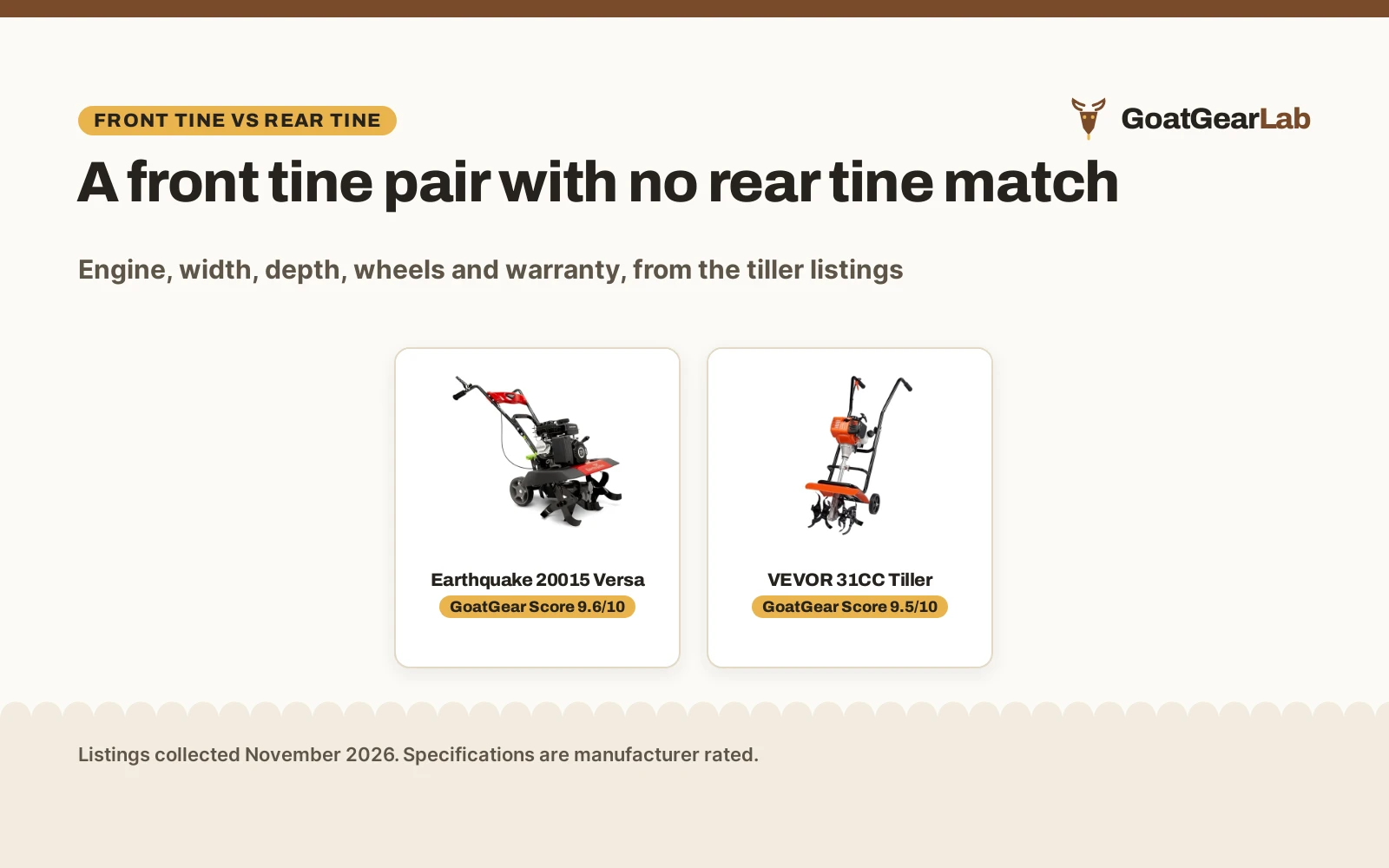
The front tine vs rear tine tiller question comes up when the garden bed needs turning and the ground is still firm from winter. This comparison was meant to put the sides against each other, but the rear tine side has no tiller listing here, only a replacement cable for rear tine machines, so the tillers below are all front tine examples. The comparison covers engine, tilling width and depth, wheels, weight and warranty, using only what each listing publishes, and the verdict names which front tine example suits which patch of ground.
GoatGearLab earns a commission when you buy through links on this page, at no extra cost to you. As an Amazon Associate I earn from qualifying purchases. Affiliate disclosure.
Quick verdict: choose the Earthquake 20015 Versa if the ground to break is wide or firm, since the maker lists a 99cc engine, a width of 11 to 21 inches and a depth of up to 11 inches, with a 5-year limited warranty behind it. Choose the VEVOR 31CC if the patch is small and the work is light, since the maker lists a 31CC engine, a width of 13.38 inches and a depth of 3.9 inches, with EPA certification and a protective shield above the tines. A rear tine machine gets no verdict here because no rear tine tiller listing was supplied, so a buyer set on that side should look for a listing that states its own width, depth and engine.
Two examples

Earthquake 20015 Versa
A 2-in-1 front tine tiller and cultivator with a 99cc 4-cycle Viper engine, a width of 11 to 21 inches, a depth of up to 11 inches and onboard wheels.
Pros
- 99cc 4-cycle Viper engine in a 2-in-1 tiller and cultivator
- Tilling width adjusts from 11 to 21 inches when the side shields and outer tines come off
- Tilling depth of up to 11 inches
- Onboard wheels and an adjustable handlebar height
Cons
- 78.0 pounds to move and store
- 50.0 by 24.0 by 34.0 inches, a large footprint to store
- Narrowing the width means removing the side shields and outer tines
- The 5-year warranty is limited, so read its terms before relying on it

VEVOR 31CC Tiller
A 31CC 4-stroke front tine tiller with four steel adjustable tines, a 13.38 inch width, a 3.9 inch depth and 5.8 inch drive wheels.
Pros
- 31CC 4-stroke engine, EPA-certified
- Four steel adjustable front tines cut a 13.38 inch width
- 5.8 inch large drive wheels with an adjustable skid assembly
- Installs in 3 easy steps with handle-mounted switches and brakes
Cons
- Cultivation depth of 3.9 inches, shallower than the Earthquake example at up to 11 inches
- Cultivation width of 13.38 inches, narrower than the Earthquake example at up to 21 inches
- No warranty term is stated
- 31CC engine, the smaller displacement of the two examples
As an Amazon Associate I earn from qualifying purchases.
Front tine vs rear tine tiller: side by side
| Tiller | GoatGear Score | Engine | Tilling width | Tilling depth | Weight | Warranty |
|---|---|---|---|---|---|---|
| Earthquake 20015 Versa | 9.6/10 | 99cc 4-cycle Viper | 11 to 21 inches | Up to 11 inches | 78.0 pounds | 5-Year Limited |
| VEVOR 31CC Tiller | 9.5/10 | 31CC 4-stroke | 13.38 inches | 3.9 inches | Not stated | Not stated |
Sizes and capacities are the manufacturer’s numbers as each listing states them, pulled 24 November 2026.
How each one breaks ground
The Earthquake 20015 Versa runs a 99cc 4-cycle Viper engine and works as a 2-in-1 tiller and cultivator, with the side shields and outer tines coming off to change the width. The VEVOR runs a 31CC 4-stroke engine, carries EPA certification, and uses four steel adjustable front tines. Both are front tine machines, so the engine gap is the gap between the two examples, not between the two sides: the Earthquake lists 99cc and the VEVOR lists 31CC.
The VEVOR adds enlarged heat dissipation holes that the maker says prevent overheating and stalling, plus an alloy metal gearbox and a thickened, long pull cord for starts. The Earthquake keeps its description short: an adjustable handlebar height and onboard wheels, with no extra engine detail. The Earthquake listing gives no tine count, and neither listing gives a fuel figure, so the engine comparison rests on displacement alone.
Tilling width and depth
Width and depth are where the two examples part company. The Earthquake adjusts from 11 to 21 inches wide and digs up to 11 inches deep. The VEVOR cuts 340 mm, or 13.38 inches, wide and 100 mm, or 3.9 inches, deep. A buyer turning a wide bed finds the wider cut and the deeper pass in the Earthquake example; a buyer working a narrow bed or a flower bed finds the VEVOR width in range.
For tractor-mounted work at a larger scale, see the best four foot tiller for tractor picks. For this pair, match the width to the bed and the depth to the soil that needs turning, and remember that the Earthquake depth is stated as up to 11 inches, a ceiling rather than a fixed cut.
Wheels, handles and moving the machine
The Earthquake rides on onboard wheels and offers an adjustable handlebar height, at 78.0 pounds and 50.0 by 24.0 by 34.0 inches. The VEVOR rides on 5.8 inch large drive wheels with an adjustable skid assembly, and the handle carries the switches and brakes for stand-up operation. The VEVOR measures 40.55 by 18.3 by 35.03 inches, and its listing states no weight, so the two cannot be compared on heft from the listings alone.
Both machines are built to be pushed, not carried, so the wheels matter more than the weight figure. Set the Earthquake handlebar height and the VEVOR skid assembly before the first pass.
Warranty and listing gaps to check
The Earthquake states a 5-year limited warranty. The VEVOR states no warranty term, and its listing also states no weight, so two figures a buyer often wants are missing from that page. The rear tine side of this comparison has no tiller listing at all: the only rear tine item supplied is a 39 inch replacement cable for Earthquake rear tine tillers, a part rather than a machine, so it earns no score and no place in the picks. If a warranty term or a weight figure decides the purchase, ask the seller before ordering.
Which should you choose?
Choose the Earthquake 20015 Versa if the ground to break is wide or firm and the bed needs a deep pass, since the maker lists a 99cc engine, a width of 11 to 21 inches and a depth of up to 11 inches, with a 5-year limited warranty behind it.
Choose the VEVOR 31CC if the patch is small, the beds are narrow and the work is light, since the maker lists a 31CC engine, a width of 13.38 inches and a depth of 3.9 inches, with EPA certification, a protective shield above the tines and installation in 3 easy steps. If the work calls for a rear tine machine after all, read the best rear tiller for tractor picks first, since no rear tine tiller was supplied for this comparison.
Whichever example fits the patch, check the width and depth figures against the bed before ordering.
Around the Barn
- Set the Earthquake handlebar height and the VEVOR skid assembly before the first pass.
- Remove the Earthquake side shields and outer tines to narrow the tilling width from 21 inches to 11 inches.
- Check the VEVOR protective shield above the tines before each use.
- Roll the Earthquake unit on its onboard wheels to the next bed instead of carrying it.
FAQs from goat keepers
Which is better, a front tine or a rear tine tiller?
The listings supplied for this comparison give two front tine tillers and no rear tine tiller, so the pages give no rear tine width, depth or engine figure to judge. Between the two front tine examples, the Earthquake 20015 lists a 99cc engine with a width of 11 to 21 inches and a depth of up to 11 inches, while the VEVOR lists a 31CC engine with a width of 13.38 inches and a depth of 3.9 inches.
How wide does a front tine tiller cut?
It depends on the model. The Earthquake 20015 adjusts from 11 to 21 inches wide when the side shields and outer tines come off, while the VEVOR cuts a fixed 13.38 inches, or 340 mm, wide.
How deep can these tillers dig?
The Earthquake 20015 digs up to 11 inches deep. The VEVOR digs 3.9 inches, or 100 mm, deep. Match the depth figure to the soil that needs turning before ordering.
Does the Earthquake 20015 come with a warranty?
Yes, the maker states a 5-year limited warranty. The VEVOR listing states no warranty term, so ask the seller if that figure matters to the purchase.
What engine does the VEVOR tiller use?
The VEVOR uses a 31CC 4-stroke gas powered engine with EPA certification. It drives four steel adjustable front tines with 5.8 inch large drive wheels.
Behind the Farm Score
| Product | GoatGear Score | Perf. /35 | Build /25 | Value /25 | Safety /10 | Warranty /5 |
|---|---|---|---|---|---|---|
| Earthquake 20015 Versa | 9.6 | 30 | 21 | 20 | 0 | 4 |
| VEVOR 31CC Tiller | 9.5 | 26 | 20 | 21 | 7 | 0 |
Our scores stay inside 9.2 and 9.8, with point totals stretched across that gap evenly, so the item with more points shows the bigger score.
The GoatGear Score weighs performance, build, value, safety and warranty. For tillers, safety points need a stated certification or a stated safety feature: the VEVOR lists EPA certification and a protective shield above the tines, so it earns safety points, while the Earthquake lists no certification or shield, so it earns none there. The Earthquake states a 5-year limited warranty, so it earns warranty points, while the VEVOR states no warranty term. The Earthquake leads on stated engine size, width and depth, and the VEVOR scores well on value for a small patch and loses points for the missing weight and warranty figures. How we pick explains the weights.
More from the barn
See every tractor and farm implements guide and all pasture tools guides.
More picks: rear tillers for tractors, rotary tiller vs rotary cutter and four foot tillers for tractors.