

On this page
Top picks at a glance
As an Amazon Associate I earn from qualifying purchases.
- 1
 Wufoty 25FT Heated Water Hose9.7/10View on Amazon
- 2
 SLASHCOOL 500W Trough Heater and Stock Tank De-Icer9.7/10View on Amazon
- 3
 15FT-100FT Heated Water Hose for RVView on Amazon
- 4
 VEVOR 50FT Heated Water Hose for RV Antifreeze to -45°FView on Amazon
- 5
 VEVOR 30FT Heated Water Hose for RV Antifreeze to -45°FView on Amazon
- 6
 KORVOS 100FT RV Heated Water Hose for RVView on Amazon
- 7
 75FT Heated Water Hose for RVView on Amazon
- 8100FT Heated Water Hose for RVView on Amazon
At morning milking, a frozen bucket means hauling water before the goats get fed, and the question is whether the freeze happens in the line or in the trough. For heated water hose vs trough heater, the short answer is that each one guards a different place: a heated hose keeps water flowing through the line to the trough, while a trough heater warms the water where the animals drink. If the line from the tap freezes, a heated hose addresses that run; if the line stays open but the trough ices over, a heater at the trough addresses the drinking water. This guide compares the two setups using heated hose listings, and points out where those listings contradict themselves.
Also worth comparing
 15FT-100FT Heated Water Hose for RVCheck price on Amazon
 VEVOR 50FT Heated Water Hose for RV Antifreeze to -45°FCheck price on Amazon
 VEVOR 30FT Heated Water Hose for RV Antifreeze to -45°FCheck price on Amazon
 KORVOS 100FT RV Heated Water Hose for RVCheck price on Amazon
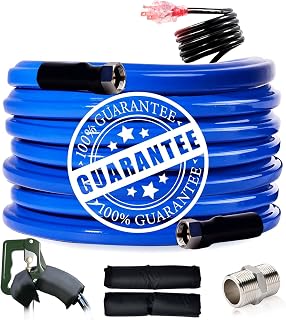 75FT Heated Water Hose for RVCheck price on Amazon
- 100FT Heated Water Hose for RVCheck price on Amazon
GoatGearLab earns a commission when you buy through links on this page, at no extra cost to you. As an Amazon Associate I earn from qualifying purchases. Affiliate disclosure.
Heated water hose vs trough heater: the short answer
Start with where the water freezes. A heated hose carries its own heating along the line, so the water arrives at the trough still flowing. A trough heater sits in the trough and warms the water there, so the drinking surface stays open. When both the line and the trough freeze, the two setups solve different halves of the same chore, and some keepers use a heated hose to reach the trough and a heater in the trough itself. If you would rather go straight to heated hose options, our heated water hose for barns roundup compares hoses on these points.
Two winter water setups compared
| Setup | What it warms | Example listing | Stated freeze protection |
|---|---|---|---|
| Heated water hose | The line to the trough | HOHOMETIC 100FT | -45°F |
| Heated water hose | The line to the trough | SZFY 50FT | -40°F application temperature |
| Heated water hose | The line to the trough | RVMATE 25FT | -20°F |
| Heated water hose | The line to the trough | Nottia 30FT | -45°F |
| Trough heater | Water in the trough | Not stated | Not stated |
Heated water hoses
A heated water hose is a drinking water hose with heating built along its length and a thermostat that adjusts with the room temperature. The listings we compared range from 25FT to 100FT, and they describe food-grade hoses, lead and BPA free materials, overload protection and fittings for RV and garden taps. A heated hose suits a run where the tap sits far from the trough and the line itself is the part that freezes.
Trough heaters
A trough heater warms the water in the trough itself rather than the line that feeds it. It suits a setup where the line stays open but the drinking surface ices over. It does not help a frozen line, just as a heated hose does not warm the water once it sits in the trough.
Reading freeze protection ratings
The hose listings state different cold limits, and each listing describes its limit in its own words. The HOHOMETIC listing states freeze protection down to -45°F, and the Nottia listing states the same -45°F figure, given as -42.7°C. The SZFY listing states an application temperature down to -40°F, given as -40°C, with a maximum heating temperature of 169°F. The RVMATE listing states freeze protection down to -20°F, given as -28°C. Treat the figures as maker claims, not as a shared standard, since no two listings describe the limit the same way.
The heated hoses compared
Ranked by freeze protection, stated safety features and warranty term, the hoses line up in this order. The HOHOMETIC 100FT hose states freeze protection down to -45°F, a food-grade hose that is lead and BPA free, overload protection and a 3 year manufacturer warranty, with 2 Teflon tapes included. Its bullets list lengths of 20FT, 30FT, 50FT, 75FT and 90FT, which do not include the 100FT length in the title, so check the length on the listing before ordering.
The Nottia 30FT hose states freeze protection down to -45°F, a smart self-regulating external thermostat, a food-grade hose that is lead and BPA free and overload protection. Its spec table states a 2 year manufacturer warranty, while its bullets mention 3 years service, and its title says 30FT while the spec table says 30 inches and the item type name says 25 FT, so read the length and the warranty term twice.
The RVMATE 25FT hose states freeze protection down to -20°F, heavy duty heated wire with UL, output power of 7 watts/ft, a PVC jacket, lead and phthalate free materials, lead free copper nickel plated connectors and a 3/4 solid brass adapter fitting. Its listing states a 1 year warranty service and says to always use a GFCI receptacle. Its spec table lists material type as Aluminum, which sits oddly against bullets describing a PVC jacket and copper nickel plated connectors.
The SZFY 50FT hose states a food-grade drinking water hose, five layers of reinforced shell, black insulation sponge at the pipe joints, a 1/2 inch inner diameter and female threads at both ends with a double-ended male thread included. Its title states -45°F while its bullets state an application temperature down to -40°F, and its spec table states a 1 year warranty while its bullets mention 3 year service, so the title and the bullets disagree on both points.
Length and power
Length decides whether the hose reaches from the tap to the trough without a joint in the middle. The listings state 100FT for HOHOMETIC, 50FT for SZFY, 25FT for RVMATE and 30FT for Nottia, though the Nottia and HOHOMETIC listings contradict themselves on length as noted above. Only the RVMATE listing states output power, at 7 watts/ft, so the other listings give no wattage to compare. Fittings also differ: the RVMATE listing includes a 3/4 solid brass adapter, the SZFY listing includes a double-ended male thread, and the HOHOMETIC listing includes 2 Teflon tapes.
Read the listing twice
Heated hose listings often contradict themselves, and the numbers that conflict are usually the ones you need to plan the install:
- HOHOMETIC: 100FT in the title against bullets listing 20FT, 30FT, 50FT, 75FT and 90FT lengths.
- SZFY: -45°F in the title against an application temperature of -40°F in the bullets, and a 1 year warranty in the spec table against 3 year service in the bullets.
- Nottia: 30FT in the title against 30 inches in the spec table and 25 FT in the item type name, and a 2 year warranty in the spec table against 3 years service in the bullets.
- RVMATE: Aluminum as the material type in the spec table against bullets describing a PVC jacket and lead free copper nickel plated connectors.
Measure your run before ordering and allow for the longer figure. Some listings also make broad service claims; the spec table warranty term is the concrete figure to plan around.
What this guide does not cover
This guide covers winter water hardware only. It does not cover how much water a goat needs, feed types or any health question. Ask your veterinarian or local extension office about rations and goat health.
FAQs from goat keepers
Should I buy a heated water hose or a trough heater?
It depends on where the water freezes. A heated hose guards the line to the trough, while a trough heater warms the water in the trough. When both freeze, the two setups cover different halves of the chore.
How cold can these heated hoses handle?
The listings state -45°F for the HOHOMETIC and Nottia hoses, an application temperature of -40°F for the SZFY hose, and -20°F for the RVMATE hose. These are maker claims, so compare them as stated limits.
Do heated water hoses need a special outlet?
The RVMATE listing says to always use a GFCI receptacle. The other listings state no outlet requirement.
What warranty do these hoses carry?
The HOHOMETIC listing states a 3 year manufacturer warranty, the Nottia spec table states 2 years, and the RVMATE and SZFY spec tables state 1 year each. The Nottia and SZFY bullets also mention 3 years service, which differs from their spec table warranty terms.
More from the barn
See every feeding and water guide.
More picks: heated water buckets for goats, water trough heaters for goats, heated water hoses with thermostat and heated bucket vs heated trough.