

On this page
Top picks at a glance
As an Amazon Associate I earn from qualifying purchases.
- 1
 AR-PRO 10 in Solid9.7/10View on Amazon
- 2
 AR-PRO 16 in Pneumatic9.6/10View on Amazon
- 3
 TICONN 10 in Solid9.6/10View on Amazon
- 4
 GICOOL 14.5 in Pneumatic9.6/10View on Amazon
A wheelbarrow with a flat tire at morning chores is a reminder that the wheel is the whole job, and the pneumatic vs solid tire wheelbarrow choice decides whether that wheel needs air or never goes flat. This comparison looks at pneumatic and solid flat-free listings, all sold as replacement wheels for wheelbarrows, hand trucks and carts.
GoatGearLab earns a commission when you buy through links on this page, at no extra cost to you. As an Amazon Associate I earn from qualifying purchases. Affiliate disclosure.
Quick verdict: choose the pneumatic side for an air-filled tire if you do not mind checking pressure, as the AR-PRO example shows with a 16 in tire, a 30 psi maximum and around 400 pounds of load. Choose the solid side for a wheel that never goes flat, as the AR-PRO solid example shows with 500 lb per wheel.
Four examples
| # | Product | GoatGear Score | Buy |
|---|---|---|---|
| 1 | AR-PRO 10 in Solid | 9.7/10 | Buy on Amazon |
| 2 | AR-PRO 16 in Pneumatic | 9.6/10 | Buy on Amazon |
| 3 | TICONN 10 in Solid | 9.6/10 | Buy on Amazon |
| 4 | GICOOL 14.5 in Pneumatic | 9.6/10 | Buy on Amazon |
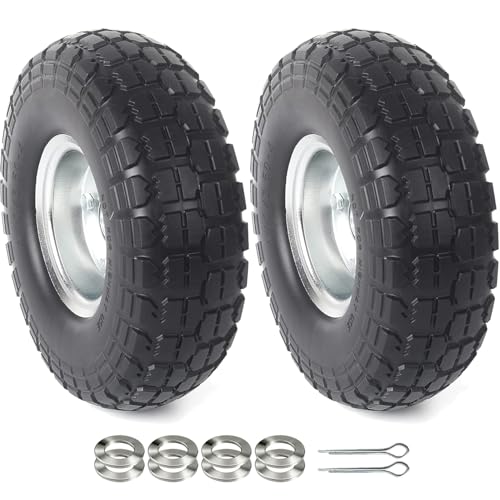
AR-PRO 10 in Solid
A flat-free solid tire and wheel, 10 in with a 4.10/3.50-4 tire, 500 lb per wheel, sealed bearings and a 2.2 in offset hub, sold as a 2-pack.
Pros
- 500 lb per wheel, the highest load figure here
- Solid, airless build needs no inflation and avoids flats from punctures
- 5/8 in double-sealed ball bearings with a 2.2 in offset hub
- Sawtooth tread for traction on concrete, gravel, grass and dirt
Cons
- 10 in wheel, smaller than the 16 in pneumatic example here
- No weight is stated in the bullets, only in the spec table
- No warranty term is stated
- 2.2 in offset hub fits only equipment that matches that hub

AR-PRO 16 in Pneumatic
A tubed pneumatic tire and wheel, 16 in with a 4.80/4.00-8 tire, 3/4 in bearings and a 3 in centered hub, sold as a 2-pack with extra 5/8 in bearings.
Pros
- 16 in tire, the largest diameter here
- Maximum load capacity of around 400 pounds, per the listing
- Tubed tire, maximum psi of 30, thick inner tubes
- Pre-mounted on a solid steel rim, with an extra set of 5/8 in bearings
Cons
- Air-filled tube needs pressure checks and can puncture, unlike the solid examples here
- Load figure is stated as around 400 pounds, with no per-wheel wording
- No warranty term is stated
- Needs rims of about 8.75 in and 3/4 in bushings, so check your equipment first

TICONN 10 in Solid
A flat-free solid tire and wheel, 10 in with a 4.10/3.50-4 tire, 440 lb per unit, double sealed bearings and a PU foam exterior over a solid plastic core.
Pros
- 440 lb per unit, solid build that eliminates punctures and inflation
- PU foam exterior over a solid plastic core absorbs shock on gravel, grass and rough pavement
- Double sealed bearings, dust-resistant, for smooth rolling with minimal drag
- 5/8 in bore fits axles of 15.4 to 15.9 mm, per the listing
Cons
- 10 in wheel, smaller than the 16 in pneumatic example here
- 440 lb per unit, below the 500 lb of the AR-PRO solid example here
- No hub figure is stated, so the offset is unclear
- No warranty term is stated

GICOOL 14.5 in Pneumatic
A pneumatic wheelbarrow tire, 14.5 in with a 3.50-8 tire, 5/8 in axle bore and 6 in centered hub, with sealed bearings and a 341 lb capacity.
Pros
- 341 lb weight capacity on a steel rim with double-sided welding
- Thickened inner and outer tubes for airtightness and wear resistance
- Staggered serrated tread for grip, drainage and slip resistance
- Fits 4.80/4.00-8, 3.50-8 and 4.00-6 sizes, per the listing
Cons
- 341 lb capacity, the lowest load figure here
- One pack, so a pair needs two orders
- Air-filled tube needs pressure checks and can puncture
- No warranty term is stated
As an Amazon Associate I earn from qualifying purchases.
Also worth comparing
 True Temper Wheelbarrow with Pneumatic Tire and Steel HandlesCheck price on Amazon
 A.M. Leonard 6-Cubic-Foot Steel Tray Wheelbarrow PneumaticCheck price on Amazon
 A.M. Leonard 6-Cubic-Foot Poly Tray Wheelbarrow Wood HandlesCheck price on Amazon
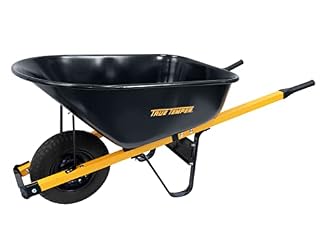 True Temper Steel Wheelbarrow with Never Flat Tire & SteelCheck price on Amazon
 A.M. Leonard 6 cu. ft. Poly Tray Wheelbarrow Steel HandlesCheck price on Amazon
 A.M. Leonard 6-Cubic-Foot Steel Tray Wheelbarrow Flat-FreeCheck price on Amazon
Pneumatic vs solid tire wheelbarrow: side by side
| Wheel | GoatGear Score | Side | Tire size | Load | Bearings | Pack | Amazon |
|---|---|---|---|---|---|---|---|
| AR-PRO 10 in Solid | 9.7/10 | Solid tire | 4.10/3.50-4 | 500 lb per wheel | 5/8 in sealed | 2-pack | View on Amazon |
| AR-PRO 16 in Pneumatic | 9.6/10 | Pneumatic | 4.80/4.00-8 | around 400 lb | 3/4 in, extra 5/8 in | 2-pack | View on Amazon |
| TICONN 10 in Solid | 9.6/10 | Solid tire | 4.10/3.50-4 | 440 lb per unit | 5/8 in double sealed | 2-pack | View on Amazon |
| GICOOL 14.5 in Pneumatic | 9.6/10 | Pneumatic | 3.50-8 | 341 lb | Sealed | 1 pack | View on Amazon |
Every spec repeats the brand’s rating from its listing (collected on 13 November 2026).
What each side actually is
A pneumatic wheel is a tire with a tube inside it. Both pneumatic listings here are tubed sets, pre-mounted on steel rims, made for wheelbarrows, hand trucks and garden carts. The AR-PRO set is a 2-pack of 16 in tires with thick inner tubes and a maximum psi of 30, while the GICOOL is one 14.5 in tire with thickened inner and outer tubes.
A solid wheel has no tube and no air. Both solid listings here are flat-free 10 in sets with a 4.10/3.50-4 tire. The AR-PRO solid example supports 500 lb per wheel with a sawtooth tread, while the TICONN example holds 440 lb per unit with a PU foam exterior over a solid plastic core.
Tire size and load
Tire size is where the two sides part most clearly. The pneumatic examples measure 16 in and 14.5 in, while both solid examples are 10 in wheels. The 16 in AR-PRO example is the largest wheel here.
Load is stated on all four listings: 500 lb per wheel on the AR-PRO solid example and 440 lb per unit on the TICONN example, against around 400 pounds on the AR-PRO pneumatic example and 341 lb on the GICOOL example. Note the wording: the AR-PRO pneumatic figure has no per-wheel wording. For more wheels by stated size and load, see the best heavy duty wheelbarrow picks.
Flats, air and upkeep
Flats are the trade the whole comparison turns on. The AR-PRO solid example has a solid, airless build that needs no routine inflation and avoids flats from punctures, and the TICONN example says its solid build eliminates punctures and the need for inflation. A pneumatic tube can pick up a thorn, so the air side trades a softer roll for pressure checks.
The AR-PRO pneumatic example lists a maximum psi of 30, while the GICOOL example states no psi figure at all. The solid examples state no psi figure either, since there is no air to measure.
Bearings, hubs and fit
Bearings and hubs decide fit. The AR-PRO pneumatic example uses 3/4 in bushings with a 3 in centered hub, plus an extra set of 5/8 in bearings. The GICOOL example has a 5/8 in bore with a 6 in centered hub and sealed bearings. On the solid side, the AR-PRO example has 5/8 in double-sealed bearings with a 2.2 in offset hub, and the TICONN example has double sealed bearings and a 5/8 in bore.
Check fit before ordering. The AR-PRO pneumatic example needs rims of about 8.75 in, and its own listing says to double check the size. The TICONN example fits axle diameters of 15.4 to 15.9 mm and warns to measure the current axle first.
Which should you choose?
Choose the pneumatic side if you want the larger wheel and an air-filled tire, as the AR-PRO example shows with a 16 in tire and a 30 psi maximum. Keepers who haul over rough ground can also compare the wheelbarrow vs garden cart picks.
Choose the solid side if the cart sits for weeks or needs a wheel that never goes flat, as the AR-PRO solid example shows with 500 lb per wheel and the TICONN example shows with 440 lb per unit. If the barrow itself is due for replacement, read the steel vs poly wheelbarrow comparison first.
Whichever you pick, match the tire size, bore and hub to the axle you own.
Around the Barn
- Check pressure on pneumatic wheels before the first load; the AR-PRO pneumatic example lists a maximum psi of 30.
- A solid wheel needs no air.
- Measure the axle and hub before ordering; the TICONN example fits axles of 15.4 to 15.9 mm.
- Keep a spare tube for pneumatic wheels.
- Wipe mud off the tread after wet chores.
FAQs from goat keepers
Is a pneumatic or solid tire better for a wheelbarrow?
It depends on the ground and the chores. A solid wheel never goes flat and needs no air. A pneumatic wheel needs pressure checks.
Can a solid tire go flat?
No. The solid examples here are airless, so there is no tube to puncture.
What size tire does my wheelbarrow need?
Match the tire on the wheel coming off. The pneumatic examples here are 4.80/4.00-8 and 3.50-8, and the solid examples are 4.10/3.50-4.
How much weight can a wheelbarrow tire hold?
The AR-PRO solid example supports 500 lb per wheel, the TICONN example holds 440 lb per unit, the AR-PRO pneumatic example lists around 400 pounds, and the GICOOL example gives 341 lb.
Do solid tires need air?
No. Solid tires are airless, so there is no pressure to check and no valve to find.
Behind the Farm Score
| Product | GoatGear Score | Perf. /35 | Build /25 | Value /25 | Safety /10 | Warranty /5 |
|---|---|---|---|---|---|---|
| AR-PRO 10 in Solid | 9.7 | 32 | 22 | 21 | n/a | 0 |
| AR-PRO 16 in Pneumatic | 9.6 | 30 | 21 | 21 | n/a | 0 |
| TICONN 10 in Solid | 9.6 | 29 | 21 | 20 | n/a | 0 |
| GICOOL 14.5 in Pneumatic | 9.6 | 28 | 20 | 20 | n/a | 0 |
We translate each weighted point total onto the 9.2 through 9.8 band; ranks never flip, because the conversion is linear. No power and no stated safety feature means no safety row: the score is then out of 90 points.
The GoatGear Score weighs performance, build, value, safety and warranty. Safety points need a stated certification; none of these four listings states one, so all four score zero there, and none states a warranty term, so all four score zero on warranty. The AR-PRO solid example leads on stated load. How we pick explains the weights.
More from the barn
See every carts and wheelbarrows guide and all barn and farm tools guides.
More picks: best wheelbarrow, two wheel wheelbarrow, small garden wheelbarrow and dump cart vs wheelbarrow.