

On this page
Top picks at a glance
As an Amazon Associate I earn from qualifying purchases.
- 1
 VEVOR Cast Iron Transfer Pump9.6/10View on Amazon
- 2
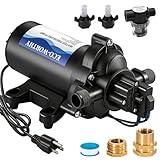 ECO-WORTHY 33-Series 4.0 GPM9.6/10View on Amazon
- 3
 FIDISP Water Transfer Pump9.6/10View on Amazon
- 4
 SumpMarine 330 GPH Pump9.5/10View on Amazon
A stock tank runs low while the rain barrel overflows, and a wet corner of the barn needs draining before morning chores, so moving water is a daily farm job. The types of water pump for that work are the electric transfer pump, which moves water from a tank, barrel, pool or pond to somewhere else, and the diaphragm pressure pump, which holds pressure in a water line. This guide explains how each type works, what flow rate and lift mean for farm jobs, and how the pumps in the gear section compare on the figures the makers state.
GoatGearLab earns a commission when you buy through links on this page, at no extra cost to you. As an Amazon Associate I earn from qualifying purchases. Affiliate disclosure.
| # | Product | GoatGear Score | Buy |
|---|---|---|---|
| 1 | VEVOR Cast Iron Transfer Pump | 9.6/10 | Buy on Amazon |
| 2 | ECO-WORTHY 33-Series 4.0 GPM | 9.6/10 | Buy on Amazon |
| 3 | FIDISP Water Transfer Pump | 9.6/10 | Buy on Amazon |
| 4 | SumpMarine 330 GPH Pump | 9.5/10 | Buy on Amazon |

VEVOR Cast Iron Transfer Pump
A cast iron 1/2 HP transfer pump rated at 1600 GPH with a 120 ft pumping height, a 10 ft power cord and brass connectors.
Pros
- 1600 GPH flow, the highest gallons-per-hour figure in this guide
- 120 ft pumping height stated by the maker
- Cast iron body with rust-proof treatment on the pump head and water-passing parts
- Filter, carbon brush and two brass connectors in the box
Cons
- 17.4 lb weight to carry between jobs
- Needs priming with water before each use
- Must stay out of the water and away from large particle impurities
- Carbon brush service life up to 200 hours, so it needs replacing over time
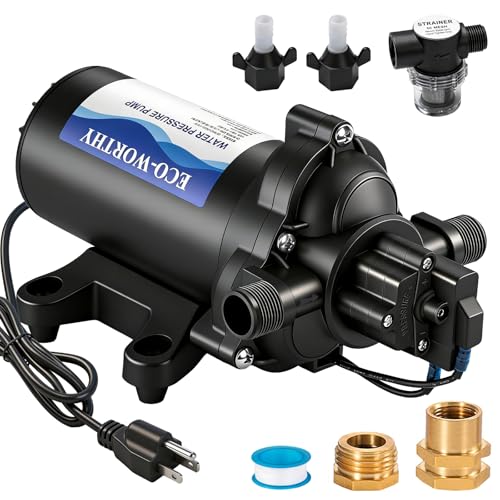
ECO-WORTHY 33-Series 4.0 GPM
A 110V diaphragm pump rated at 4.0 GPM and 50 PSI, with a smart pressure switch adjustable from 45 to 70 PSI and garden hose adapters.
Pros
- Smart pressure switch adjustable from 45 to 70 PSI
- Self-priming up to 9.8 vertical feet, lift up to 131 feet
- Thermal overload protection built in
- Garden hose adapters included
Cons
- 4.0 GPM flow, the lowest here
- 50 PSI set point is below the 70 PSI of the other diaphragm pumps
- No strainer is stated as included
- AC power only, with no battery option

FIDISP Water Transfer Pump
A 115V electric utility water pump rated at 330 gallons per hour with a 42 ft maximum lift, two 6 ft hoses and a 1/8 inch low suction strainer.
Pros
- 330 gallons per hour, stated as 5.5 gallons per minute
- Lifts water to a maximum of over 42 ft
- Two 6 ft hoses and a suction strainer that draws water down to 1/8 inch of the surface
- Heavy-duty metal body with a zinc alloy pump volute and a built-in switch
Cons
- No warranty term is stated
- Runs from a 115V outlet, so it needs an outlet near the water
- The pump must be primed with water before use
- Designed for clean water, so it does not suit fuel transfer
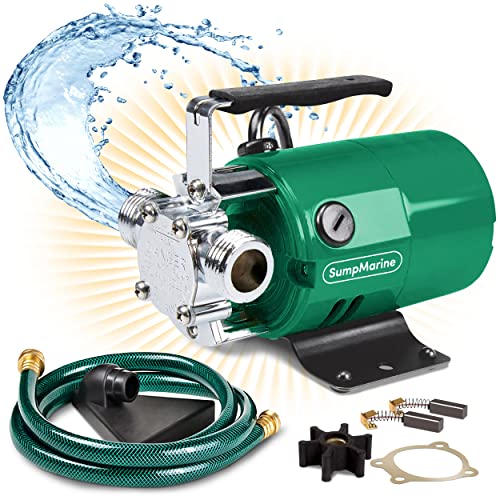
SumpMarine 330 GPH Pump
A 1/10 HP portable transfer pump rated at 330 GPH with a 6 ft hose kit and a suction attachment.
Pros
- 330 GPH flow from a 1/10 HP motor
- 6 ft hose and suction attachment in the box
- Impeller replacement kit in the box
- Primes with food-grade vegetable oil
Cons
- 1/10 HP motor moves less water than the 1/2 HP VEVOR
- Needs priming and a submerged suction attachment before switching on
- This size comes without an on/off switch
- 6 ft hose limits how far the pump sits from the water
As an Amazon Associate I earn from qualifying purchases.
Types of water pump: the short answer
A transfer pump is the pick for moving water: it pulls water in through an inlet and pushes it out through a hose to a tank, a garden or a drain. A diaphragm pressure pump is the pick for holding pressure in a line, such as an RV water line. Flow rate decides how fast the water moves, and lift decides how high the pump can push it, so match both figures to the job before buying.
Transfer pumps and diaphragm pumps
The transfer pumps in this guide are electric utility pumps that run on household current. The VEVOR lists a 1/2 HP motor rated at up to 1600 GPH with a 120 ft pumping height, while the SumpMarine and the FIDISP each list a 1/10 HP motor rated at 330 GPH. The ECO-WORTHY is the diaphragm pump here, rated at 4.0 GPM and 50 PSI for an RV water line. A transfer pump suits draining and moving water, while a diaphragm pump suits a line that needs pressure.
| Type | Example pump | Stated flow | Stated power | Amazon |
|---|---|---|---|---|
| Transfer pump | VEVOR Cast Iron Transfer Pump | 1600 GPH | 1/2 HP | |
| Transfer pump | SumpMarine 330 GPH Pump | 330 GPH | 1/10 HP | |
| Diaphragm pressure pump | ECO-WORTHY 33-Series Pump | 4.0 GPM | 110V AC | |
| Transfer pump | FIDISP 330 GPH Transfer Pump | 330 GPH | 1/10 HP |
The gear: water pumps for farm and stock water
The pumps below cover the types above, from the high-flow transfer pump for draining a pool or pond to the small pump for a rain barrel and the pressure pump for a water line.
How to choose the best types of water pump
Flow rate and lift
Flow rate is the volume a pump moves, given in gallons per hour or gallons per minute, and lift is the height it can push water. The VEVOR lists up to 1600 GPH, the highest gallons-per-hour figure here, and a 120 ft pumping height. The SumpMarine and the FIDISP each list 330 GPH, and the ECO-WORTHY lists 4.0 GPM at 50 PSI. Match the stated flow and lift to the job: draining a pool or pond calls for the larger figures, while emptying a rain barrel or aquarium calls for less. A separate roundup compares high lift transfer pumps. Once the water is moved, it needs somewhere to go: the water storage tank with hose connection roundup covers tanks that take a hose.
Power and priming
The VEVOR, the SumpMarine and the FIDISP run on 115V AC, and the ECO-WORTHY runs on 110V AC, so each one needs an outlet nearby. The VEVOR lists a 10 ft power cord, which sets how far it can sit from the outlet. The VEVOR and the SumpMarine need priming: the VEVOR maker says to add water through the inlet to submerge the impeller before each use, and the SumpMarine maker says to prime with food-grade vegetable oil and to switch on only with the suction attachment fully submerged. Neither pump should run dry. For moving water by hand, see the transfer pump manual.
Size, weight and what comes with it
The VEVOR weighs 17.4 lb and measures 9.6 by 5.7 by 8.9 inches, with a portable handle and a cast iron body. The SumpMarine measures 8.0 by 8.0 by 7.5 inches and comes with a 6 ft hose, a water suction attachment and an impeller replacement kit. The VEVOR box holds a filter, a carbon brush with a service life up to 200 hours, and two brass connectors. The cast iron VEVOR at 17.4 lb suits a fixed spot by the barn, while the SumpMarine with its hose kit suits carrying between a rain barrel and a tank.
What this guide does not cover
This guide covers pump hardware only. It does not cover how much water stock needs, water quality or any animal health question. Ask a veterinarian or local extension office about stock water and animal health.
FAQs from goat keepers
What is the difference between a transfer pump and a diaphragm pump?
A transfer pump moves water from one container to another, such as from a rain barrel to a tank. A diaphragm pump holds pressure in a water line, such as the ECO-WORTHY at 4.0 GPM and 50 PSI for an RV water line. Pick the transfer pump for moving water and the diaphragm pump for a pressurized line.
How much water can a transfer pump move?
The VEVOR lists up to 1600 GPH, while the SumpMarine and the FIDISP each list 330 GPH. Match the stated flow to the job: the larger figure suits draining a pool or pond, and the smaller figure suits a rain barrel or aquarium.
Do water transfer pumps need priming?
The VEVOR and the SumpMarine need priming before use. The VEVOR maker says to add water through the inlet to submerge the impeller before each use, and the SumpMarine maker says to prime with food-grade vegetable oil and to switch on only with the suction attachment fully submerged. Neither pump should run dry.
What power do these water pumps need?
The VEVOR, the SumpMarine and the FIDISP run on 115V AC, and the ECO-WORTHY runs on 110V AC. Each one needs an outlet nearby, and the VEVOR lists a 10 ft power cord.
More from the barn
See every barn and farm tool guide and all farm water guides.
More picks: high lift transfer pumps, submersible pumps with float, potable water storage tanks and farm water hoses.