

On this page
Top picks at a glance
As an Amazon Associate I earn from qualifying purchases.
- 1
 +QSO Vegetable Rennet Tablets for Cheese Making9.6/10View on Amazon
- 2
 Bixa Liquid Rennet for Cheese Making9.6/10View on Amazon
- 3
 QSO Vegetable Rennet Tablets9.5/10View on Amazon
- 4
 10 Tablets of Vegetable Cuajo Marschall 50 Coagulant TabletsView on Amazon
- 5
 Readyline Vegetable Rennet TabletsView on Amazon
- 6
 Liquid Vegetable RennetView on Amazon
- 7
 Marschall Rennet Tablet Vegetable Rennet Tablets 100 TabletsView on Amazon
- 8
 Vegetable Coagulant Tablets for Cheesemaking: 10 Tablets ofView on Amazon
- 9
 North Mountain Supply Premium Professional Quality LiquidView on Amazon
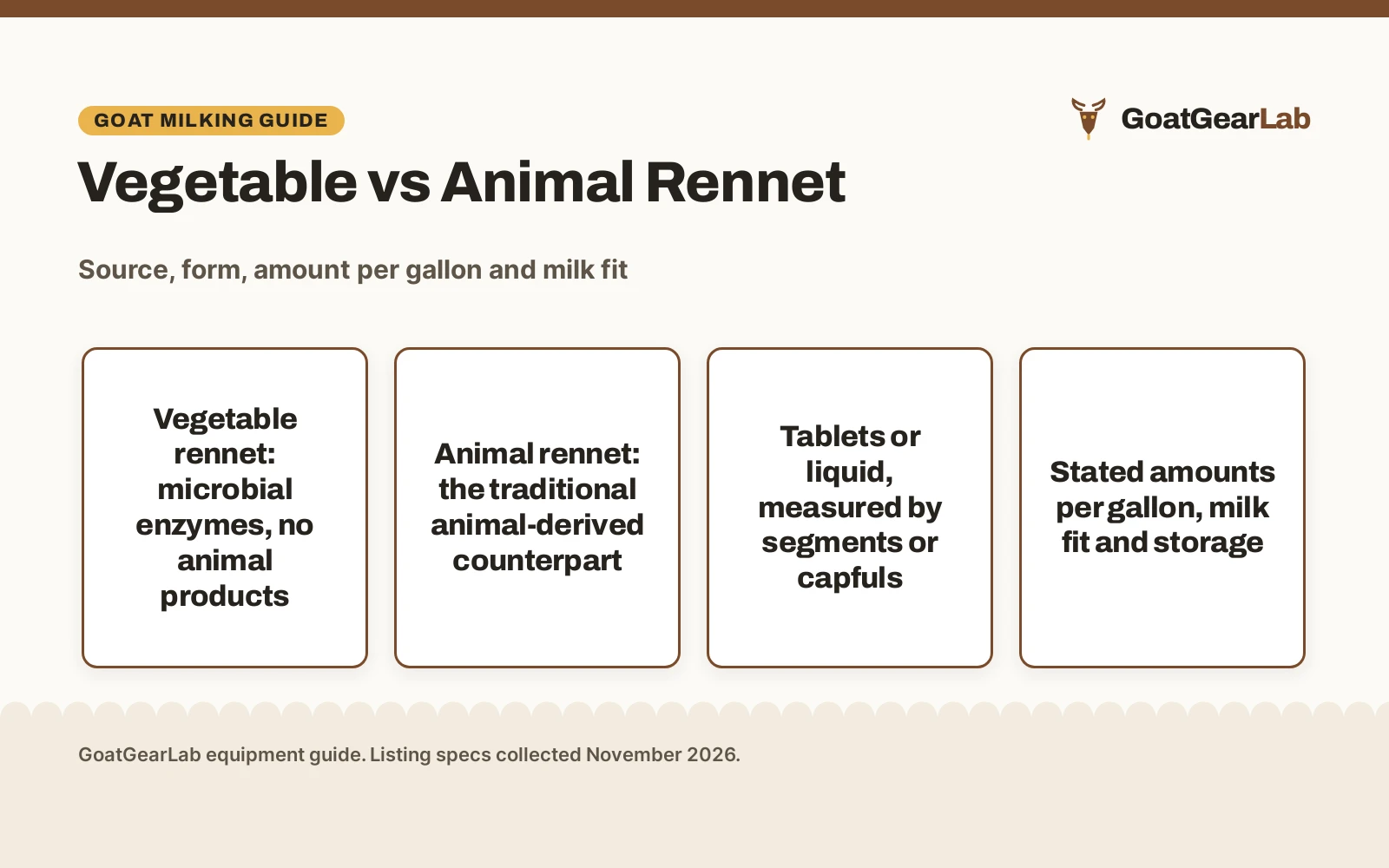
The morning milk is still warm in the pail, and the cheese pot is already on the stove, so the rennet you reach for decides whether the milk sets into a clean curd or stays a stubborn liquid. Vegetable vs animal rennet is the choice at the heart of that pot: vegetable rennet is made without animal ingredients, while animal rennet is the traditional counterpart made with animal-derived enzymes. This guide compares the two on source, form, amount per gallon and milk fit, using four vegetable rennet listings as working examples.
Also worth comparing
 10 Tablets of Vegetable Cuajo Marschall 50 Coagulant TabletsCheck price on Amazon
 Readyline Vegetable Rennet TabletsCheck price on Amazon
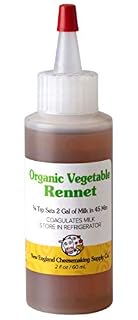 Liquid Vegetable RennetCheck price on Amazon
 Marschall Rennet Tablet Vegetable Rennet Tablets 100 TabletsCheck price on Amazon
 Vegetable Coagulant Tablets for Cheesemaking: 10 Tablets ofCheck price on Amazon
 North Mountain Supply Premium Professional Quality LiquidCheck price on Amazon
GoatGearLab earns a commission when you buy through links on this page, at no extra cost to you. As an Amazon Associate I earn from qualifying purchases. Affiliate disclosure.
Vegetable vs animal rennet: the short answer
Pick vegetable rennet if you want a cheese that stays free of animal ingredients. Every listing in this guide is a vegetable or microbial rennet, and each one says so plainly: microbial enzymes with no animal products, or a vegetable-based formula made without animal ingredients. Animal rennet is the traditional counterpart those listings position themselves against. For a home cheese maker working with goat milk, the vegetable listings here cover tablets and liquid, small and large packs, and clear amounts per gallon.
If you are setting up the rest of the cheese bench first, our cheese making kit vs yogurt maker roundup scores four kits on the same practical points.
Two rennet sources compared
| Source | Made from | Form in these listings | Milk fit stated |
|---|---|---|---|
| Vegetable / microbial | Microbial enzymes, no animal products | Tablets and liquid | Cow, goat and sheep milk |
| Animal | Animal-derived enzymes | Varies by listing | Varies by listing |
The vegetable side is the one with stated facts here. The Danisco tablet listing says its tablets are made with microbial enzymes which contain no animal products. The QG group liquid listing says its formula is 100 percent vegetarian microbial enzyme, made without animal ingredients, and calls itself a reliable vegetarian alternative. The Readyline listing describes natural ingredients that are gluten free and NON-GMO. None of the four listings states anything about animal rennet beyond that contrast.
The gear: four vegetable rennet listings
Four listings cover the vegetable side of this comparison, ranked here by how clearly each listing states its form, amount per gallon, milk fit and storage. All four are vegetable or microbial rennet; they differ in form, pack size and how much guidance the listing gives.
1. QG group microbial liquid rennet, 3 fl oz
The QG group liquid ranks first on stated detail. The listing gives a 3 fl oz bottle, listed as 88 ml, and a clear amount: 1/2 capful per gallon or 1 capful per 2 gallons of milk, with no dilution required. It says to add the rennet directly to milk heated to 89 to 100 degrees F, listed as 32 to 38 degrees C, and let it rest. It works with cow, goat and sheep milk, and names mozzarella, cheddar, feta, parmesan and cream cheese among the cheeses it suits. The formula is described as 100 percent vegetarian microbial enzyme, made without animal ingredients, and highly concentrated.
2. Danisco vegetarian rennet tablets, box of 100
The Danisco tablet box ranks second. It lists a box of 100 vegetarian rennet tablets made with microbial enzymes which contain no animal products, used for coagulating milk into curds for cheese. Each tablet is scored into 4 segments for ease of use, and the listing says 1/4 tablet will set 1-3 gallons of milk. It also says calcium chloride is needed for making cheese with pasteurized milk and even sometimes raw milk, because it helps the curds set.
3. Readyline vegetable rennet tablets, strip of 10
The Readyline strip ranks third. It lists a strip of 10 precisely measured tablets, described as simple to use for consistent results, with natural ingredients that are gluten free and NON-GMO. It suits hard, soft and fresh cheeses, and is described as professional quality for home cheese makers and small-scale artisanal producers. Storage is the clearest of the four listings: a long shelf life in a cool, dry place, and keep in the freezer for up to 5 years.
4. Danisco Marschall vegetable tablets, 10 tablets
The Danisco Marschall listing ranks last because it states the least. It lists 10 tablets of Vegetable Cuajo Marschall 50 coagulant tablets for cheesemaking, in white, with an item weight of 0.06 pounds. The bullets are mostly keyword strings rather than usage guidance, and the listing gives no amount per gallon, no milk types and no storage guidance. It still belongs in the ranking as a small pack of vegetable tablets, but a buyer would need the amount guidance from another listing before using it.
Tablets or liquid
Three of the listings are tablets and one is liquid, and the form decides how you measure. Tablets are counted: the Danisco box scores each tablet into 4 segments, so a quarter tablet is the measuring unit, and the Readyline strip holds 10 precisely measured tablets. Liquid is poured: the QG group bottle measures by the capful, at 1/2 capful per gallon, with no dilution required. Tablets keep longer on the shelf, and the Readyline listing is the only one that states freezer storage of up to 5 years. Liquid is faster to add, since the QG group listing says to add it directly to heated milk and let it rest.
How much rennet per gallon
Two listings state an amount per gallon, and they agree in spirit while differing in units. The QG group liquid says 1/2 capful per gallon or 1 capful per 2 gallons of milk. The Danisco tablet box says 1/4 tablet will set 1-3 gallons of milk. The other two listings state no amount at all, which is a gap worth noting before you buy: a strip of 10 tablets with no stated amount per gallon leaves the cheese maker guessing. The Danisco tablet listing also notes that calcium chloride is needed for making cheese with pasteurized milk, because it helps the curds set.
Milk fit: cow, goat and sheep
Only one listing names the milks it suits, and it names all three: the QG group liquid is designed for use with fresh cow, goat or sheep milk, with dependable curd formation. The Danisco tablet listing speaks generally about coagulating milk into curds for cheese, with no milk types named. The Readyline and Marschall listings name no milk type either. For a goat keeper making cheese from the morning milking, the QG group listing is the only one that states goat milk outright.
Storage and shelf life
Storage is stated on only one listing, and it is generous: the Readyline strip keeps a long shelf life in a cool, dry place, and the listing says to keep it in the freezer for up to 5 years. The other three listings state no storage guidance at all. Tablets are the form that stores longest in general, and the scored Danisco box of 100 is the pack that would sit on the shelf the longest, so the missing storage note on that listing is a real gap.
Read the listing twice
Rennet listings contradict themselves, and the numbers that conflict are usually the ones you need to plan the batch:
- Danisco Marschall: the title says 10 tablets and Marschall 50 in the same line, the bullets are keyword strings rather than guidance, and the spec table lists Size as 10 Count (Pack of 1) against NumberOfItems as 1.
- Danisco box of 100: the bullets say 1/4 tablet will set 1-3 gallons of milk in approximately, and the sentence ends there, so the timing the listing meant to state is missing.
- QG group liquid: the title and bullets agree on 1/2 capful per gallon, and the title gives 3 fl oz with 88 ml in parentheses, while the spec table lists an item weight instead of a volume.
- Readyline: the title and bullets agree on a strip of 10 tablets, while the spec table lists Size as 1 Count (Pack of 1) and NumberOfItems as 1.
Check the amount per gallon and the milk types before ordering, and allow for the larger figure where a listing gives two.
What this guide does not cover
This guide covers rennet hardware and stated amounts only. It does not cover cheese recipes, aging, or any health question. Ask your veterinarian or local extension office about milk handling and goat health.
FAQs from goat keepers
What is the difference between vegetable and animal rennet?
Vegetable rennet is made without animal ingredients: the listings here describe microbial enzymes with no animal products, or a vegetable-based formula made without animal ingredients. Animal rennet is the traditional counterpart made with animal-derived enzymes.
Is vegetable rennet vegetarian?
The listings here say so plainly. The QG group liquid is described as a 100 percent vegetarian microbial enzyme, and the Danisco tablets are made with microbial enzymes which contain no animal products.
How much rennet do I use per gallon of milk?
The QG group liquid says 1/2 capful per gallon or 1 capful per 2 gallons of milk. The Danisco tablet box says 1/4 tablet will set 1-3 gallons of milk. The other two listings state no amount per gallon.
Can I use vegetable rennet with goat milk?
The QG group liquid is designed for use with fresh cow, goat or sheep milk. The other three listings name no milk type, so check the listing before you buy if you make cheese only from goat milk.
How should I store rennet tablets?
The Readyline listing says to store tablets in a cool, dry place, with a long shelf life, and to keep them in the freezer for up to 5 years. The other listings state no storage guidance.
More from the barn
See every cheese making kit guide and all milking guides.
More picks: cheese making kit vs yogurt maker, best cheesecloth for making feta, best cheese press bag and cheese press bag vs cheesecloth.