

On this page
Top picks at a glance
As an Amazon Associate I earn from qualifying purchases.
- 1
 BOSKA Stainless Steel Cheese 3 Knife Set9.6/10View on Amazon
- 2
 Zyliss Cheese Knife9.6/10View on Amazon
- 3
 ZWILLING Collection 3-pc Cheese Knife Set9.6/10View on Amazon
The morning milk goes from the pail to the pot, and by the time the pot is warm the milk has begun to set. What is a cheese curd? It is the solid lump that forms when milk is coagulated and the liquid whey is drained away. That lump is the start of every cheese, from a fresh curd eaten the same day to a wheel that ages on a shelf. This guide walks through what a curd is, how it forms, and what to do with it after it leaves the pot.
GoatGearLab earns a commission when you buy through links on this page, at no extra cost to you. As an Amazon Associate I earn from qualifying purchases. Affiliate disclosure.
What is a cheese curd: the short answer
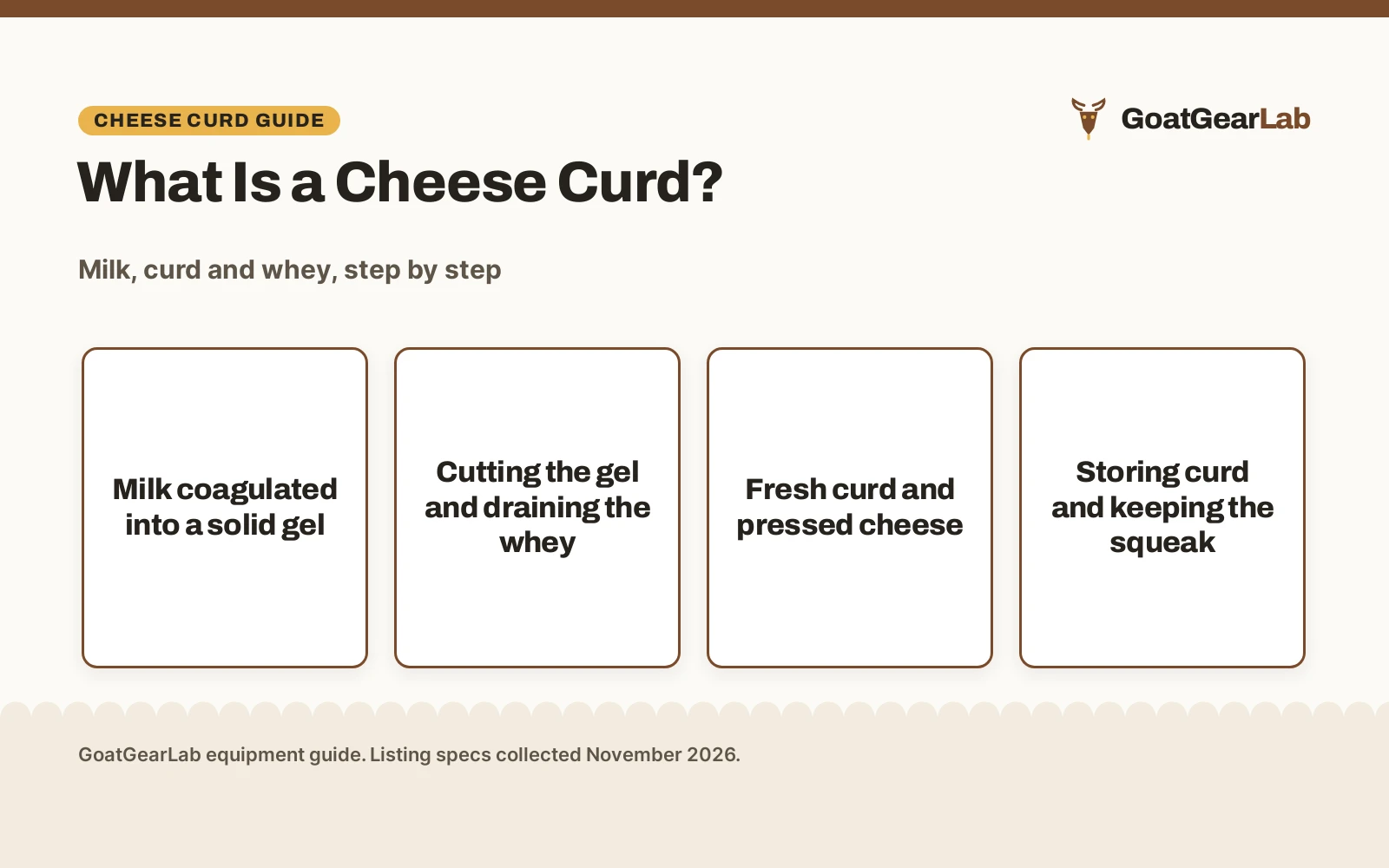
A cheese curd is milk that has set into a solid. Warm milk is coagulated with rennet or an acid culture, and the milk proteins link together into a soft gel. That gel is cut into pieces, and the liquid whey drains away from the pieces. What stays behind is curd: soft, moist lumps that hold together in the pot and squeak when you bite them fresh.
For the tools, our best cheese curd knife guide compares knives for cutting curd, and our cheese making kit vs yogurt maker guide compares starter kits.
From milk to curd: the stages
| Stage | What happens | What you get |
|---|---|---|
| Milk | Warm milk waits in the pot | Liquid milk, ready to set |
| Coagulation | Rennet or culture sets the milk into a gel | A soft gel that holds its shape |
| Cutting | A curd knife cuts the gel into pieces | Curd pieces floating in whey |
| Draining | Whey drains away from the pieces | Fresh curd, ready to eat or press |
| Pressing | Weight presses the pieces together | A firm wheel, ready to age |
Milk
Start with fresh milk from the morning milking, strained and cooled as usual. Goat milk works well for curd, and the milk you already handle for the house is the milk to use. Warm it gently in the pot until it feels warm to the touch, then take it off the heat.
Coagulation and cutting
Stir in the rennet or culture, then leave the pot alone while the milk sets into a gel. The gel is ready when it holds a clean break: a knife drawn through it leaves a clean line and the whey that seeps in looks clear. Cut the gel into pieces with a curd knife or a long knife, and let the pieces rest while the whey seeps out.
Draining and pressing
Scoop the pieces into cheesecloth or a draining mat and let the whey drain away. The curd that stays behind is fresh curd, ready to salt and eat. To make a wheel, pack the curd into a pressing form and add weight until the pieces knit into a firm wheel.
Fresh curds and pressed cheese
Fresh curd and pressed cheese start from the same pot, and the difference is what happens after draining. Fresh curd is eaten as it is, soft and moist, with the squeak that gives it away. Pressed cheese is curd that has been packed into a form and pressed under weight until the pieces knit together, then left to age. A wheel that ages grows firmer and drier as the whey keeps leaving it, while fresh curd stays soft because it never goes under the press.
What makes curds squeak
A fresh curd squeaks because the curd is still springy and the surface is still moist. Bite into a piece and the curd rubs against your teeth, and that rub is the squeak. The squeak fades as the curd cools and dries, so a curd eaten warm from the pot squeaks louder than a curd that has sat in the fridge.
Curds from goat milk
Goat milk makes a soft curd with a clean, mild flavor, and the curd sets much like cow milk curd. The milk you milk in the morning is the milk for the pot, and the curd you get is the same curd any milk gives, shaped by the milk and the culture you use. If your herd gives more milk than the house drinks, a pot of curd is a good way to use the extra.
Our how to process goat milk guide covers straining, cooling and storing the milk before it reaches the pot, and our how to pasteurize goat milk guide covers heating, watching and cooling.
Storing fresh curds
Fresh curd keeps best cool and covered, and it tastes best while it is still fresh. Keep the curd in a covered bowl in the fridge and eat it soon, while the squeak is still there. If the curd dries out, it loses the squeak and turns firm, so cover it well and do not leave it open on the counter.
What to watch in a recipe
Cheese recipes disagree with each other, and the points that differ are usually the ones that matter for the pot:
- Rennet or culture: some recipes use rennet, some use a culture, and some use an acid such as vinegar or lemon juice. Use whichever your recipe names and follow it as written.
- Cut size: some recipes cut the gel into small pieces and some into large pieces. Small pieces drain faster and give a drier curd, while large pieces hold more whey and give a softer curd.
- Pressing: some recipes press the curd and some eat it fresh. A wheel needs the press, and fresh curd needs none.
Read the recipe through before you start, and have the pot, the knife and the cloth ready before the milk goes on the heat.
What this guide does not cover
This guide covers curd only: what it is, how it forms, and what to do with it after it leaves the pot. It does not cover aging cheese, smoking cheese, or milk handling beyond the pot. Ask your veterinarian or local extension office about goat health.
FAQs from goat keepers
What is a cheese curd made of?
Milk, and the rennet or culture that sets it. Warm milk is coagulated, the gel is cut, and the whey drains away, leaving curd behind.
Are cheese curds the same as cheese?
Curds are the start of cheese, not the end of it. Fresh curd is eaten as it is, while pressed cheese is curd that has been packed, pressed and aged.
Why do cheese curds squeak?
Fresh curds squeak because they are still springy and moist, so they rub against your teeth when you bite them. The squeak fades as the curd cools and dries.
Can I make cheese curds from goat milk?
Yes. Goat milk sets into curd much like cow milk, and the milk from the morning milking is the milk to use. Warm it, set it, cut it and drain it, and the curd is ready.
What do I need to cut the curd?
A curd knife, or a long knife that reaches across the pot. The knife should reach across the pot so the cut runs clean through the gel.
More from the barn
See every cheese making kits guide and all milking guides.
More picks: best cheese curd knives, cheese making kit vs yogurt maker, cheese press bags and how to process goat milk.