

On this page
Top picks at a glance
As an Amazon Associate I earn from qualifying purchases.
- 1
 Gallagher S80 Solar9.6/10View on Amazon
- 2
 briidea HX-319 Charger9.6/10View on Amazon
- 3
 LEOMAUNYX 15-Mile Charger9.5/10View on Amazon
- 4
 EVIORTER 0.18J Solar9.4/10View on Amazon
The ac vs solar fence charger question comes up on the morning a goat leans against the fence wire and the line stays quiet. A charger that fits the pasture keeps the wire live whether the barn outlet sits close by or the paddock lies far down the lane. We compared the AC examples and the solar examples in this comparison on output joules, rated range, voltage, power source, and what each unit states about batteries and backup, using only what each listing publishes.
GoatGearLab earns a commission when you buy through links on this page, at no extra cost to you. As an Amazon Associate I earn from qualifying purchases. Affiliate disclosure.
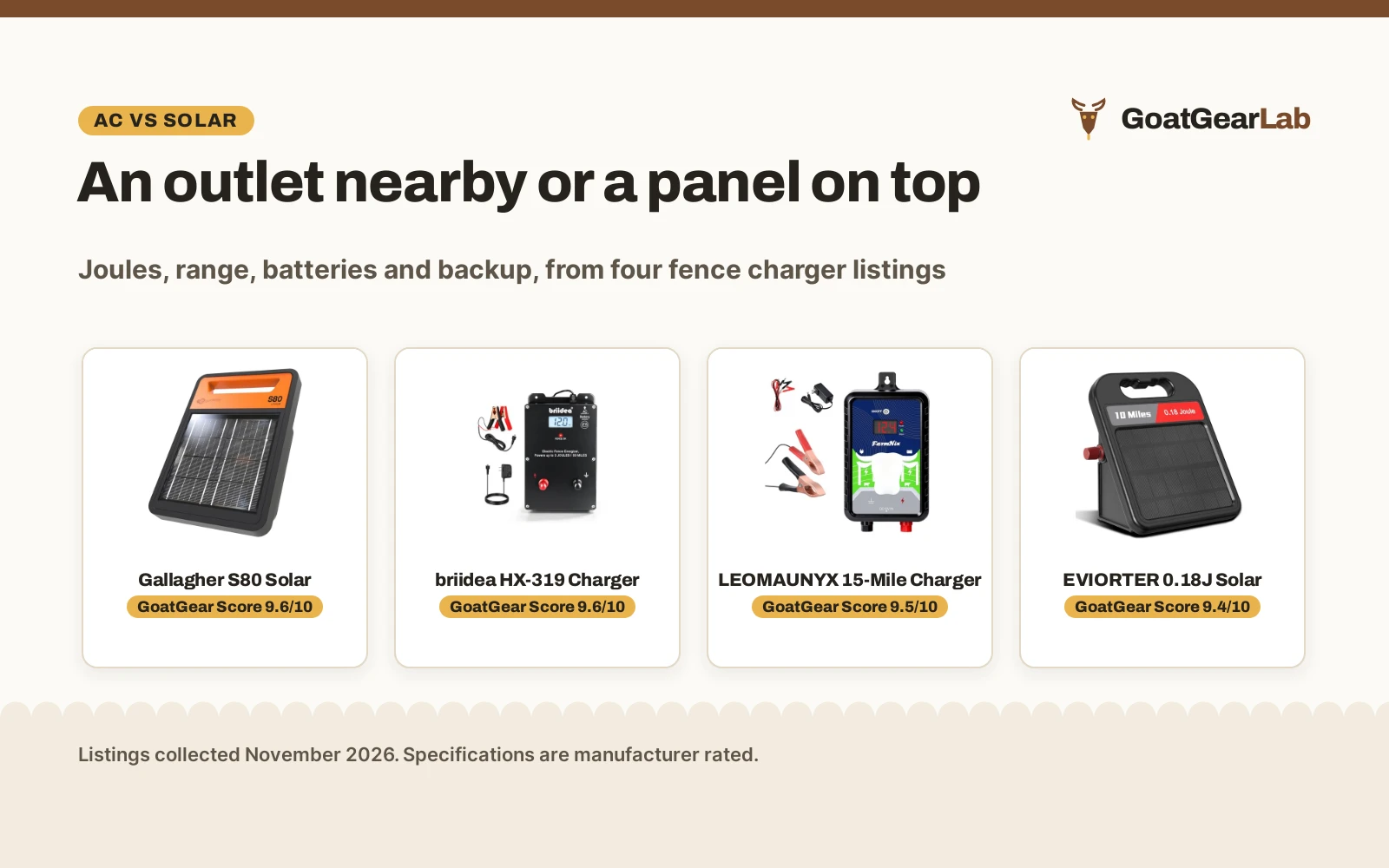
Quick verdict: choose the AC side if an outlet sits within reach of the fence and the line runs long, as the briidea example shows with 3 joules, 12,000 volts, and a 50-mile rating, and the LEOMAUNYX example shows with 4 joules and 12KV. Choose the solar side if the fence sits far from the barn and nobody wants to haul a battery, as the Gallagher S80 shows with its solar panel and lithium battery, and the EVIORTER shows with up to 25 days of backup. The two sides sit in different output classes, so read this as a comparison of power sources first.
Four examples
| # | Product | GoatGear Score | Buy |
|---|---|---|---|
| 1 | Gallagher S80 Solar | 9.6/10 | Buy on Amazon |
| 2 | briidea HX-319 Charger | 9.6/10 | Buy on Amazon |
| 3 | LEOMAUNYX 15-Mile Charger | 9.5/10 | Buy on Amazon |
| 4 | EVIORTER 0.18J Solar | 9.4/10 | Buy on Amazon |

Gallagher S80 Solar
A solar fence charger with 0.8 joules, a 25 mile range, lithium battery storage, and a three-year warranty.
Pros
- Lithium battery storage with solar charging
- Rated up to 25 miles of clean fence, or 7 miles in typical multi-wire setups
- Pulse intervals drop to 2.5 seconds at night to hold 9,300 volts
- Smart Adaptive Energy Control adjusts output to battery and fence load
Cons
- 0.8 joule output is lower than the AC examples here
- 25 mile rating applies to clean fence under ideal conditions
- Heaviest stated weight here at 4.98 pounds
- No display or voltage readout is stated

briidea HX-319 Charger
An electric fence energizer with 3 joules, 12,000 volts, a 50-mile rating, and AC or 12V battery power.
Pros
- 3 joules, 12,000 volts, and a 50-mile rating
- Runs on 110-240V AC or a 12V battery
- LCD screen shows real-time voltage, plus a FENCE OK LED
- Flame-resistant housing with built-in lightning protection
Cons
- 12V battery, ground rods, and fence wires are not included
- Waterproof cover is recommended for outdoor setups but not included
- No warranty term is stated
- No weight is stated, so portability is unclear

LEOMAUNYX 15-Mile Charger
An AC or DC fence charger with 4 joules, 12KV output, and a 15-mile range.
Pros
- 4 joules at 12KV, the highest output stated here
- 15-mile range in vegetation-free areas, with an LED display
- Operates from -20 to 60 Celsius, stated as -4 to 140 Fahrenheit
- 100-microsecond pulse for a brief numbing sensation, as the maker states
Cons
- No warranty term is stated
- No dimensions or weight are stated
- 15-mile rating applies only to vegetation-free areas
- AC or DC power needs an outlet or a battery nearby, with no solar charging
EVIORTER 0.18J Solar
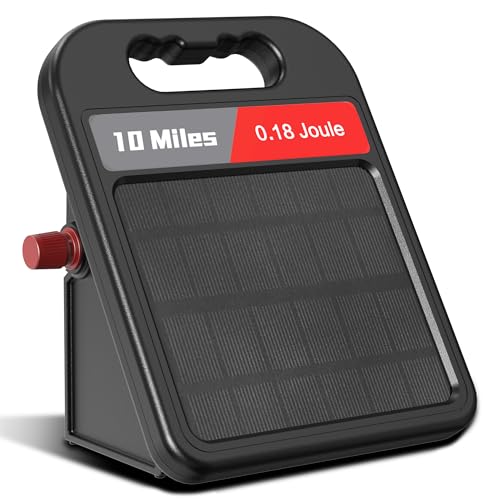
A solar fence charger with 0.18 joules, a 10-mile range, and a 5W panel with up to 25 days of backup.
Pros
- 5W monocrystalline panel, up to 25 days of backup
- Recharges in 6 sunny days, runs in low light or storms
- Portable, lightweight, tool-free setup for pastures
- Waterproof construction that helps prevent short circuits in rain
Cons
- 0.18 joule output is the lowest stated here
- 10-mile rating is the lowest stated here
- No display is stated for checking fence voltage
- Panel needs sun to recharge, with 6 sunny days for a full recharge
As an Amazon Associate I earn from qualifying purchases.
AC vs solar fence charger: side by side
| Charger | GoatGear Score | Power | Output | Rated range | Battery | Weight | Amazon |
|---|---|---|---|---|---|---|---|
| Gallagher S80 Solar | 9.6/10 | Solar panel, lithium battery | 0.8 joules | 25 miles | Included, rechargeable | 4.98 pounds | View on Amazon |
| briidea HX-319 Charger | 9.6/10 | 110-240V AC or 12V battery | 3 joules | 50 miles | Not included | Not stated | View on Amazon |
| LEOMAUNYX 15-Mile Charger | 9.5/10 | AC or DC power | 4 joules | 15 miles | Not stated | Not stated | View on Amazon |
| EVIORTER 0.18J Solar | 9.4/10 | Solar panel, rechargeable | 0.18 joules | 10 miles | Included, rechargeable | Not stated | View on Amazon |
Figures come from the product pages and reflect what the maker rates, current as of 22 November 2026.
How each one keeps the fence live
An AC charger draws power from an outlet or a battery. The briidea HX-319 runs on 110-240V AC power or a 12V battery, so it plugs in at the barn or switches to battery power in remote fields. The LEOMAUNYX EF-BB03 runs on AC or DC power with a real-time voltage display, and its 2 terminals connect the ground system and the fence.
A solar charger carries its own panel and battery. The Gallagher S80 pairs solar charging with lithium battery storage, and its Smart Adaptive Energy Control adjusts output to battery and fence load. The EVIORTER unit uses a 5W monocrystalline panel and states up to 25 days of backup after 6 sunny days of charging. For more solar picks, see our solar fence charger roundup.
Output joules and rated range
Output joules describe how much energy each pulse carries. The LEOMAUNYX example lists 4 joules at 12KV, and the briidea example lists 3 joules at 12,000 volts. On the solar side, the Gallagher S80 lists 0.8 joules with a maximum output of 9,300 volts, and the EVIORTER lists 0.18 joules with a maximum output of 9300 volts. The AC examples state higher figures than the solar examples here, and both sides state their figures clearly.
Rated miles are maker figures with different conditions attached. The briidea example rates up to 50 miles, the Gallagher S80 up to 25 miles of clean fence under ideal conditions or approximately 7 miles under typical multi-wire setups with light vegetation, the LEOMAUNYX example 15 miles in vegetation-free areas, and the EVIORTER example 10 miles. Treat miles as a ceiling for clean fence. Our electric fence charger for goats roundup lists more units by stated output.
Weeds, animals and what each listing names
Weeds touching the wire pull energy out of every pulse. The Gallagher S80 states its 7 mile figure for typical multi-wire setups with light vegetation, and the LEOMAUNYX example rates 15 miles only in vegetation-free areas. The briidea and EVIORTER listings give no weed rating.
Each listing names the animals it aims to deter, and the names differ. LEOMAUNYX names cattle, horses, sheep, chickens, and dogs, and lists wolves, foxes, raccoons, and skunks as wild intruders. Gallagher names deer, raccoons, and coyotes. The briidea listing speaks of livestock, gardens, and pet areas without naming goats, and EVIORTER names gardens, small livestock farms, leisure farms, and pet farms. None of the four listings names goats.
Size, weight and the box
The briidea charger measures 5.91 by 3.15 by 10.43 inches with no weight stated, and the Gallagher charger measures 8.25 by 8.0 by 11.0 inches at 4.98 pounds. LEOMAUNYX and EVIORTER state no dimensions or weight. Gallagher ships a lithium battery with the unit, EVIORTER ships a rechargeable solar panel setup, and briidea ships without a 12V battery, ground rods, fence wires, or a waterproof cover.
Warranty and listing gaps to check
Gallagher is the only one of the four that states a warranty term: a three-year warranty on its lithium chargers. LEOMAUNYX and briidea state no warranty term, and EVIORTER states no term in years or months. The gaps go further: briidea states no weight, LEOMAUNYX and EVIORTER state no dimensions or weight, and neither solar example states a display. If any of those points decides your purchase, ask the seller before you order.
Which should you choose?
Choose an AC fence charger if an outlet sits within reach of the fence or a 12V battery is easy to swap, and the line runs long, as the briidea example shows with 3 joules, 12,000 volts, and a 50-mile rating, and the LEOMAUNYX example shows with 4 joules and 12KV. Keepers who rotate paddocks can also compare our electric fence charger for rotational grazing picks.
Choose a solar fence charger if the fence sits far from the barn and nobody wants to carry a battery back and forth, as the Gallagher S80 shows with solar charging and lithium battery storage, and the EVIORTER shows with up to 25 days of backup. If an outlet sits within reach, read our AC vs battery fence charger comparison first.
Whichever you pick, walk the fence after storms and keep the bottom wire clear of weeds.
Around the Barn
- Face the solar panel toward open sky and wipe dust and snow off it.
- Keep a spare 12V battery charged for the briidea unit so the fence never goes dead on swap day.
- Check the voltage display or the FENCE OK LED each morning before turning goats out.
FAQs from goat keepers
Is an AC or solar fence charger better for goats?
It depends on power access and fence length. The AC examples here state 4 joules at 12KV and 3 joules at 12,000 volts. The solar examples state 0.8 and 0.18 joules.
Does a solar fence charger need a battery?
Yes. A solar charger stores the panel energy in a battery and pulses the fence from it. The Gallagher S80 lists lithium battery storage, and the EVIORTER unit lists a rechargeable panel with up to 25 days of backup.
How long does a solar fence charger run without sun?
Only the listing can say. EVIORTER states up to 25 days of backup after 6 sunny days of charging. Gallagher states lithium battery storage but no backup figure in days.
Which fence charger here has a warranty?
Gallagher is the only one of the four that states a warranty term, a three-year warranty on its lithium chargers. The other three listings state no warranty term in years or months.
Behind the Farm Score
| Product | GoatGear Score | Perf. /35 | Build /25 | Value /25 | Safety /10 | Warranty /5 |
|---|---|---|---|---|---|---|
| Gallagher S80 Solar | 9.6 | 32 | 22 | 21 | 5 | 0 |
| briidea HX-319 Charger | 9.6 | 30 | 22 | 21 | 6 | 0 |
| LEOMAUNYX 15-Mile Charger | 9.5 | 29 | 20 | 20 | 5 | 0 |
| EVIORTER 0.18J Solar | 9.4 | 26 | 19 | 19 | 4 | 0 |
Points become a score between 9.2 and 9.8 by simple proportion, which means a higher point count always reads higher.
The GoatGear Score weighs performance, build, value, safety and warranty. For fence chargers, safety means stated features such as flame-resistant housing, lightning protection, short-circuit prevention, a dual-insulated enclosure, and a short pulse that the maker describes as a brief numbing sensation. One of the four listings states a warranty term, a three-year warranty on the Gallagher S80. The Gallagher leads on solar charging, lithium storage, and warranty, while the briidea leads on stated range and display. The LEOMAUNYX scores on output and the EVIORTER on backup and portability. How we pick explains the weights.
More from the barn
See every fence charger guide and all fencing and shelter guides.
More picks: solar fence chargers, plug-in electric fence chargers, high joule solar electric fence chargers and goat shelters.