

On this page
Top picks at a glance
As an Amazon Associate I earn from qualifying purchases.
- 1
 Cotton Farm Grade 100 Cheesecloth9.7/10View on Amazon
- 2
 Country Trading Co. Organic Cheesecloth9.6/10View on Amazon
- 3
 Sufaniq Grade 90 Cheesecloth9.6/10View on Amazon
- 4
 Olicity Cheese Cloth RollView on Amazon
- 5
 CheeseclothView on Amazon
- 6
 Cheesecloth for Straining Grade 100View on Amazon
- 7
 10 Pcs Unbleached Cheese ClothsView on Amazon
- 8
 Olicity Cheese ClothsView on Amazon
Cheesecloth grade for yogurt is simpler than the numbers make it look: Grade 90 works for most yogurt straining, and Grade 100 gives you a tighter weave when you want thicker results without folding layers. Both grades appear in the listings as unbleached, reusable cotton, and the grade number tells you the thread count: higher grade, tighter weave, slower drip. This guide walks through what each grade means, which one suits yogurt, and the listing details that matter when you buy.
Also worth comparing
 Sufaniq Cheese ClothsCheck price on Amazon
 Olicity Cheese Cloth RollCheck price on Amazon
 CheeseclothCheck price on Amazon
 Cheesecloth for Straining Grade 100Check price on Amazon
 10 Pcs Unbleached Cheese ClothsCheck price on Amazon
 Olicity Cheese ClothsCheck price on Amazon
GoatGearLab earns a commission when you buy through links on this page, at no extra cost to you. As an Amazon Associate I earn from qualifying purchases. Affiliate disclosure.
Cheesecloth grade for yogurt: the short answer
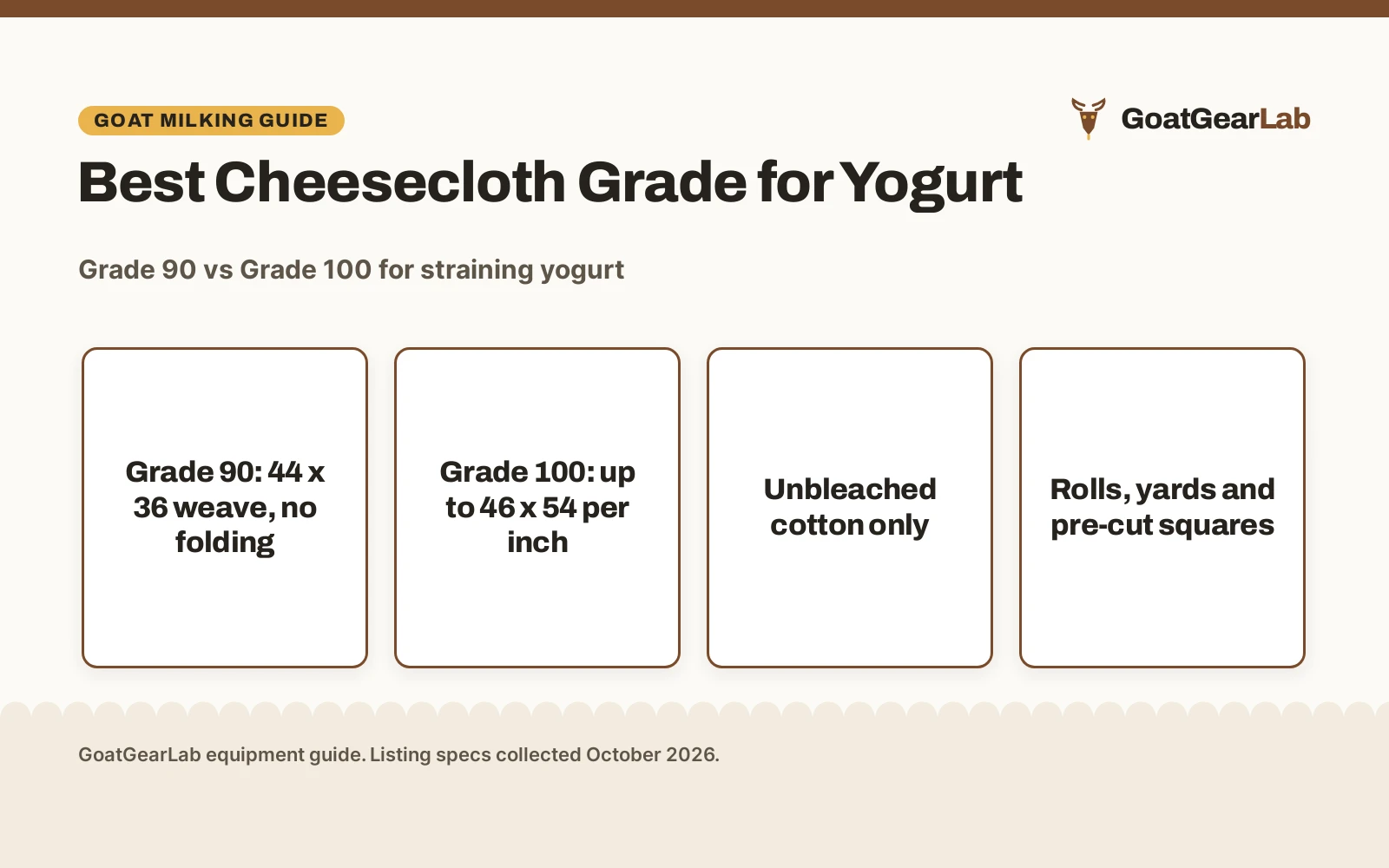
Pick Grade 90 for everyday yogurt straining: the Sufaniq and Olicity listings both give Grade 90 a 44 x 36 weave count, tight enough to strain yogurt without folding or layering. Pick Grade 100 when you want the tightest weave on the market: the Olicity organic (on Amazon) listing gives Grade 100 a 56×41 thread count, and the Dynta and Jofuler listings give 46 x 54 threads per inch. In every case choose unbleached cotton, and skip the Halloween decor gauze sold as cheesecloth: the ZYP listings describe 410 x 80 inch and 600 x 80 inch cloths for yard decorations, which are not for food. For cloth picks side by side, see our best cheesecloth for straining yogurt roundup.
What the grades mean
The grade number is a thread count rating: it describes how many threads are woven into each square inch of the cloth. A higher grade means a tighter weave, which strains finer particles and drips more slowly. The listings give three grades:
- Grade 60: the Meyeyaia listing describes a Grade 60 roll, 36 inches wide by 70 yards long, 1.85 kg, with a 0.01 inches mesh opening. It is the loosest weave here, suited to coarse jobs rather than yogurt.
- Grade 90: the Sufaniq listing gives Grade 90 a 44 x 36 weave count with a 0.02 inches mesh opening, and the Olicity listing gives the same 44×36 thread count with a 0.15 millimeters mesh opening. Both describe the weave as tight enough to strain yogurt, milk and broth without folding or layering.
- Grade 100: the Olicity organic listing gives Grade 100 a 56×41 thread count with a 0.01 inches mesh opening, while the Dynta listing gives 46 x 54 threads per inch and the Jofuler listing gives up to 46 x 54 yarns per inch. This is the tightest weave in the listings.
For yogurt, the choice is between Grade 90 and Grade 100. Grade 60 is too open for yogurt: whey and fine curds would pass straight through.
Grade 90 vs Grade 100 for yogurt
| Grade | Thread count stated | Mesh opening stated | Example listing |
|---|---|---|---|
| Grade 90 | 44 x 36 | 0.02 inches / 0.15 millimeters | Sufaniq 9 sq ft, Olicity 135 sq ft roll |
| Grade 100 | 56×41 / 46 x 54 per inch | 0.01 inches | Olicity organic 36×36, Dynta 8-pack, Jofuler 10-pack |
Grade 90 is the practical pick for regular yogurt. The Sufaniq listing states its Grade 90 cloth strains milk, yogurt and broth without any need to fold or layer it, and the Olicity listing states the tighter weave means you use one layer instead of three when straining foods. One layer is easier to wash, dries faster and is simpler to line a colander with than a triple-folded square.
Grade 100 suits thicker results. The Jofuler listing describes its Grade 100 cloth as providing a balanced weave for smooth flow and consistent straining, and the Dynta listing states the high density filters out impurities for a more delicate, smooth result. If you strain yogurt toward a thick, spoon-standing texture, the tighter weave gets you there with less waiting. The trade is speed: a tighter weave drips more slowly, so a large batch takes longer.
Unbleached, reusable and food grade
Every yogurt-suitable listing here is unbleached cotton. The Sufaniq listing describes 100 percent pure cotton that is unbleached, dye-free and odorless, marked unbleached, lint free and reusable in the spec table. The Olicity organic listing is GOTS certified organic cotton, and the YJL listing describes food-grade, unbleached ultra-fine mesh. Unbleached matters because you do not want residual bleach leaching into food, and the S.CENG listing makes the same point about its Grade 90 cloth.
Reusability is the other detail to check. The Sufaniq listing marks its cloth reusable, the Olicity listing states it can be reused many times with a simple rinse, and the Meyeyaia listing advises washing by machine or hand while skipping detergents and fabric softeners. A cloth you can wash and reuse beats a single-use square for a weekly yogurt habit. The Dynta listing adds a practical step: boil the cloth in hot water for 5 minutes before first use.
Sizes and shapes: rolls, yards and pre-cut squares
Cheesecloth comes in three shapes, and the listings state the sizes plainly:
- Pre-cut squares: the Dynta listing gives 8 pieces of 20 x 20 inches, 6.72 ounces, and the Jofuler listing gives 10 pieces of 20 x 20 inches with hemmed edges. Pre-cut squares are ready to line a colander with no cutting.
- Yard cuts: the Sufaniq listing gives 9 sq feet (1 square yard) at 36 x 36 x 0.1 inches and 1.12 ounces, and the Olicity organic listing gives a 36×36 inch cut at 40 g. The S.CENG listing gives 72 sq feet in an 8 yard length, 1 yard wide.
- Bulk rolls: the Olicity listing gives a Grade 90 roll of 3 x 45 ft, 135 sq ft, 1.2 pounds, and the YJL listing gives a 6 yard roll of 54 sq feet at 216 x 36 x 1.77 inches. Rolls suit a busy kitchen that strains often; cut what you need and the rest stays clean.
Hemmed edges are worth preferring. The Dynta listing describes a hemmed design so the cloth does not fray, and the Jofuler listing states securely hemmed edges add strength and prevent fraying and tearing. The Olicity listings mention closed edges for the same reason: loose threads in yogurt are the failure you are buying the cloth to avoid.
How to strain yogurt with cheesecloth
Line a colander with the cloth, set the colander over a bowl and pour the yogurt in. Grade 90 needs no folding according to the Sufaniq and Olicity listings; one layer does the job. Let the whey drip until the yogurt reaches the thickness you want, then lift the cloth by its corners and scrape the yogurt out. Rinse the cloth right away: dried yogurt is harder to wash out than fresh.
For a thicker result, give it more time rather than a second layer. The tighter Grade 100 weave slows the drip on its own, which is why the Jofuler listing pairs its 46 x 54 weave with consistent straining. Save the whey that collects in the bowl if you cook with it; the cloth’s job is only the separation.
What this guide does not cover
This guide covers cheesecloth grades for straining yogurt only. It does not cover yogurt recipes, culturing times or temperatures. For cloth comparisons by brand, see our best grade cheesecloth for making cheese guides, and browse every cheese making kit guide.
FAQs from goat keepers
What grade cheesecloth is best for straining yogurt?
Grade 90 for everyday straining, Grade 100 for the thickest results. The listings give Grade 90 a 44 x 36 weave and Grade 100 up to 46 x 54 threads per inch, both in unbleached cotton.
Do I need to fold Grade 90 cheesecloth for yogurt?
No. The Sufaniq listing states its Grade 90 cloth strains yogurt without any need to fold or layer it, and the Olicity listing states one layer replaces three with a tighter weave.
Is Grade 100 better than Grade 90 for yogurt?
It is tighter, not automatically better. Grade 100 gives a finer strain for thicker yogurt but drips more slowly. Grade 90 strains faster and needs no folding, which suits a weekly batch.
Should cheesecloth for yogurt be bleached or unbleached?
Unbleached. Every yogurt-suitable listing here is unbleached cotton, so no bleach residue reaches the food. The Olicity organic listing adds GOTS certification for its organic cotton.
Can I reuse cheesecloth after straining yogurt?
Yes. The Sufaniq, Olicity and Meyeyaia listings all describe their cloths as washable and reusable. Rinse right after use, wash without fabric softener and air dry.
More from the barn
See every cheese making kit guide and all milking guides.
More picks: cheesecloth for straining yogurt, cheesecloth for greek yogurt, grade cheesecloth for making cheese and goat milking.