

On this page
Top picks at a glance
As an Amazon Associate I earn from qualifying purchases.
- 1
 Vacuum Pump 50 L/Min with SwitchView on Amazon
- 2
 Vacuum Pump OilView on Amazon
The pump that lost suction halfway through morning milking is the real question behind dry vs oil lubricated vacuum pump. A dry vacuum pump moves air with a diaphragm or piston and no oil in the pumping chamber, so there is nothing to change and nothing to spill. An oil lubricated vacuum pump bathes its moving parts in oil, which seals and cools them for heavier, longer duty at the cost of oil changes and oil checks. This guide explains what each pump type does, which chores each suits and the listed flow rates and noise figures to compare. Every number below comes from a product listing; where a listing gives no figure, we say so.
Also worth comparing
 Vacuum Pump 50 L/Min with SwitchCheck price on Amazon
 Vacuum Pump OilCheck price on Amazon
GoatGearLab earns a commission when you buy through links on this page, at no extra cost to you. As an Amazon Associate I earn from qualifying purchases. Affiliate disclosure.
Dry vs oil lubricated vacuum pump: the short answer
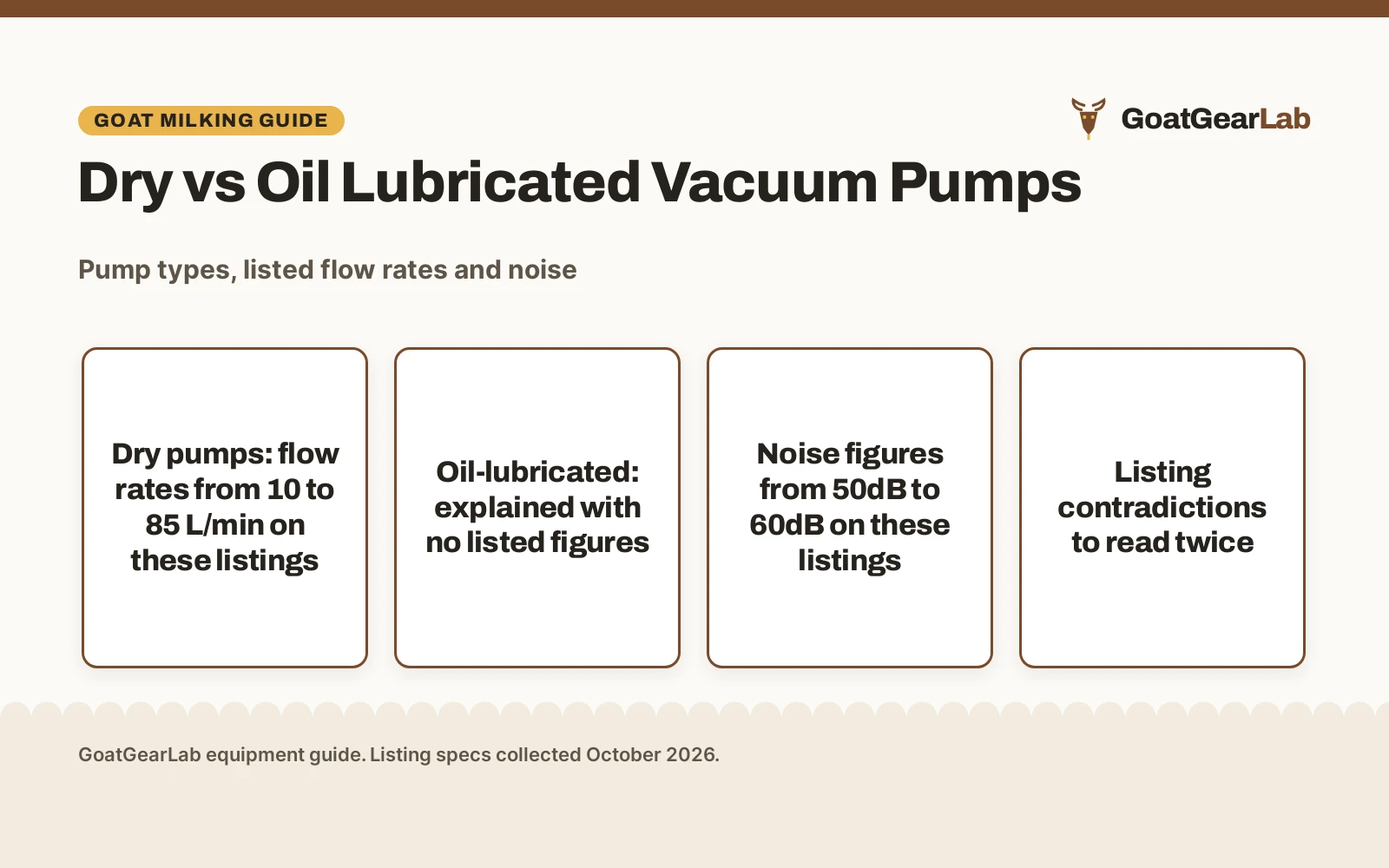
Pick a dry pump when you want the simplest upkeep: no oil to check, no oil to change and no oil mist near the milk. The dry listings here state flow rates from 10 to 85 liters per minute and noise figures from 50dB to 60dB, which covers small milking setups and bench work. Pick an oil lubricated pump when the pump runs long hours every day: oil seals and cools the moving parts, which suits continuous duty, at the cost of regular oil changes and oil-level checks. If you would rather go straight to the products, our best goat milking machine roundup scores milking machines on these points.
How a dry (oil-free) vacuum pump works
A dry pump uses a diaphragm or a piston to move air, with no oil anywhere in the pumping chamber. Every vacuum pump listing we compared is this type: oil-free by design. The ScitoLAB 50L/min listing states an oil-free pump at 180W with -85Kpa and a vacuum meter, and says it can operate without any lubrication. The Win Outdoor HZW-165 listing states a 2-stage oil-free pump at 50L/min with noise reduced to 55dB(A) and a motor running at 1400 RPM.
The appeal is the lack of a maintenance schedule. The GOYOJO listing states that no oil changes or oil-level monitoring are required, and the LVDALAB listings state oil-free operation with no oil mist for a clean vacuum path. The trade-off is heat and wear: the listings address this with silencers, cooling fins and double fans, and the ScitoLAB 50L/min listing says one model can run more than 20 hours without overheating. Flow rates on these listings run from 10 to 15 L/min (GOYOJO, LVDALAB), to 23 L/min (Rocker 300, at 1750 RPM and 50 dB), to 24 L/min (Win TC-100A, at -95Kpa), to 50 L/min (ScitoLAB, Win Outdoor), up to 85 L/min (ScitoLAB 85L/min at 180W with noise at or under 57dB).
How an oil lubricated vacuum pump works
An oil lubricated pump runs its moving parts in oil, which seals the chamber, carries heat away and cushions the parts against wear. That makes it the usual pick for pumps that run for long stretches every day: the oil bath handles continuous duty better than a dry chamber, and the seal tends to hold a steadier vacuum under load. None of the reference listings we compared is an oil lubricated pump; they are all oil-free models, so the figures here about oil pumps are the setup explained, not a listed spec.
The cost is maintenance you cannot skip. An oil pump needs its oil level checked and its oil changed on the maker’s schedule, and it needs an oil mist filter so oil vapor does not drift where it should not. Spilled oil in the barn and used oil to dispose of come with the territory. For a pump that runs an hour at milking time and then rests, that upkeep buys little; for a pump that runs all day, it is the price of steady performance.
Dry vs oil lubricated at a glance
| Pump type | How it works | Listed flow rates | Suits | Watch for |
|---|---|---|---|---|
| Dry (oil-free) | Diaphragm or piston, no oil in the chamber | 10 to 85 L/min on these listings | Simple upkeep, clean vacuum path | Heat and wear on long continuous runs |
| Oil lubricated | Moving parts run in an oil bath | Not stated on these listings | Long daily duty, steadier vacuum | Oil changes, oil checks, oil mist |
Which should you buy?
Match the pump to how long it runs. If the pump runs at milking time and rests between, a dry pump from these listings covers the job with no oil schedule: the LVDALAB mini at 10 L/min and 2.6 lbs suits a bench or a small setup, while the ScitoLAB 85L/min at 180W covers larger demand. The Rocker 300 listing states 23 LPM at 1750 RPM with 50 dB noise and overflow protection, which suits a setup where quiet matters.
If the pump runs most of the day, every day, an oil lubricated pump earns its keep through the oil bath’s sealing and cooling, and you accept the oil changes as part of the routine. Compare the listed flow rate to your demand: the GOYOJO lists 10 to 15 L/min with dual ports for pump and blow, while the Win TC-100A lists 24 L/min. Read our goat milking machines guides for how pumps pair with buckets and pulsators.
Read the listing twice
Vacuum pump listings contradict themselves, and the flow rate is the usual place it happens:
- Win Outdoor HZW-165: the title states a 2-stage 50L/min pump while the application notes say not to pump liquid or oil, which matters more for an oil-free pump.
- ScitoLAB 16-18 L/min: the listing states a 5 watt pump moving 16 to 18 liters per minute, which is far less power than the 180W models at similar or higher flow rates.
- Rocker 300: the spec table states no warranty, while the other listings here state warranty terms or say nothing; note the stated term before you buy.
Trust the title and bullets over the spec table, and confirm the flow rate and the oil-free statement in the title or bullets before you buy: every figure in these listings is named there, not buried in the specs.
What this guide does not cover
This guide covers pump types only. It does not cover pump sizing for a specific herd, vacuum level settings or any animal health question. For health questions, ask your veterinarian.
FAQs from goat keepers
What is the difference between a dry and an oil lubricated vacuum pump?
A dry pump moves air with a diaphragm or piston and no oil in the chamber, while an oil lubricated pump runs its moving parts in an oil bath. Dry pumps need no oil changes; oil pumps need oil checks and oil changes on the maker’s schedule.
What flow rates do dry vacuum pumps list?
These dry listings state 10 to 15 L/min (GOYOJO, LVDALAB), 23 L/min (Rocker 300), 24 L/min (Win TC-100A), 50 L/min (ScitoLAB, Win Outdoor) and 85 L/min (ScitoLAB). Match the flow rate to your setup’s demand.
Are dry vacuum pumps quiet?
These listings state noise figures from 50 dB (Rocker 300) to 55dB(A) (Win Outdoor HZW-165) to under 60dB (LVDALAB) to 57dB or less (ScitoLAB 85L/min). Compare the noise figure on the listing you are reading.
Do dry pumps overheat?
Heat management is stated on several listings: silencers, cooling fins and double fans. The ScitoLAB 50L/min listing says one model can run more than 20 hours without overheating, and the Win Outdoor listing states a motor at 1400 RPM for less wear.
When does an oil lubricated pump pay off?
When the pump runs long hours every day: the oil bath seals and cools the moving parts for continuous duty. For a pump that runs at milking time and rests between, a dry pump means no oil schedule.
More from the barn
See every goat milking machine guide and all milking guides.
More picks: best goat milking machines and milking guides.