

On this page
Top picks at a glance
As an Amazon Associate I earn from qualifying purchases.
- 1
 FZIFZI Electric Poultry Netting9.7/10View on Amazon
- 2
 Goldenrod 405 Fence Stretcher-Splicer for High Tensile9.6/10View on Amazon
- 3
 Electric Fence NettingView on Amazon
- 4
 RentACoop Poultry Netting Electric FenceView on Amazon
- 5
 Electric NettingView on Amazon
- 6
 Electric Poultry Netting 48" x 82' Electric Poultry NettingView on Amazon
- 7All-Purpose Utility NettingView on Amazon
- 8
 All-Purpose Electric Utility NettingView on Amazon
The electric netting vs barbed wire question has a clear answer for goats: choose electric netting. Electric netting gives a portable, electrified mesh that trains goats to respect the fence, while barbed wire is a sharp steel wire that injures goats without containing them reliably. Barbed wire belongs on cattle fence, not goat fence. This guide explains how each works, what the listings state, and where each fits.
Also worth comparing
 Electric Fence NettingCheck price on Amazon
 RentACoop Poultry Netting Electric FenceCheck price on Amazon
 Electric NettingCheck price on Amazon
 Electric Poultry Netting 48" x 82' Electric Poultry NettingCheck price on Amazon
- All-Purpose Utility NettingCheck price on Amazon
 All-Purpose Electric Utility NettingCheck price on Amazon
GoatGearLab earns a commission when you buy through links on this page, at no extra cost to you. As an Amazon Associate I earn from qualifying purchases. Affiliate disclosure.
Electric netting vs barbed wire: the short answer
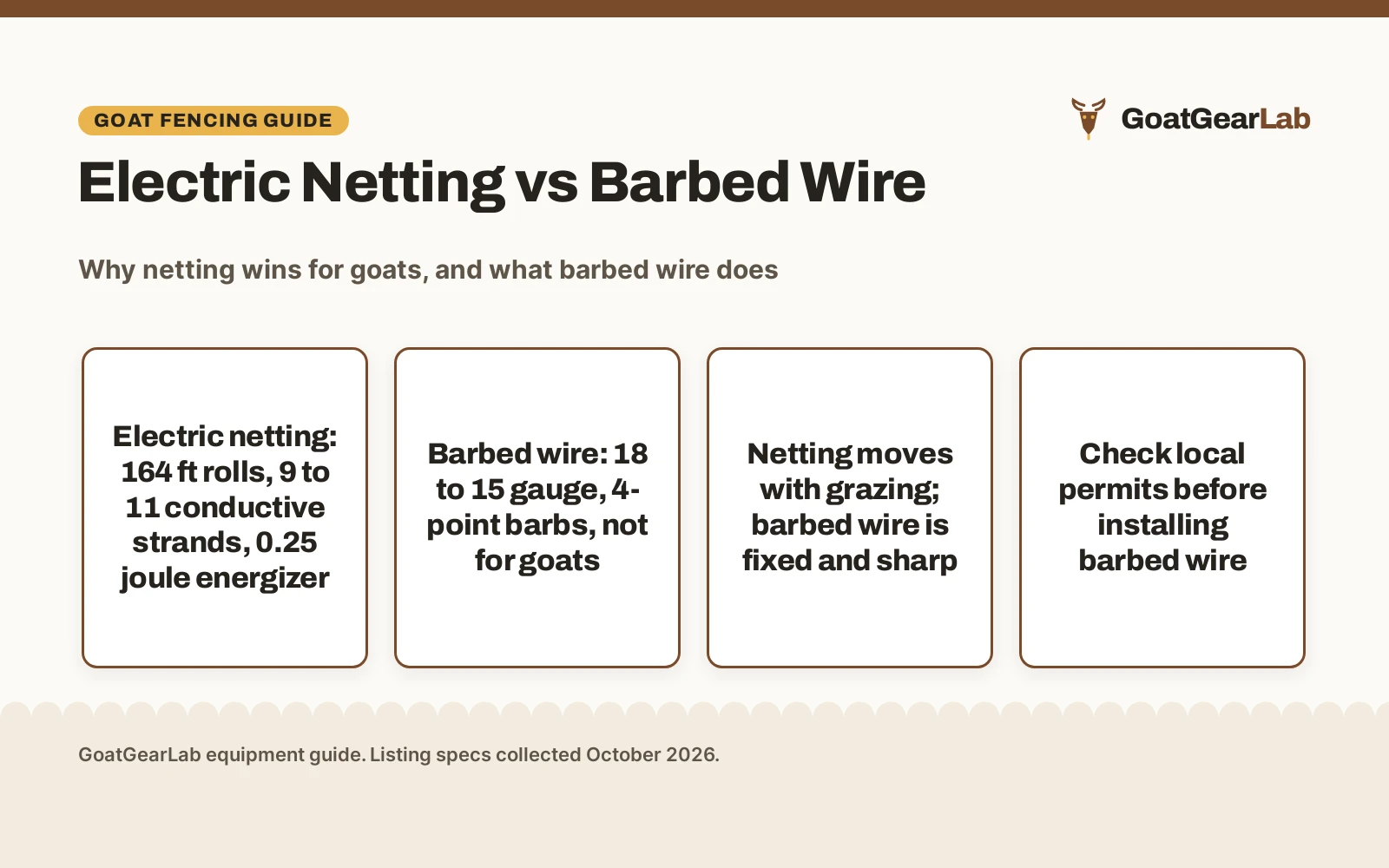
Pick electric netting for goats: the PPOLB listings describe 164 ft rolls with 11 to 14 horizontal strands, 9 to 11 of them conductive, needing a 0.25 joule energizer. The netting is portable, moves with the grazing plan, and delivers a safe low-impedance shock. Skip barbed wire for goats entirely: the listings describe 18 to 15 gauge sharp wire with 4-point barbs at 4 to 5 in spacing, and it tears hides without teaching the animal anything. Every number below comes from one of these listings.
How electric netting works
Strands and posts
The PPOLB 47.5 in netting lists 14 horizontal strands with 11 conductive, and the 41.5 in version lists 11 strands with 9 conductive, both with triple-braided stainless steel wire. Built-in glass fibre rods sit every 12.5 to 13.1 ft to hold the mesh up. The 164 ft rolls weigh 15.21 and 17.2 pounds, light enough to move by hand. Energizer, grounding rod and two connector clips are required and not included.
What the shock does
The listing describes a low-impedance electric shock that is safe and humane for animals and humans, and it warns against continuous-current energizers. Goats learn the boundary after one or two contacts, which is why netting works for rotational grazing. A 0.25 joule solar or AC/DC energizer is the stated recommendation.
How barbed wire works
Gauge and barbs
The barbed wire listings run from 18 gauge on the Dlh western, YAGJIA 25 ft and AggFencer examples to 16 gauge on the YAGJIA 50 and 328 ft examples, up to 15 gauge (1.7 mm) on the MOEUFFIR examples. All are 4-point barbs at 4 or 5 in spacing, double-twisted wire, galvanized against rust. Roll lengths run from 25 ft to 1320 ft. The MOEUFFIR 328 ft roll weighs 12 pounds and states 400 MPa tensile strength.
Why it fails for goats
Barbed wire deters by pain, not by training: goats push through it, tear their hides and get tangled. It cannot be moved quickly, and it offers no shock to teach the boundary. The YAGJIA listings include gloves and warn that the barbs are sharp, which tells the whole story. Keep barbed wire off goat fence.
Installation and portability
Electric netting unrolls, steps in with its built-in rods and moves to the next paddock the same day, per the PPOLB listings. Barbed wire needs posts, tensioning and gloves, and the AggFencer listing advises checking local wire fence permits before installation. For a permanent goat perimeter, woven wire beats both; for movable electric fence, netting beats barbed wire every time. For netting picks, see our best electric netting for goats; for the barbed wire comparison, see our barbed wire vs electric fence.
What this guide does not cover
This guide does not cover energizers; netting only works with a low-impedance energizer, never a continuous-current one. It does not cover woven wire fence, which is the standard permanent goat perimeter. For netting comparisons, see our electric netting vs poly wire.
FAQs from goat keepers
Is barbed wire safe for goats?
No. The listings describe sharp 4-point barbs at 4 to 5 in spacing that tear hides, and goats push through barbed wire instead of respecting it. Electric netting trains the boundary with a safe shock instead.
How much fence does one netting roll cover?
The PPOLB listings are 164 ft long, at 47.5 or 41.5 in tall. Barbed wire rolls here run from 25 ft to 1320 ft but need multiple strands per fence line.
What energizer does electric netting need?
The PPOLB listing recommends a 0.25 joule solar or AC/DC energizer, plus a grounding rod and two connector clips. It warns not to use continuous-current energizers with netting.
Can electric netting move with rotational grazing?
Yes. The listing calls it lightweight and portable, with built-in glass fibre rods every 12.5 to 13.1 ft, and it can be relocated without leaving a permanent structure.
Do I need a permit for barbed wire?
The AggFencer listing advises checking local wire fence permits before installation. Rules vary by area, so check before buying.
More from the barn
See every goat fencing guide and all fencing and shelter guides.
More picks: electric netting for goats, barbed wire vs electric fence, electric netting vs poly wire and fence stretchers for barbed wire.