

On this page
Top picks at a glance
As an Amazon Associate I earn from qualifying purchases.
- 1
 Martx 5x5ft Round Bale Hay Net9.7/10View on Amazon
- 2
 Bloomoak Slow Hay Net Feeder for Horses9.6/10View on Amazon
- 3
 Partrade Ultra Slow Feeder Hay Net Black9.6/10View on Amazon
- 4
 Weaver Equine Slow Feed Hay Net 36in BlackView on Amazon
- 5
 Harrison Howard 2 PCS Slow Feed Hay Net for HorsesView on Amazon
- 6
 Aoneky Bale Hay Net -Average Feed Haynet for HorsesView on Amazon
- 7
 5x5 ft Round Bale Hay Net for HorsesView on Amazon
- 8
 Tough 1 Slow Feed Hay Net Brand: Tough 1View on Amazon
- 9
 Slow Feed Hay NetView on Amazon
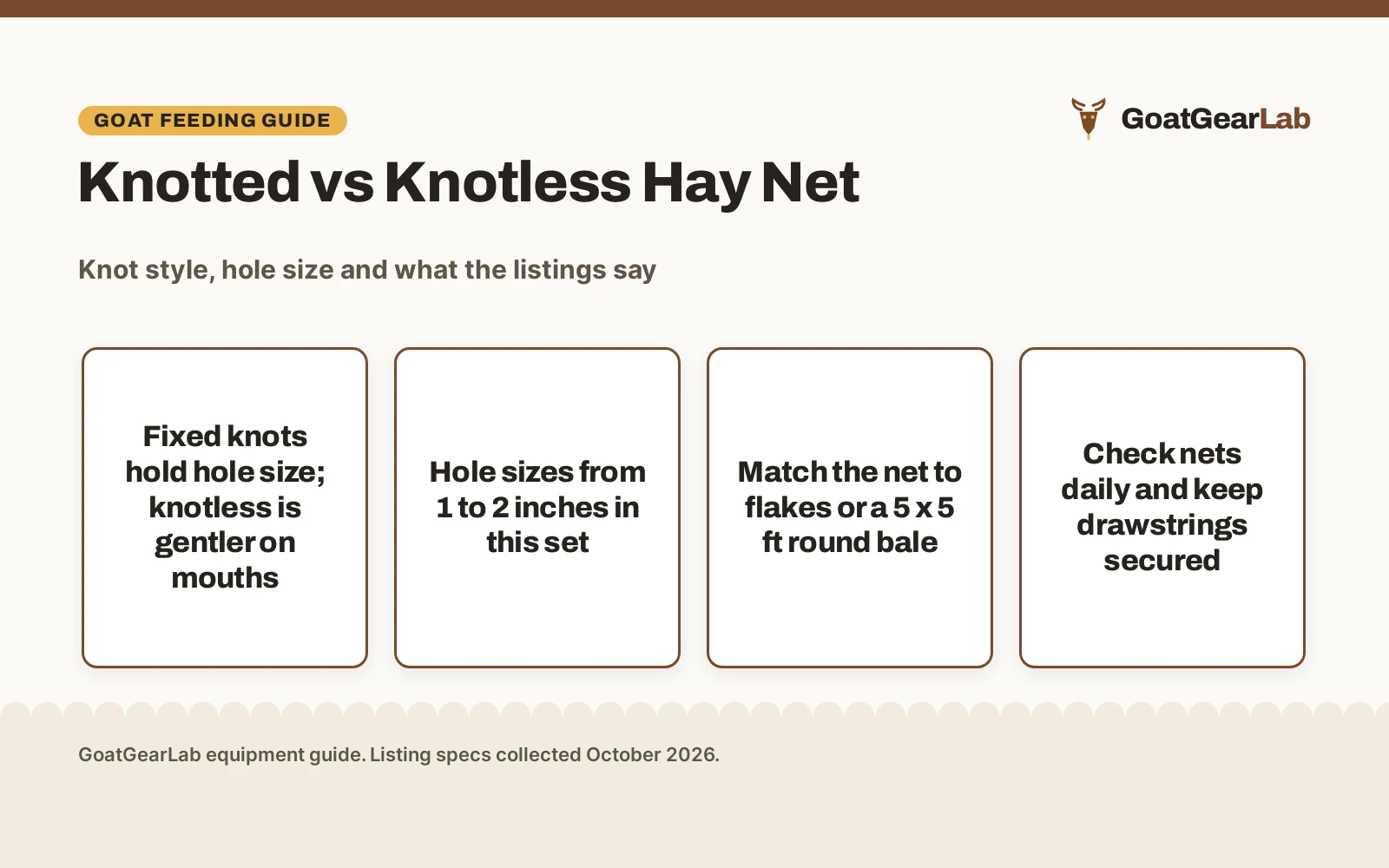
Knotted hay nets use fixed knots that hold the hole size steady when goats pull at the mesh; knotless nets use a woven mesh with no knots, which is gentler on mouths but can stretch over time. Both slow feeding and cut waste compared to loose hay. This guide compares knotted and knotless construction using four listings we reviewed: the Hay Chix fixed-knot net, the NETYSAY knotless round-bale net, and the Weaver Equine and Harrison Howard slow-feed nets.
Also worth comparing
 Weaver Equine Slow Feed Hay Net 36in BlackCheck price on Amazon
 Harrison Howard 2 PCS Slow Feed Hay Net for HorsesCheck price on Amazon
 Aoneky Bale Hay Net -Average Feed Haynet for HorsesCheck price on Amazon
 5x5 ft Round Bale Hay Net for HorsesCheck price on Amazon
 Tough 1 Slow Feed Hay Net Brand: Tough 1Check price on Amazon
 Slow Feed Hay NetCheck price on Amazon
GoatGearLab earns a commission when you buy through links on this page, at no extra cost to you. As an Amazon Associate I earn from qualifying purchases. Affiliate disclosure.
Knotted vs knotless hay net: the short answer
Pick a knotted net when you want the hole size to stay put. The Hay Chix listing states fixed-knot construction that keeps its 1 3/4 in holes consistent, and it is handmade in Texas from marine-grade UV-treated nylon. Pick a knotless net when a softer mouth feel matters most: the NETYSAY listing describes a knotless weave that stays gentle on horses’ mouths while handling outdoor exposure and daily tension. The Weaver Equine and Harrison Howard listings are slow-feed nets whose listings do not state whether the mesh is knotted, so treat their construction as not stated.
Four nets compared
| Net | Construction stated | Hole size | Capacity |
|---|---|---|---|
| Hay Chix Half Bale | Fixed knots | 1 3/4 in | 4 to 6 flakes |
| NETYSAY 5×5 | Knotless weave | 2 in | 5 x 5 ft round bale |
| Weaver Equine 36 in | Not stated | 1 to 1.5 in | 36 in net |
| Harrison Howard 40 in | Not stated | 2 in | 1 to 2 flakes |
Knotted nets
The Hay Chix is the only listing here that states its knot style: fixed knots, handmade, with 1 3/4 in openings and a patented rope and hoggle closure for filling and hanging. The listing cites a university study showing up to 94% less hay waste than loose hay on the ground. Fixed knots resist the mesh shifting when animals pull, which keeps the slow-feed effect working over time. The Weaver Equine 36 in net lists 1 to 1.5 in holes in synthetic rope and suits goats as well as horses, but its listing does not say whether it is knotted.
Knotless nets
The NETYSAY 5×5 is built for round bales: a knotless weave from quality rope, 2 in holes, a wide opening for 5 x 5 ft bales and a drawstring to keep it in place. The listing says the weave stays gentle on mouths while handling outdoor exposure and daily tension, and it ships with a PVC bag, a netting needle, braided twine and twenty reusable self-locking ties. The listing is honest about wear: all nets wear with use, and animals that chew, pull or paw aggressively wear any net faster, so check it daily.
Hole size and what it does
Hole size sets the feeding speed. The Weaver Equine lists the smallest holes here at 1 to 1.5 in, the Hay Chix lists 1 3/4 in, and the Harrison Howard and NETYSAY list 2 in. Smaller holes mean smaller bites and slower eating, which suits easy keepers; larger holes suit animals that get frustrated with a very slow net. Match the hole size to the animal and the hay: soft, easily edible hay feeds fine through small holes, while coarse stalky hay needs a bigger opening. See our best hay feeder for goats roundup for more feeder styles.
Safety notes from the listings
The NETYSAY listing gives the clearest safety guidance: check the net daily, use it with a hay ring or enclosed feeder to keep hooves clear, keep drawstrings secured, and keep the mesh and drawstrings inside the barrier. Its directions add a note for shod horses to use the net only with a hay ring or enclosed feeder. For any net, hang it where animals cannot get tangled and retire a net with broken mesh. Ask your veterinarian or local extension office about rations and goat health.
FAQs from goat keepers
Are knotted hay nets better than knotless?
Knotted nets hold their hole size better; the Hay Chix states fixed-knot construction for consistent 1 3/4 in holes. Knotless nets like the NETYSAY are gentler on mouths. Neither style is stated as stronger by both sides.
What hole size should a goat hay net have?
The listings here state 1 to 1.5 in, 1 3/4 in and 2 in. Smaller holes slow feeding more; pick against the animal’s patience and the coarseness of the hay.
Do hay nets really reduce waste?
The Hay Chix listing cites a university study showing up to 94% less waste than loose hay on the ground. The Harrison Howard and NETYSAY listings also claim less waste from contained feeding.
Which net fits a round bale?
The NETYSAY 5×5 is built for 5 x 5 ft round bales with a wide opening and drawstring. The other three are sized for flakes: 4 to 6 flakes, 1 to 2 flakes, or a 36 in net.
See every hay feeder guide and all feeding and water guides.
More picks: best hay feeders for goats, slow feed hay nets for goats and hay nets for square bales.