

On this page
Top picks at a glance
As an Amazon Associate I earn from qualifying purchases.
- 1
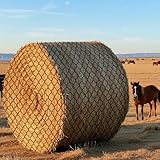 Sancunhui 5x5 ft Hay Net9.7/10View on Amazon
- 2
 BRINGERPET Hay Net 5x5 ft9.7/10View on Amazon
- 3
 NETYSAY 5x5 ft Hay Net9.6/10View on Amazon
Goats pull hay out of any feeder, drop half of it and then refuse to eat what landed in the bedding, so the bale format you buy matters as much as the feeder you hang. This guide covers the round bale vs square bale feeder question for goat keepers: how the two setups compare on waste, herd size and daily work. Every number below comes from Amazon listings for round bale hay nets, which are the feeder format the reference listings describe, and we point out where those listings contradict themselves.
GoatGearLab earns a commission when you buy through links on this page, at no extra cost to you. As an Amazon Associate I earn from qualifying purchases. Affiliate disclosure.
Round bale vs square bale feeder: the short answer
A round bale setup feeds a whole herd from one bale with less daily labor, and a net over the bale cuts waste and slows the eating. A square bale setup gives you portion control, with flakes you can hand out by the flake to a few goats, but it means daily or twice-daily feeding work. Pick the round bale side when you have several goats and want the bale to last days; pick the square bale side when you have a few goats and want to control exactly what each one eats.
The two setups compared
| Point | Round bale feeder | Square bale feeder |
|---|---|---|
| Herd size | Suits groups; one bale feeds many goats for days | Suits a few goats; flakes portioned by hand |
| Daily work | Low; net the bale and check daily | Higher; feed flakes daily or twice daily |
| Waste control | Nets with 1.2 to 2 in holes slow eating and cut waste | Feeders and racks catch what falls |
| Storage | Bales stored outdoors under cover | Bales stored dry in the barn |
| Upfront gear | Net from 15.2 oz to 11.73 lb, plus a hay ring | Rack, manger or wall feeder |
The reference listings are all round bale hay nets, so the round bale column carries listing figures and the square bale column is general guidance without figures.
How round bale feeders work
A round bale feeder is usually a net, sometimes paired with a hay ring. You pull the net over the bale, tighten the drawstring and let the goats eat through the mesh. The listings describe bale sizes from 2.6 by 2.6 ft up to 6 by 6 ft, with nets to match: the TONGMO example fits 4 by 4 ft bales, the NETYSAY examples fit 4 by 4, 5 by 5 and 6 by 6 ft bales, the kingump examples fit 5 by 5 ft and 2.6 by 2.6 ft, and the Martx example fits 4 by 4, 5 by 5 and 6 by 6 ft bales. Net weights run from 15.2 ounces on the small kingump net to 11.73 pounds on the Finerelprot 6 by 6 ft net.
The mesh is the whole point. Hole sizes in the listings run 2 inches on the TONGMO, NETYSAY, Finerelprot, SOSECCE and Gasgimos examples (Gasgimos states 1.75 inches), 1.5 inches on the kingump 5 by 5 ft and Martx examples, and 1.2 inches on the small kingump example. Smaller holes slow the goats down more and waste less, but they also take more effort to eat through. The Martx listing claims its 1.5 in holes reduce hay waste by 80 to 90 percent, which is the maker’s claim, not a measured figure.
Safety notes repeat across the listings: use the net with a hay ring or enclosed feeder to keep hooves clear, keep drawstrings inside the barrier, and check the net daily for wear. The NETYSAY and SOSECCE listings spell this out for shod horses, and the same logic applies to goats with any kind of hoof or horn that can snag. See our hay net vs hay rack guide for the net-versus-rack trade-off.
How square bale feeders work
A square bale feeder is a rack, manger, wall feeder or hay bag that holds flakes from a square bale. You break the bale into flakes and load the feeder by hand, which gives you exact control over how much each goat gets. That control is the square bale side’s main advantage: a milker in late lactation and a dry doe do not need the same ration, and flakes let you split the difference.
The trade-off is labor. Somebody has to be there with flakes once or twice a day, and the bale has to stay dry in the barn, which needs storage space a round bale does not. The reference listings carry no square bale feeder figures, so treat this section as general guidance: buy the rack for the number of goats you have, and hang it high enough that they cannot climb in.
Reading capacity against your herd
Match the bale to the head count. A 6 by 6 ft round bale feeds a large group for days; a 4 by 4 ft bale suits a smaller herd; the 2.6 by 2.6 ft kingump net is sized for a bale a couple of goats can work through. On the square bale side, count flakes per day per goat and buy bales to match, since flakes are the only unit you control.
Warranties vary on the net side: the TONGMO example states 1 year, the kingump examples state 2 years, and the Martx example states a 1 to 2 year quality term. The other listings state no warranty term. A net that gets chewed through in a season costs you the net plus the wasted hay, so the warranty is worth reading.
Materials and build
The listings describe knotless mesh as the gentle option: no knots means softer contact on mouths and less tooth wear, which the TONGMO, NETYSAY, kingump, Martx, Finerelprot and SOSECCE listings all name. The Gasgimos example is the exception, using knotted 2.5 mm thick nylon rope instead. Materials named include polyester fiber on the Martx example, polyethylene on the Finerelprot example and nylon on the Gasgimos example. For outdoor year-round use, the Martx listing claims resistance from 0 to 100 degrees, which is the maker’s claim.
Repair matters on nets. The NETYSAY and SOSECCE examples include a netting needle shuttle, braided twine and self-locking ties for repairs, and the kingump examples include a repair tool. A net you can mend lasts seasons longer than one you cannot.
Read the listing twice
Hay net listings contradict themselves often. The Finerelprot title says 6 by 6 ft while the bullets describe a 5 by 5 ft net, so confirm the size before ordering. The Martx title says 5 by 5 ft while the bullets say it fits 4 by 4, 5 by 5 and 6 by 6 ft bales. The Gasgimos title calls it a round bale net and then says square slow feed hay nets in the same line. Weights and package dimensions in the spec tables describe the shipped package, not the net’s working size, so read bale fit from the title and bullets.
What this guide does not cover
This guide does not cover grain feeding, which is a separate question once the kids start on solid feed; see our creep feeder vs bunk feeder comparison for that. It also does not cover slow-feed nets for boredom, which is a behavior question rather than a bale-format question.
FAQs from goat keepers
Do goats need a hay net on a round bale?
They do not need one, but the listings show nets cut waste and slow eating, with hole sizes from 1.2 to 2 inches.
What size net fits a 5 by 5 ft bale?
The NETYSAY, kingump and Martx examples all list 5 by 5 ft options. Confirm the title size before ordering.
Can goats share a bale with horses?
The listings name horses, goats, cattle and other livestock together. Watch for hoof and horn snags on the mesh.
How often should I check the net?
Daily, per the NETYSAY, SOSECCE and Martx listings. Check for wear, loose drawstrings and hoof contact.
More from the barn
See every goat hay feeders guide and all feeding and water guides. Also see our best slow feed hay net for boredom picks.
More picks: hay net vs hay rack, slow feed vs free choice hay and hay feeder for small barns.