

On this page
Top picks at a glance
As an Amazon Associate I earn from qualifying purchases.
- 1
 OCPO Kitchen Cheese Mold9.6/10View on Amazon
- 2
 Palksky Silicone Bar Mold9.6/10View on Amazon
- 3
 OFXDD Plastic Cheese Mold9.6/10View on Amazon
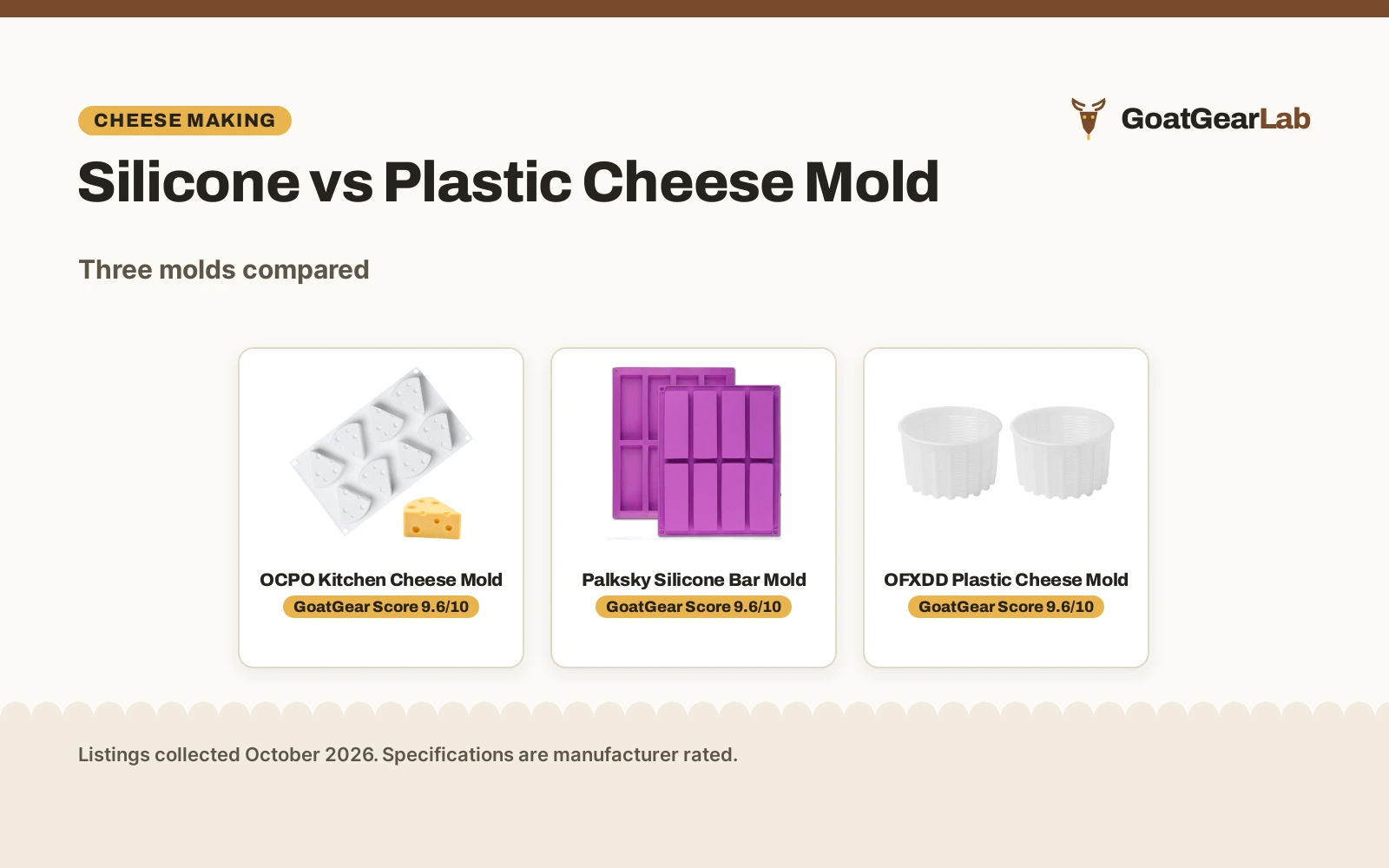
The verdict on silicone vs plastic cheese mold: pick the perforated plastic mold if you make soft cheese like ricotta, feta or camembert, because it is built to drain whey. Pick silicone if you want flexible, non-stick molds for molded desserts, mousses and shaped cheese, and you like oven-to-freezer range. The three molds below show both sides in practice: two silicone molds and one perforated plastic cheese mold.
GoatGearLab earns a commission when you buy through links on this page, at no extra cost to you. As an Amazon Associate I earn from qualifying purchases. Affiliate disclosure.
The gear we picked
| # | Product | GoatGear Score | Buy |
|---|---|---|---|
| 1 | OCPO Kitchen Cheese Mold | 9.6/10 | Buy on Amazon |
| 2 | Palksky Silicone Bar Mold | 9.6/10 | Buy on Amazon |
| 3 | OFXDD Plastic Cheese Mold | 9.6/10 | Buy on Amazon |

OCPO Kitchen Cheese Mold
An 8-cavity cheese-shaped silicone mold with 100% food-grade silicone and a wide heat range.
Pros
- 100% food-grade silicone
- Wide heat range: -76 to 446 F
- 3500 uses stated
- Non-stick, easy release
Cons
- Single mold only
- 1.34 inch depth limits tall items
- No warranty term stated
- Freezing an hour needed for best release

Palksky Silicone Bar Mold
Two 8-cavity rectangle silicone bar molds with food-grade silicone and 3000 uses stated.
Pros
- 3000 uses stated
- 2 molds per set
- Microwave, oven, freezer and dishwasher safe
- Food-grade silicone, PVC free
Cons
- Marketed for bars, not cheese
- No per-cavity volume stated
- Needs a tray for support
- No warranty term stated

OFXDD Plastic Cheese Mold
A perforated plastic cheese mold, 20 oz, two per set, built for soft cheese making.
Pros
- Purpose-built for soft cheese making
- Perforated for draining
- 2 molds per set
- PVC free
Cons
- No heat range stated
- No dimensions stated
- No warranty term stated
- Rigid plastic has no flexible release
As an Amazon Associate I earn from qualifying purchases.
Silicone vs plastic cheese mold: side by side
Silicone and plastic molds do different jobs in the cheese kitchen. The silicone side, shown by the OCPO Kitchen and Palksky examples, is flexible and non-stick: food pops out with a finger press, and the wide heat range covers oven, microwave, refrigerator and freezer. The plastic side, shown by the OFXDD example, is a rigid perforated basket built for one job: forming soft cheese while whey drains away. Flexibility and heat range are the silicone wins; drainage and purpose-built shape are the plastic wins.
The listings make the split clear. Both silicone examples state food-grade silicone with PVC-free claims, and both state a heat range that spans hundreds of degrees. The OFXDD plastic example states none of that; instead it states perforations, a 20 oz capacity and suitability for ricotta, feta and camembert. If you only make soft cheese, the plastic mold is the tool made for it. If you make molded desserts, mousses and the occasional shaped cheese, silicone covers more ground.
How each one shapes the cheese
The OCPO Kitchen example is an 8-cavity cheese-shaped silicone mold, each cavity holding 2.46 oz (73 ml). It is shaped for mousse cakes and desserts, and the listing names cheese among its uses. The non-stick surface releases food with a gentle press, and the listing suggests freezing for an hour for an even cleaner release. It is a mold for shaping, not draining: there are no perforations, so whey has nowhere to go.
The Palksky example is an 8-cavity rectangle bar mold, two molds per set. It is marketed for granola bars, brownies and chocolate rather than cheese, but the flexible food-grade silicone would shape anything poured into it. The listing recommends using a tray to hold the mold, because silicone this flexible needs support when filled with liquid.
The OFXDD example is the only true cheese mold of the three: a perforated plastic basket, 20 oz capacity, two per set, named for ricotta, feta and camembert. The perforations let whey drain while the curds set into shape. It states easy cleaning with soap and water, and a high-quality plastic resistant to warping and breaking. For soft cheese, drainage is the feature that matters, and only this side has it.
Heat range and freezer use
The OCPO Kitchen example states a heat range of -76 F to 446 F, and the Palksky example states -40 F to 446 F. Both cover microwave, oven, refrigerator, freezer and dishwasher. The OFXDD plastic example states no heat range at all, so its safe temperatures are unclear from the listing. If your process involves baking, freezing or both, the silicone side is the documented choice. If the mold only ever sees the countertop and the fridge, the plastic side needs no heat range.
Size, weight and the pieces
The OCPO Kitchen example is a single mold, 11.61 x 6.81 x 1.34 inches, weighing 0.18 kg. The Palksky example is two molds per set, each 10.5 x 8.26 x 1 inch, 6.4 ounces. The OFXDD example is two molds per set with a 20 oz capacity and a 0.09 kg item weight; no dimensions are stated. Two of the three come as pairs, so batch work is covered on both sides. The OFXDD listing leaves its dimensions unclear, which is a gap worth noting rather than a win for either side.
Warranty and listing gaps to check
None of the three listings states a concrete warranty term. The OCPO Kitchen listing offers a 24-hour reply and a satisfactory solution for dissatisfied buyers, which is a service promise rather than a warranty. The Palksky and OFXDD listings state no warranty term at all. Gaps to check before buying: the OFXDD states no dimensions and no heat range; the Palksky states no per-cavity volume; the OCPO Kitchen is a single mold, so larger batches need more than one.
Spec comparison
| Mold | Goat Score | Material | Use | Heat Range | Pieces | Amazon |
|---|---|---|---|---|---|---|
| OCPO Kitchen Cheese Mold | 9.6/10 | Silicone | Mousse, dessert, cheese | -76 to 446 F | 1 | View on Amazon |
| Palksky Silicone Bar Mold | 9.6/10 | Silicone | Bars, brownies, cheese | -40 to 446 F | 2 | View on Amazon |
| OFXDD Plastic Cheese Mold | 9.6/10 | Plastic | Ricotta, feta, camembert | Not stated | 2 | View on Amazon |
Figures come from the product pages and reflect what the maker rates, current as of 20 October 2026.
Which should you choose?
Choose the perforated plastic mold if you make ricotta, feta, camembert or other soft cheeses: drainage is the job, and the OFXDD example is built for it. Choose silicone if you shape mousses, desserts and molded cheese and want oven-to-freezer range with easy release: the OCPO Kitchen example is the most documented of the two. The Palksky example is the value play, two flexible molds for bars and brownies that can double as cheese shapers with a tray underneath. For more cheese gear, see our cheese molds for mozzarella and the plastic vs stainless cheese mold comparison.
Around the Barn
- Use a tray under silicone molds; the Palksky listing recommends one.
- Freeze an hour for easier release; the OCPO Kitchen listing suggests it.
- Perforations drain whey; the OFXDD mold is built for that job.
- Wash right after use; the OFXDD needs only soap and water.
FAQs from goat keepers
Can I use a silicone baking mold for cheese?
The OCPO Kitchen example is shaped for mousse and dessert but names cheese among its uses, and its flexible non-stick release suits molded cheese. The Palksky example is a bar mold marketed for bars and brownies rather than cheese. Neither drains whey, so they shape cheese rather than make soft cheese.
Do silicone molds handle the oven?
The Palksky example states -40 to 446 F and the OCPO Kitchen example states -76 to 446 F, both covering oven, microwave, freezer and dishwasher. The OFXDD plastic example states no heat range.
Which mold is best for soft cheese?
The OFXDD example: a perforated plastic mold with 20 oz capacity, named for ricotta, feta and camembert. The perforations drain whey while the curds set, which the silicone examples cannot do.
Behind the Farm Score
The Goat Score weighs performance, build, value, safety and warranty. For cheese molds, performance means fit for the stated use: the OFXDD scores for being purpose-built for soft cheese, the OCPO Kitchen for documented food-grade silicone and a wide heat range. Safety follows the material statements: both silicone examples state food-grade silicone. None states a warranty term, so warranty scores zero across the board. How we pick explains the weights.
| Product | GoatGear Score | Perf. /35 | Build /25 | Value /25 | Safety /10 | Warranty /5 |
|---|---|---|---|---|---|---|
| OCPO Kitchen Cheese Mold | 9.6 | 30 | 21 | 20 | 8 | 0 |
| Palksky Silicone Bar Mold | 9.6 | 29 | 20 | 21 | 8 | 0 |
| OFXDD Plastic Cheese Mold | 9.6 | 32 | 20 | 21 | 5 | 0 |
Points become a score between 9.2 and 9.8 by simple proportion, which means a higher point count always reads higher.
More from the barn
See every cheese making kit guide. Also see our cheese making kit vs cheese mold comparison.
More picks: cheese molds for mozzarella, plastic vs stainless cheese molds and cheesecloth for cream cheese.