

On this page
Top picks at a glance
As an Amazon Associate I earn from qualifying purchases.
- 1
 BOONEVE CHPR1 Wooden Cheese Press with Spring Mechanism9.6/10View on Amazon
- 2
 PetriStor 35 Cheese Press with Metal Guides and Cheese Mold9.5/10View on Amazon
- 3
 V TOWER CC-WG Wooden Cheese Slicer Board with Locking Blade9.4/10View on Amazon
The best wood for a cheese press is a hard, close-grained hardwood with no strong flavor or odor, and maple is the usual first choice. The press squeezes whey from curds under steady pressure, so the wood has to stay flat, resist denting and never flavor the cheese. This guide covers which woods to use, which to avoid, how to finish the wood, how to size boards to your mold, and where the reference listings contradict themselves. Every number below comes from a product listing; the woodworking advice comes from standard practice.
GoatGearLab earns a commission when you buy through links on this page, at no extra cost to you. As an Amazon Associate I earn from qualifying purchases. Affiliate disclosure.
Best wood for cheese press: the short answer
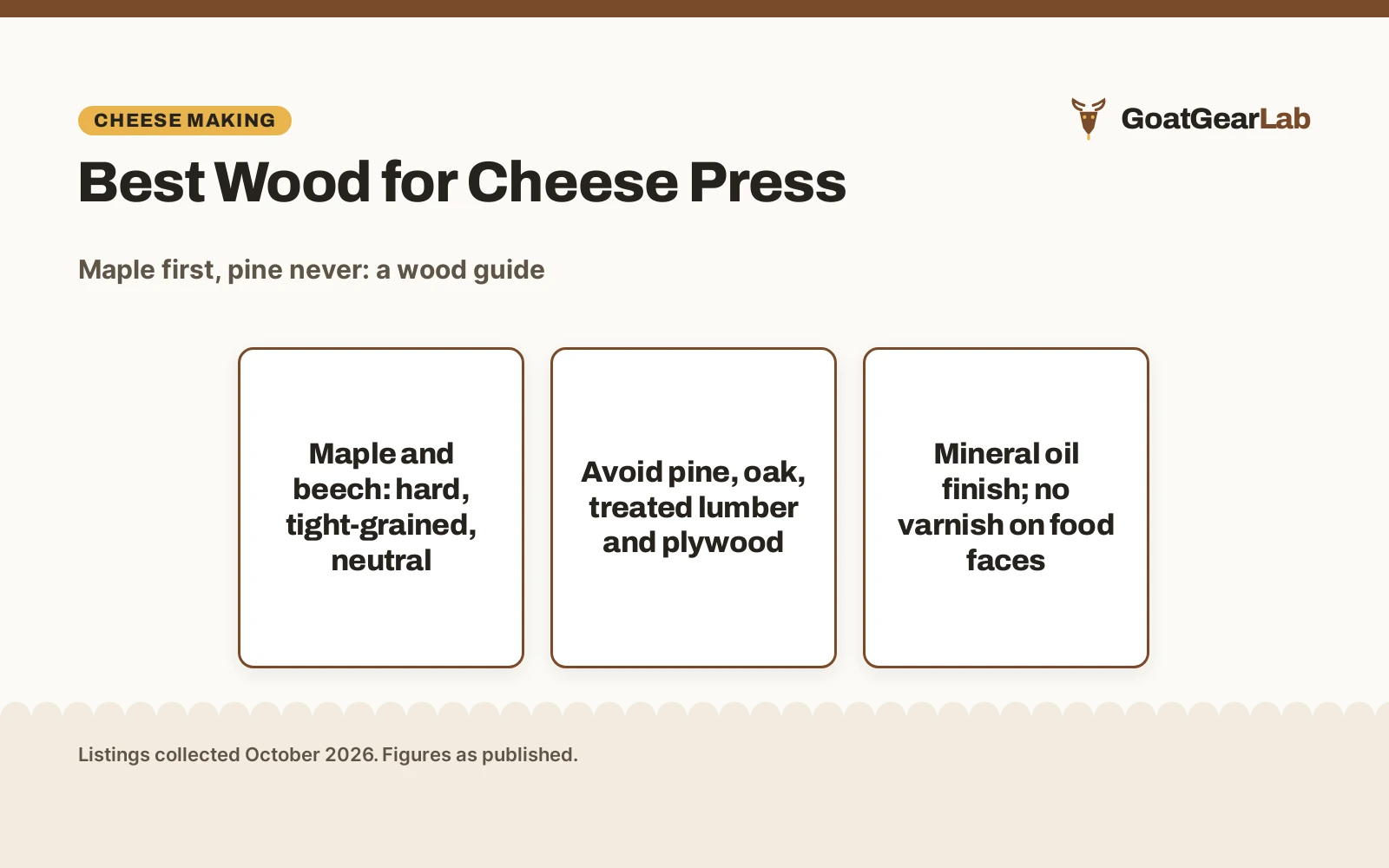
Use maple. It is hard, tight-grained, neutral in flavor and widely available as cutting-board stock, which makes it the default for press bases, followers and slatted molds. Beech is the other traditional choice and behaves much the same way. Whatever species you pick, it must be untreated, unpainted and finished with food-grade mineral oil at most. Skip pine and other softwoods, skip oak, skip pressure-treated lumber and skip plywood.
Why the wood matters
A cheese press does two things: it holds the mold steady and it drives the follower down onto the curds. The base board takes the full load, and the follower takes it on a smaller face. Soft wood dents under that pressure, and a dented follower presses unevenly, which leaves wet spots in the finished cheese. Open-grained or resinous wood is worse: it can lend flavor to the cheese and its pores hold whey that later turns rancid. Hard, tight-grained wood resists all three problems, which is why press makers keep coming back to maple.
Woods to use
Maple is the standard for a reason. It is hard enough to stay flat under a screw press, its grain is tight enough to wipe clean, and it adds no flavor of its own. Boards sold as cutting-board or butcher-block stock are usually maple and already surfaced flat, which saves work. Beech is the European equivalent and appears in traditional presses for the same reasons: hardness, tight grain and neutrality. Either one, unfinished or oiled, is a safe choice for every part of a wooden press that touches curds or whey.
Woods to avoid
Pine and other softwoods are the most common mistake. They dent under pressure, their grain is open enough to hold whey, and resinous boards can flavor the cheese. Oak is hard but its tannins can discolor curds and lend a bitter note, so it is a poor pick despite its strength. Pressure-treated lumber is out entirely: the preservatives are not food-safe and have no place near cheese. Painted, varnished or lacquered wood is out too, because the finish can flake into the curd under pressure. Plywood and particleboard hide glues and voids you cannot see, so solid stock is the only sensible choice.
Finish and care
Keep the finish minimal. Food-grade mineral oil, wiped on and buffed off, is enough to slow moisture uptake on faces that see whey. Do not use varnish, lacquer, polyurethane or any film finish on a food-contact face: it will crack under pressure and the flakes end up in the cheese. After pressing, wash the boards in hot water with plain soap, rinse well and stand them on edge to air dry. A board that stays damp will warp and then press unevenly. Replace any board that cracks or warps instead of trying to flatten it again.
Sizing the wood to your mold
Size the boards to the mold you actually own. The PetriStor listing gives a 6 inch top diameter, a 5.5 inch bottom diameter and a 2.7 inch height for its mold, with a 1.3 quart capacity, so a base board and follower should clear 6 inches across with room for the cheesecloth to wrap. The Grand Way listing gives a 1.5 L mold at 5.9 by 5.9 by 2.76 inches with a 39 by 36 inch cheesecloth, and another Grand Way listing gives a 1.6 quart mold at 7.48 by 6.3 by 4.72 inches. Cut the base a couple of inches wider than the mold on each side so the press frame has something solid to bear on, and keep the follower just under the mold’s inner width so it slides without binding.
Read the listing twice
Press and mold listings contradict themselves often enough that the numbers deserve a second look. One Grand Way listing titles the mold “1,6QT” while the spec table gives a 1.5 L capacity. The EJWOX manual press, which is hand powered, lists “Wattage: 250 watts” in its spec table. The SQUEEZE master title gives the capacity as “0.53Gallon/ 2 Litre” while its spec table gives 0.53 gallons. When a listing disagrees with itself, trust the spec table over the title, and measure your own mold before cutting wood.
What this guide does not cover
This guide covers press wood only. It does not cover pressing weights or times, cheese recipes, milk handling or any health question. Ask your local extension office about dairy practice and food safety.
FAQs from goat keepers
Can I use pine for a cheese press?
Pine is a poor choice. It dents under pressure, its open grain holds whey, and resinous boards can flavor the cheese. Use a hard, tight-grained hardwood such as maple instead.
Should I varnish the wood on my cheese press?
No. Film finishes crack under pressure and the flakes can end up in the cheese. Food-grade mineral oil at most is the right finish for any wood that touches curds or whey.
What size boards do I need?
Match your mold. The PetriStor listing gives a 6 inch top diameter, so boards should clear that with room for the cheesecloth, and the Grand Way 1.5 L mold measures 5.9 by 5.9 inches. Cut the base wider than the mold so the press frame bears on solid wood.
More from the barn
See every cheese making kit guide and all goat milking guides.
More picks: cheese presses for hard cheeses, cheese making kits with press, cheesecloth for straining yogurt and goat milking.