

On this page
Top picks at a glance
As an Amazon Associate I earn from qualifying purchases.
- 1
 VEVOR Goat Milking Machine9.7/10View on Amazon
- 2
 Hantop 6L Pro Plus Rechargeable Goat Milking Machine with9.7/10View on Amazon
- 3
 8-Pack 000U Black Silicone Milking Machine Liners9.7/10View on Amazon
- 4
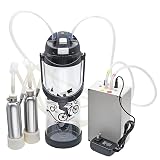 3L Cow Milking Machine Electric Pulsation Vacuum Pump CowView on Amazon
- 5
 Electric Goat Milking MachineView on Amazon
- 6
 7L Goat Milking MachineView on Amazon
- 73L Goat Milking MachineView on Amazon
- 8
 5L Goat Milking Machine Adjustable Pulsation Electric MilkerView on Amazon
- 9
 Electric Milking MachineView on Amazon
Morning milking waits for no one, and the walk to the barn with a bucket in each hand is where the portable vs stationary milking machine question gets real. The answer comes down to this: a portable machine carries pump, pulsator and bucket to the animals, while a stationary system fixes the pump in one place and brings the milk to it. We compared portable milking machine listings, from 3-liter battery units to a 25-liter cart model, to explain what each setup does and which herds each suits. Every number below comes from a product listing; where a listing gives no figure, we say so.
Also worth comparing
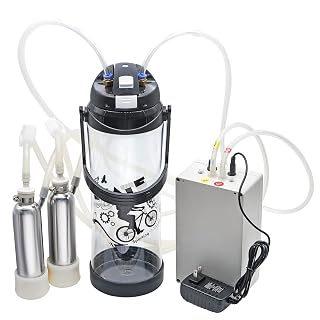 3L Cow Milking Machine Electric Pulsation Vacuum Pump CowCheck price on Amazon
 Electric Goat Milking MachineCheck price on Amazon
 7L Goat Milking MachineCheck price on Amazon
- 3L Goat Milking MachineCheck price on Amazon
 5L Goat Milking Machine Adjustable Pulsation Electric MilkerCheck price on Amazon
 Electric Milking MachineCheck price on Amazon
GoatGearLab earns a commission when you buy through links on this page, at no extra cost to you. As an Amazon Associate I earn from qualifying purchases. Affiliate disclosure.
Portable vs stationary milking machine: the short answer
Choose portable when the animals move or the herd is small: battery and corded units with 3 to 12 liter buckets that you carry to the goat. Choose stationary when the herd milks in one parlor every day: a fixed pump with lines, or a heavy cart unit that lives in the barn. If you would rather go straight to the products, our best goat milking machines roundup scores the portable picks.
How a portable milking machine works
A portable milker packs the vacuum pump, pulsator and bucket into one carryable unit. The listings show the spread: the MUDUOBAN 3-liter corded unit weighs 5.3 pounds, the Hantop 12-liter runs on a rechargeable battery with a 110 to 220V adapter and weighs 10.12 pounds, and the Enkreefi 10-liter pairs a 5200mAh battery with a 2-hour charge for 40 to 60 minutes of use. Pulsation rates run 32 to 46 per minute across the listings, and most buckets are 304 stainless steel.
Portable suits a small herd and a short walk: carry it to the stand, milk, carry it back to wash. Buckets run 3 to 12 liters on these listings, so a bigger herd means emptying mid-session. Battery units free you from the outlet: the YPSLZY lists a 13200 mAh battery for 3 hours of use, while corded units like the Nakkaa 3-liter just plug in.
What a stationary setup looks like
A stationary system fixes the pump in the milk room or barn and runs milk lines or carries buckets to it. None of the listings we compared is a true stationary pipeline system; they are all portable units. The closest is the GarveeTech: a 25-liter bucket on a steel cart with wheels, a 550W motor, 60 to 80 pulsations per minute at 45 to 50 kPa vacuum, 8.2 ft of tubing and a listed rate of 5 to 8 cows per hour, weighing 64.4 pounds. At that weight it lives in the barn rather than riding to pasture.
True stationary rigs serve bigger herds from one spot: one pump, fixed lines, buckets that stay put. The tradeoff is commitment: you milk where the system is, and installation takes planning. For a homestead with a few goats, that is more system than the chore needs; for a dairy milking twice daily in one parlor, it pays back in routine.
Portable vs stationary at a glance
| Setup | How it works | Suits | Watch for |
|---|---|---|---|
| Portable battery | Pump, pulsator and bucket in one carryable unit | Pasture, no outlet nearby | 3 to 12L buckets; charge between sessions |
| Portable corded | Plugs in, no battery to charge | Barn with outlets | Cord reach limits where you milk |
| Cart or stationary | Heavy unit or fixed pump in one place | Bigger herds, one parlor | 64.4 lbs on the listed cart unit; milk where it sits |
Which should you buy?
Count the animals and map the walk. A few goats on pasture point to portable: the 5.3-pound MUDUOBAN or a battery unit like the 10-liter Enkreefi. A barn herd milked in one place points toward the cart end of the scale: the 25-liter GarveeTech on its wheeled cart. Then match the pump type to the chore with our dry vs oil lubricated vacuum pump guide, and see the goat milking machines category for the full range.
Read the listing twice
Milking machine listings contradict themselves on capacity and speed:
- YPSLZY 3L: the title says 3 liters while the bullets claim a 14-liter capacity.
- GarveeTech: the title says 15000 RPM while the bullets say 1680 RPM.
- Hantop 12L: the spec table marks battery powered with an x, but the bullets describe a built-in rechargeable battery.
Trust the title and bullets over the spec table, and confirm the bucket size: it decides how often you empty mid-milking.
What this guide does not cover
This guide covers machine types only. It does not cover milking technique, udder health or cleaning routines, which depend on your animals and setup. Your veterinarian and the machine manual cover those.
FAQs from goat keepers
How many animals can a portable milking machine handle?
The listings do not give animal counts; they give bucket sizes from 3 to 25 liters. Smaller buckets mean more trips to empty, while the 25-liter cart unit lists 5 to 8 cows per hour.
How long does a battery milking machine run?
The YPSLZY lists a 13200 mAh battery for 3 hours of use, and the Enkreefi lists a 5200mAh battery with a 2-hour charge for 40 to 60 minutes of use. Charge between milkings.
What pulsation rates do these listings give?
Listings state 32 to 42 per minute on the Aowoil, Zlshmoee and ZFNWXFP units, 40 to 46 on the YPSLZY, 43 to 46 on the Enkreefi and PKNYBZN, and 60 to 80 per minute on the GarveeTech.
Do I need a stationary system for goats?
None of these listings is a stationary pipeline system. For a small goat herd, a portable unit with a 3 to 12 liter bucket covers the chore; the cart-style 25-liter unit suits bigger herds milked in one place.
More from the barn
See every goat milking machine guide and all milking guides.
More picks: best goat milking machines, dry vs oil vacuum pumps and milking guides.