

On this page
Top picks at a glance
As an Amazon Associate I earn from qualifying purchases.
- 1
 Zareba EAC100M-Z9.6/10View on Amazon
- 2
 Epoify 1.6J Solar Charger9.5/10View on Amazon
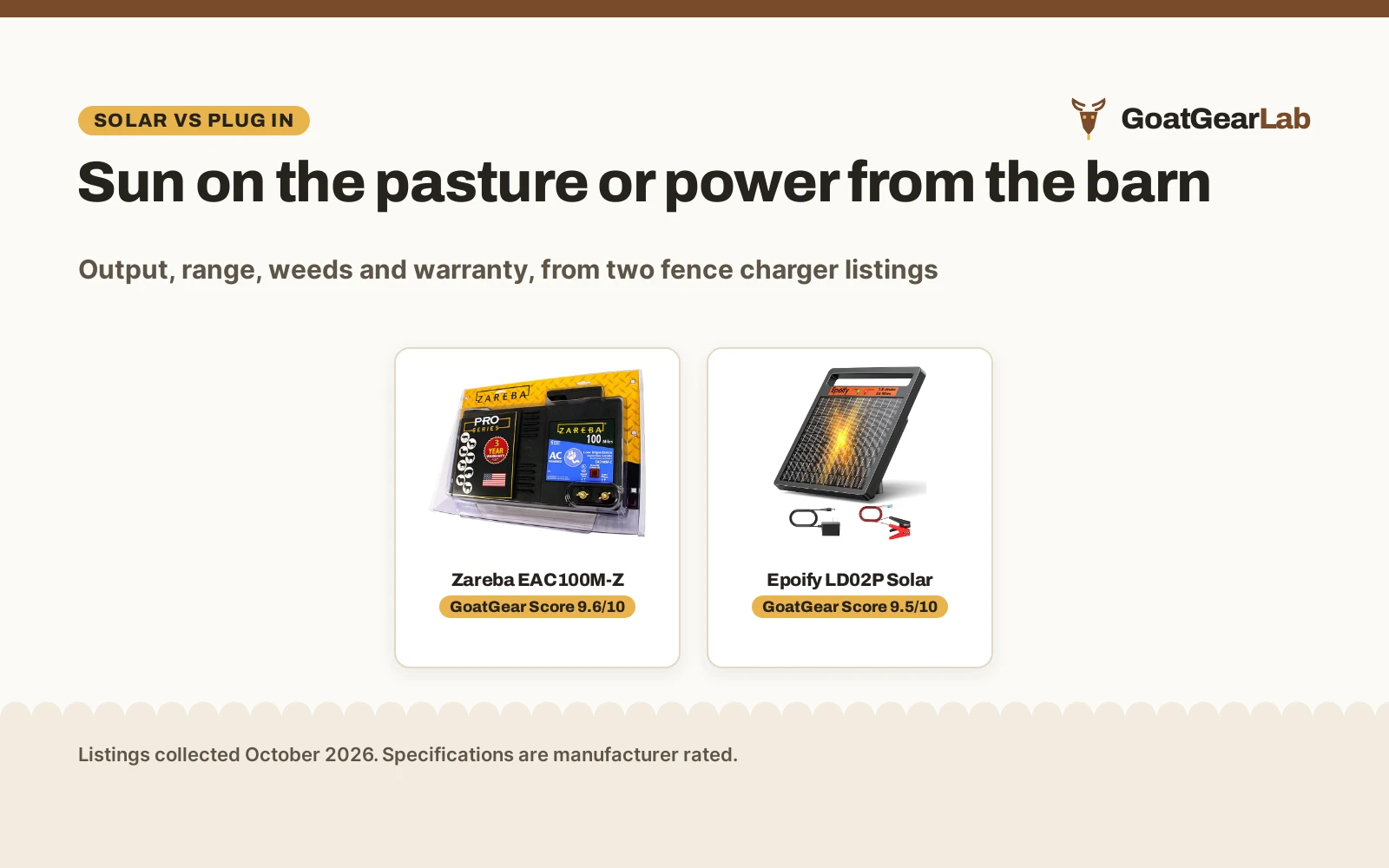
The solar vs plug in fence charger choice comes down to one question for most goat keepers: is there an outlet where the fence starts? A plug-in charger like the Zareba EAC100M-Z draws steady power from the barn, while a solar charger like the Epoify LD02P runs on its own panel out on the pasture. We compared these two listings on output, rated range, weed handling, setup, warranty and the gaps each listing leaves, using only what each Amazon page publishes.
GoatGearLab earns a commission when you buy through links on this page, at no extra cost to you. As an Amazon Associate I earn from qualifying purchases. Affiliate disclosure.
Quick verdict: choose the plug-in side if your fence starts near an outlet and you want the most output for long or weedy lines, as the Zareba example shows with 6 joules at 75 ohms. Choose the solar side if your goats graze far from power or move between paddocks, as the Epoify example shows with an 8W panel and a 1.6J output. These two units sit in different power classes, so read this as a comparison of power sources first and of models second.
Two examples

Zareba EAC100M-Z
An AC powered low impedance charger that the listing rates for up to 100 miles of fence, with 6 joule output at 75 ohms.
Pros
- Highest stated range in this group at 100 miles
- 6 joule output at 75 ohms, per the bullets
- Works in heavy weed conditions, according to the listing
- 2-year limited warranty with lightning damage, 3 years with registration
Cons
- Goats are not named; the title speaks of small animals in general
- No lightning or surge protection is listed in the bullets, only in the warranty line
- Spec table weight of 8.1 pounds is the heaviest unit in this group

Epoify 1.6J Solar Charger
A solar energizer with a stated 1.6J output, an 8-watt solar panel and a 12-month manufacturer warranty.
Pros
- 1.6J rating with an 11 kilovolt output stated
- 8-watt solar panel, which the bullets call larger than standard
- Short circuit alarm flags vegetation, broken wires or loose connections, per the bullets
- Stated 12-month manufacturer warranty
Cons
- The 55-mile coverage is the maker's figure, with no fence setup given
- Its 12-month warranty is shorter than the 3-year term on the Red Sizzle
- The 1.6J rating is lower than the 4.5 joules output stated for the PROOVEELLY
As an Amazon Associate I earn from qualifying purchases.
Also worth comparing
 Zareba ESP2M-Z Solar Powered Low Impedance Electric FenceCheck price on Amazon
 24-Hour Solar Electric Fence ChargerCheck price on Amazon
 Solar Fence ChargerCheck price on Amazon
 Solar Electric Fence Charger 5 MilesCheck price on Amazon
 Solar Electric Fence Charger 10 MilesCheck price on Amazon
 Gallagher S6 Solar Electric Fence Charger with 328ft TurboCheck price on Amazon
Solar vs plug in fence charger: side by side
| Charger | GoatGear Score | Power | Output | Rated range | Warranty |
|---|---|---|---|---|---|
| Zareba EAC100M-Z | 9.6/10 | AC plug-in | 6 J at 75 ohms | 100 miles | 2-year limited, 3 with registration |
| Epoify LD02P Solar | 9.5/10 | 8 W solar panel, AC adapter included | 1.6 J | 55 miles | 12-month |
Figures come from the product pages and reflect what the maker rates, current as of 15 October 2026.
Power source and where the charger can sit
A plug-in charger has to live within reach of a standard outlet. The Zareba listing describes an AC powered unit, so it usually mounts in a barn, shed or garage, with a lead-out wire running to the fence. That works well for a home paddock or a fence line that starts at the barn wall.
A solar charger carries its own power. The Epoify listing describes an 8W solar panel that charges the unit, and it adds an included AC adapter for cloudy weather and winter. That combination is useful: you can run the LD02P on the sun in a back pasture and plug it in near the barn when the days are short. For more solar options sized for small paddocks, see our best solar fence charger for remote pastures picks.
Output joules and rated range
Output joules describe how much energy each pulse carries. The Zareba EAC100M-Z lists 6 joules at 75 ohms and a rating of up to 100 miles of fence. The Epoify LD02P lists 1.6 joules and up to 55 miles, with an 11 kilovolt output voltage in its spec table. On paper the plug-in unit carries well over three times the output of the solar unit.
Rated miles are a maker figure for ideal conditions, and neither listing explains how its mileage was worked out. Most small goat setups run far less fence than either rating. Use the joule figure to compare power between units, and treat the miles as an upper ceiling rather than a plan. Our best electric fence charger for goats roundup lists more units by output.
Weeds and grounding
Weeds that touch the wire pull energy out of every pulse. The Zareba listing calls the EAC100M-Z a low impedance charger and says it works in heavy weed conditions, though it gives no separate mileage for heavy weeds. The Epoify listing does not state a weed rating. Instead it lists a short circuit alarm that warns when vegetation, broken wires or loose fence connections reduce performance, which helps you find the problem on a long walk of the fence line.
Neither listing mentions ground rods in the box. Both units need a ground system, so budget for rods, clamps and insulated wire whichever power source you choose.
Size, weight and controls
The Epoify spec table gives 8.2 x 4.3 x 6.6 inches and 5.5 pounds in an ABS housing, small enough to move between paddocks. An external magnetic switch turns the unit off without opening the enclosure, which the listing pitches for daily fence checks. The Zareba listing gives an 8.1 pound weight and an LCD display, but no dimensions. A display helps you read the fence at a glance each morning from the barn.
Warranty and listing gaps to check
The Zareba listing states a 2-year limited warranty including lightning damage, extended to 3 years with product registration. The Epoify spec table states a 12-month manufacturer warranty. Lightning coverage is worth noting for any charger wired to a long fence. Gaps remain on both pages: Zareba gives no dimensions and no heavy-weed range, and Epoify gives no weed rating and no detail on battery type or runtime without sun. Confirm those points with the seller if they decide your purchase.
Which should you choose?
Choose a plug-in fence charger if the fence starts within reach of an outlet, the line is long or weedy, and you want the most output per pulse, as the Zareba EAC100M-Z shows. Plug-in units also suit permanent perimeter fences around a home paddock.
Choose a solar fence charger if your goats graze far from power, you move electric netting for goats between paddocks, or you want one unit that can run on the sun or an adapter, as the Epoify LD02P shows. Keepers who rotate paddocks can also compare our best electric fence charger for rotational grazing picks.
Whichever you pick, the listings describe containment as a maker claim. Walk the fence after storms and keep the bottom wire clear.
Around the Barn
- Mount a plug-in charger indoors, out of reach of goats, as its manual directs.
- Face a solar panel toward open sky and wipe dust and snow off it.
- Check the display or alarm each morning before turning goats out.
- Clear weeds from the lowest wire, where goats graze first.
FAQs from goat keepers
Is a solar or plug in fence charger better for goats?
It depends on where your fence starts. The plug-in Zareba EAC100M-Z lists 6 joules at 75 ohms and suits fences near an outlet. The solar Epoify LD02P lists 1.6 joules with an 8W panel and an AC adapter, and suits pastures far from power or paddocks you move often.
Do solar fence chargers work in winter?
Solar output drops on short, cloudy days. The Epoify LD02P listing addresses this with an included AC adapter that keeps the fence powered through cloudy weather and winter. The listing does not state how long the unit runs on its own without sun, so plan a backup if your winters are dark.
How many joules does a plug in fence charger have?
Output varies by model. The Zareba EAC100M-Z in this comparison lists 6 joules at 75 ohms and a range of up to 100 miles. Our goat fence charger roundup covers plug-in units from 1.0 to 2.0 joules for smaller paddocks near the barn.
Do fence chargers come with a warranty?
These two do. The Zareba listing states a 2-year limited warranty including lightning damage, 3 years with registration. The Epoify spec table states a 12-month manufacturer warranty. Several low-cost chargers state no warranty term at all, so check the listing before you buy.
Behind the Farm Score
| Product | GoatGear Score | Perf. /35 | Build /25 | Value /25 | Safety /10 | Warranty /5 |
|---|
Points become a score between 9.2 and 9.8 by simple proportion, which means a higher point count always reads higher.
The GoatGear Score weighs performance, build, value, safety and warranty. For fence chargers, safety points need a stated certification such as a UL listing; neither of these two listings states one, so both score zero there. The Zareba earns its lead on output, its low impedance design and the longer warranty with lightning coverage. The Epoify scores well on value and flexibility thanks to its panel, AC adapter and fault alarm, and its 12-month warranty earns some points. How we pick explains the weights.
More from the barn
See every fence charger guide and all fencing and shelter guides. Also see our solar vs battery fence charger.
More picks: fence chargers for goats, chargers for Nigerian Dwarf goats, solar chargers for homesteads and goat shelters.