

On this page
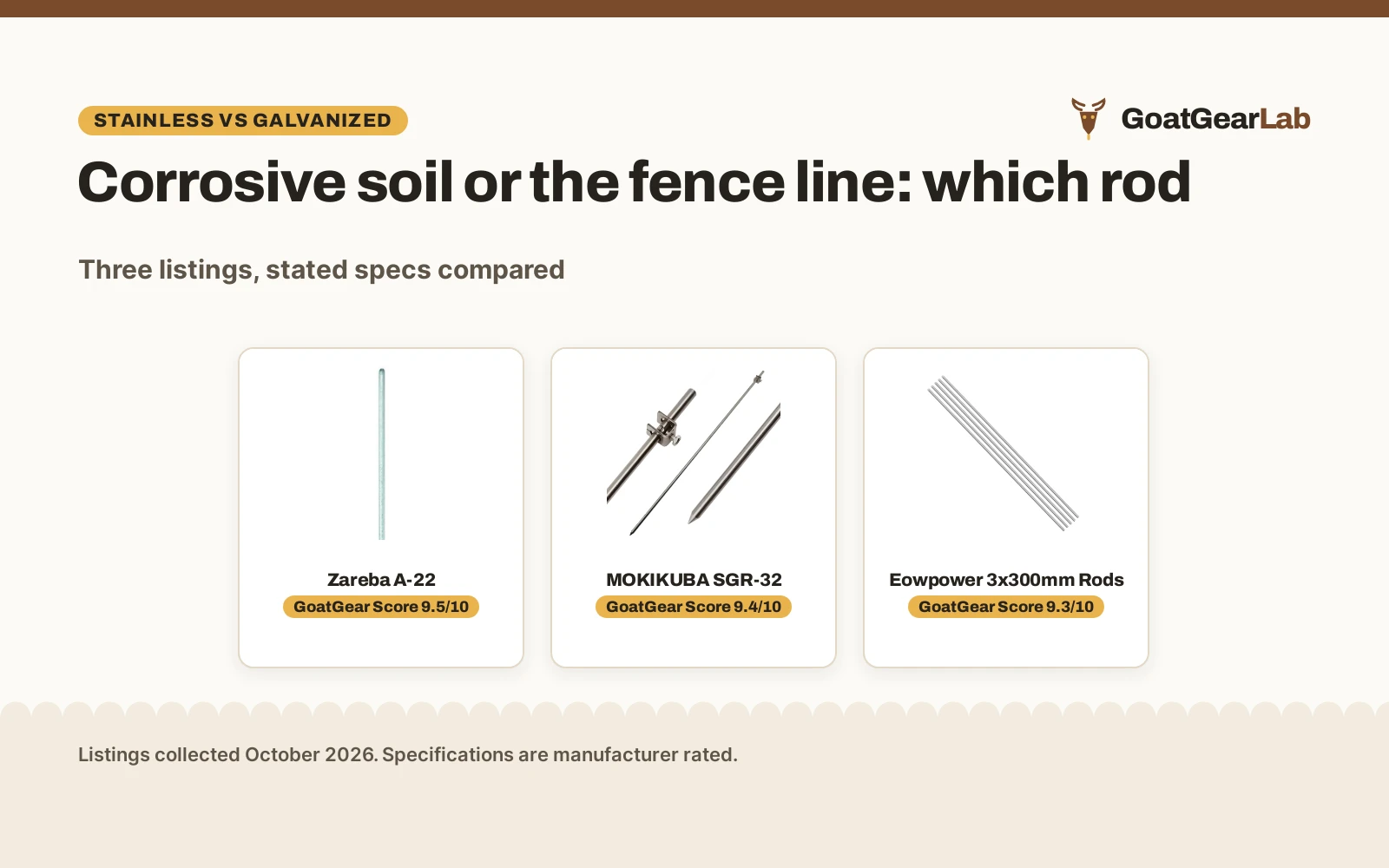
Top picks at a glance
As an Amazon Associate I earn from qualifying purchases.
- 1
 Zareba A-229.5/10View on Amazon
- 2
 MOKIKUBA SGR-329.4/10View on Amazon
- 3
 Eowpower 3x300mm Rods9.3/10View on Amazon
The goats lean on the fence line every morning, and the charger clicks away on its post, so the ground rod under it matters more than most keepers think. The stainless vs galvanized ground rod question comes down to soil and listing honesty: one side resists corrosion, the other is the standard fence-line workhorse. We compared three listings, two stainless examples and one galvanized, on stated material, length, diameter, weight and included hardware, using only what each listing publishes.
GoatGearLab earns a commission when you buy through links on this page, at no extra cost to you. As an Amazon Associate I earn from qualifying purchases. Affiliate disclosure.
Quick verdict: choose stainless if the soil is highly corrosive, as the MOKIKUBA SGR-32 example shows with 304 stainless steel stated for grounding use in highly corrosive soils. Choose galvanized for a standard electric fence ground, as the Zareba A-22 example shows with an 8-foot galvanized rod built for fence chargers. The Eowpower listing is 304 stainless rod stock for DIY projects, not a ground rod, so it does not decide the comparison.
Three examples
| # | Product | GoatGear Score | Buy |
|---|---|---|---|
| 1 | Zareba A-22 | 9.5/10 | Buy on Amazon |
| 2 | MOKIKUBA SGR-32 | 9.4/10 | Buy on Amazon |
| 3 | Eowpower 3x300mm Rods | 9.3/10 | Buy on Amazon |

Zareba A-22
An 8-foot galvanized steel ground rod with a 5/8-inch diameter and tapered end, built for grounding electric fence chargers.
Pros
- 8-foot length and 5/8-inch diameter are stated
- Tapered end stated for easy installation
- Galvanized steel construction stated for durability in the elements
- 6.4-pound weight stated in the spec table
Cons
- No clamp or connection hardware is listed as included
- No warranty term is stated
- The conductivity claim is the maker claim with no stated figure

MOKIKUBA SGR-32
A 32-inch 304 stainless steel ground rod with a tapered driving spike and preinstalled stainless clamp posts for multiple wire positions.
Pros
- 304 stainless steel (EN 1.4301) stated, for grounding use in highly corrosive soils
- 85,000 psi minimum tensile strength stated
- Preinstalled non-sliding stainless clamp posts support multiple wire positions
- 32-inch length with 3/8-inch diameter and tapered driving spike stated
Cons
- Specification Met reads only True, with no standard named
- No warranty term is stated
- Single pack only; the listing names no multi-rod option

Eowpower 3x300mm Rods
A 5-piece set of 304 stainless steel round rods, 3 mm by 300 mm, listed as DIY raw material rather than a ground rod.
Pros
- 304 stainless steel stated
- 5 pieces stated in the package
- 3 mm diameter and 300 mm length stated
- 47 g item weight stated
Cons
- The listing describes DIY raw material for punch pins, gear shafts and models, not grounding use
- No clamp, spike or grounding hardware is stated
- No warranty term is stated
- Diameter is stated in millimeters while the ground rods state inches, so compare carefully
As an Amazon Associate I earn from qualifying purchases.
Also worth comparing
 12 inches Long 1/4" Diameter 304 Stainless Steel Solid RoundCheck price on Amazon
 Portable Grounding RodCheck price on Amazon
 18" Portable Ground Rod L-shaped Galvanized Steel GroundingCheck price on Amazon
 815860Upc Galvanized Ground RodCheck price on Amazon
 SkywalkerCheck price on Amazon
 SDS-Plus Ground Rod Driver for 5/8 Inch and 3/4 Inch GroundCheck price on Amazon
Stainless vs galvanized ground rod: side by side
| Ground rod | GoatGear Score | Material | Length | Diameter | Weight | Warranty | Amazon |
|---|---|---|---|---|---|---|---|
| Zareba A-22 | 9.5/10 | Galvanized steel | 8 ft | 5/8 in | 6.4 pounds | Not stated | View on Amazon |
| MOKIKUBA SGR-32 | 9.4/10 | 304 stainless steel | 32 inch | 3/8 inch | 0.5 kg | Not stated | View on Amazon |
| Eowpower 3x300mm Rods | 9.3/10 | 304 stainless steel | 300 mm | 3 mm | 47 g | Not stated | View on Amazon |
Every spec repeats the brand’s rating from its listing (collected on 22 October 2026).
What each listing actually states
The Zareba A-22 states an 8-foot length, a 5/8-inch diameter, a 6.4-pound weight and galvanized steel construction with a tapered end for easy installation. The MOKIKUBA SGR-32 states a 32-inch length, a 3/8-inch diameter, 304 stainless steel (EN 1.4301), an 85,000 psi minimum tensile strength, a tapered driving spike and preinstalled stainless clamp posts for multiple ground wire positions. The Eowpower listing states 5 pieces of 3 mm by 300 mm round rod at 47 g, described as DIY raw material. One listing describes each rod only, so read every figure as belonging to that listing alone.
| Ground rod | Material | Length | Diameter |
|---|---|---|---|
| Zareba A-22 | Galvanized steel | 8 ft | 5/8 in |
| MOKIKUBA SGR-32 | 304 stainless steel | 32 inch | 3/8 inch |
| Eowpower rods | 304 stainless steel | 300 mm | 3 mm |
Figures as stated in each listing. The two ground rods state length in feet and inches while the rod stock states millimeters, so read each row in its own units.
Corrosion claims, clamps and gaps
The MOKIKUBA listing states 304 stainless steel for grounding use in highly corrosive soils, and it is the only one of the three that includes connection hardware: preinstalled non-sliding stainless steel clamp posts supporting multiple ground wire positions. The Zareba listing states galvanized steel for added durability to withstand the elements and names fence chargers as the purpose, but it lists no clamp or connection hardware as included. Neither listing states a warranty term, and the MOKIKUBA spec table lists Specification Met as True with no standard named, which tells the buyer nothing. If a corrosion comparison matters for your soil, see our stainless vs copper ground rod comparison.
The odd one out
The Eowpower listing is tagged to the stainless side, but it is 5 pieces of 3 by 300 mm round rod stock for DIY use: punch pins, gear shafts and models of ships and cars. It states no grounding use, no clamp and no tapered driving end. It is included because the tag put it here, and it scores lowest because the topic is ground rods. For fence grounding picks that state their purpose, see our best ground rod for electric fence roundup.
Which should you choose?
Choose stainless if the ground sits in highly corrosive soil, as the MOKIKUBA SGR-32 example shows with 304 stainless steel stated for that use and clamp posts included. Choose galvanized if the job is a standard electric fence ground, as the Zareba A-22 example shows with its 8-foot length and fence-charger purpose. If the charger wiring is copper, read our copper vs steel ground rod comparison before you buy.
Around the Barn
- Drive the rod tapered-end first; the Zareba and MOKIKUBA listings both state a tapered end.
- Connect ground wires to the MOKIKUBA preinstalled stainless clamp posts, which support multiple wire positions.
- The Zareba rod states 6.4 pounds and 8 ft, so carry it to the fence line before driving it in.
- Keep the Eowpower rods on the workbench; the listing describes DIY raw material, not a ground rod.
FAQs from goat keepers
Is a stainless or galvanized ground rod better for an electric fence?
The Zareba galvanized example is built for fence chargers at 8 ft and 5/8 in. The MOKIKUBA stainless example is stated for highly corrosive soils at 32 inches and 3/8 in. Match the rod to the soil and the charger rather than to the material name alone.
What lengths do these listings state?
The Zareba states 8 ft, the MOKIKUBA states 32 inch, and the Eowpower rod stock states 300 mm per rod.
Do any of these state a warranty term?
No. None of the three listings states a warranty term, so all three score zero on warranty.
Can I use the Eowpower stainless rods as a ground rod?
The listing does not say so. It describes 5 pieces of 3 by 300 mm rod stock for DIY projects such as punch pins, gear shafts and models, with no grounding use, clamp or tapered end stated.
What does 304 stainless mean in these listings?
It is the maker-stated grade: both stainless listings state 304 stainless steel, and the MOKIKUBA adds EN 1.4301 and an 85,000 psi minimum tensile strength. We report the grade as stated without adding our own claims.
Behind the Farm Score
| Product | GoatGear Score | Perf. /35 | Build /25 | Value /25 | Safety /10 | Warranty /5 |
|---|---|---|---|---|---|---|
| Zareba A-22 | 9.5 | 30 | 21 | 21 | 0 | 0 |
| MOKIKUBA SGR-32 | 9.4 | 29 | 20 | 20 | 0 | 0 |
| Eowpower 3x300mm Rods | 9.3 | 23 | 18 | 18 | 0 | 0 |
We translate each weighted point total onto the 9.2 through 9.8 band; ranks never flip, because the conversion is linear.
The GoatGear Score weighs performance, build, value, safety and warranty. For ground rods, safety points need a stated safety certification; none of the three listings states one, so all three score zero there, and none states a warranty term, so all three score zero on warranty. The Zareba leads on stated completeness for fence use: 8-foot length, 5/8-inch diameter, 6.4-pound weight and a tapered end. The MOKIKUBA follows with 304 stainless, an 85,000 psi tensile figure and included clamp posts, but loses points for the spec table dimension error. The Eowpower scores lowest because it is rod stock, not a ground rod. How we pick explains the weights.
More from the barn
See every Goat Fencing guide and all Fencing and Shelter guides.
More picks: ground rods for electric fences, copper vs steel ground rods, stainless vs copper ground rods and galvanized vs stainless fence staples.