

On this page
Top picks at a glance
As an Amazon Associate I earn from qualifying purchases.
- 1
 FarmNix EF-03 AC 4J9.6/10View on Amazon
- 2
 L-FENCE LYDITE AC 4.5J9.5/10View on Amazon
- 3
 ONTISIV Solar Battery 0.4J9.4/10View on Amazon
- 4
 FenceMate FM B50 B Battery9.4/10View on Amazon
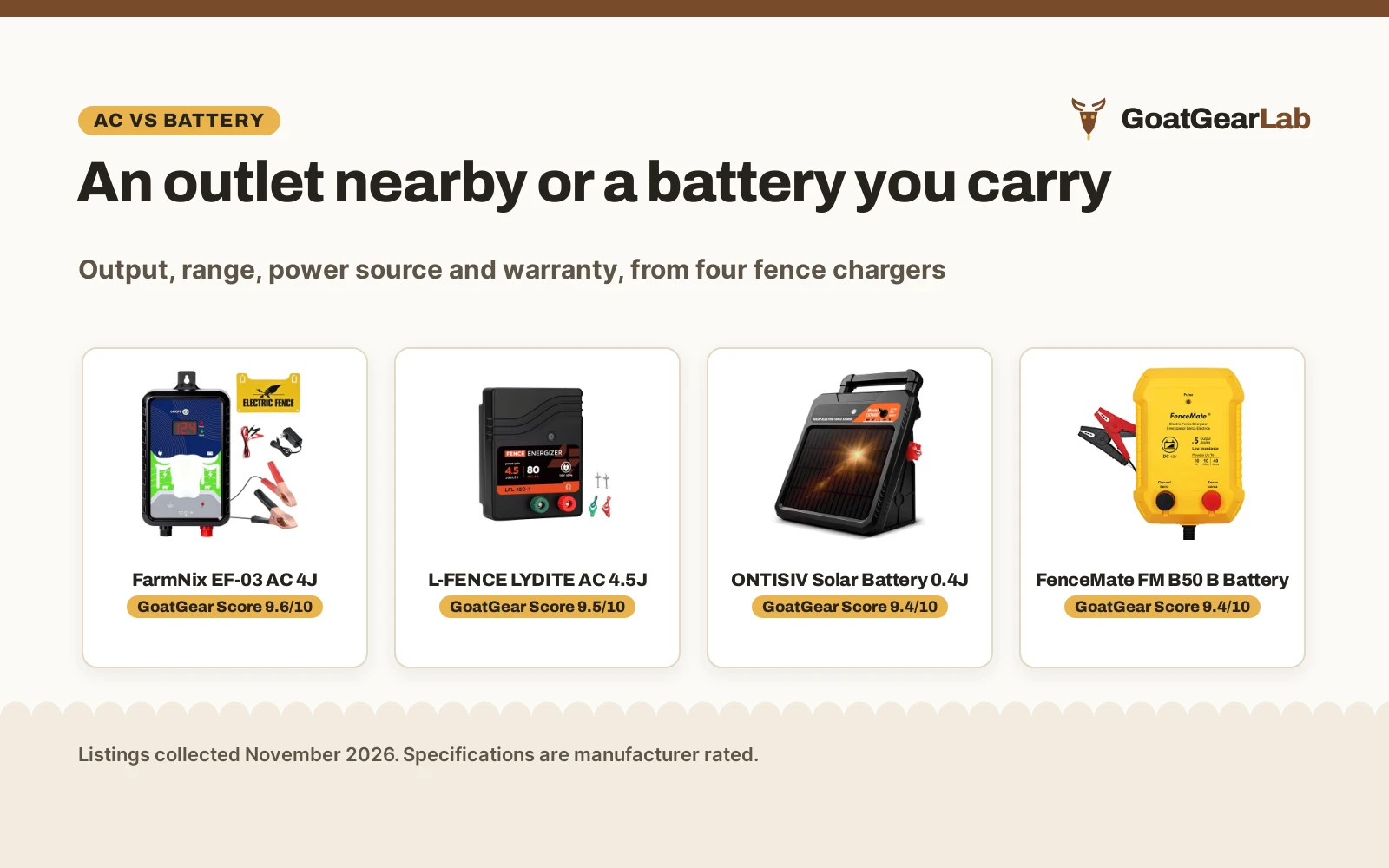
A goat leaning on the fence at milking time, nudging every wire with her nose, is the reason the ac vs battery fence charger question matters more than the fence itself. The question comes down to where the fence sits: near an outlet, an AC charger gives steady power without a battery to tend, while a battery charger suits a fence far from the barn. We compared four chargers, two on each side, on output, range, power and contents.
GoatGearLab earns a commission when you buy through links on this page, at no extra cost to you. As an Amazon Associate I earn from qualifying purchases. Affiliate disclosure.
Quick verdict: choose the AC side if the fence runs near an outlet and covers a long line, as the L-FENCE example shows. Choose the battery side if the fence sits far from power or moves with the herd, as the ONTISIV example shows.
Four examples
| # | Product | GoatGear Score | Buy |
|---|---|---|---|
| 1 | FarmNix EF-03 AC 4J | 9.6/10 | Buy on Amazon |
| 2 | L-FENCE LYDITE AC 4.5J | 9.5/10 | Buy on Amazon |
| 3 | ONTISIV Solar Battery 0.4J | 9.4/10 | Buy on Amazon |
| 4 | FenceMate FM B50 B Battery | 9.4/10 | Buy on Amazon |

FarmNix EF-03 AC 4J
An AC powered fence charger with a 4 joule output, a 12 kV maximum and a 15 mile rating, with three power methods and a waterproof housing.
Pros
- 4 joule output with a 12 kV maximum and a 1 second pulse interval
- Three power methods: AC outlet, DC battery or solar
- Waterproof housing rated from -20 °C to +60 °C
- Kit includes warning signs, LED display and connection cables
Cons
- Battery and solar panel sold separately for the DC and solar methods
- 15 mile rating is the lowest on the AC side
- No warranty term is stated
- No usable weight is stated for planning a mount
L-FENCE LYDITE AC 4.5J
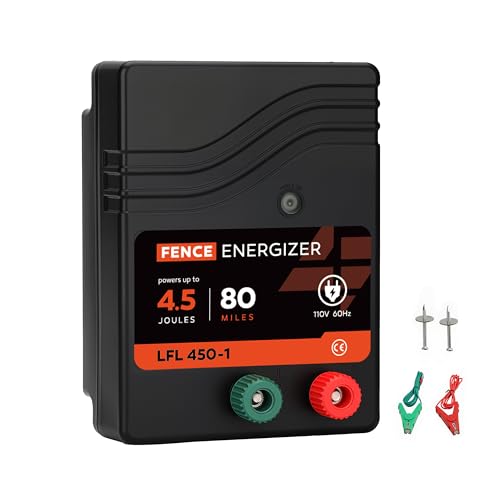
An AC powered fence charger with a 4.5 joule output, a 10 kV maximum and a rated coverage of 80 miles and 250 acres, with a one-year warranty.
Pros
- 4.5 joule output with a 10 kV maximum and 6.5 kV at 500 ohms
- Rated coverage of 80 miles and 250 acres, the longest range in this comparison
- Indicator lights show operating status, with separate ground and fence terminals
- One-year warranty stated
Cons
- Not waterproof, so it needs shelter from rain outdoors
- AC power only, so the fence must sit near an outlet
- No weight or dimensions stated for planning a mount
- No pulse interval is stated

ONTISIV Solar Battery 0.4J
A solar fence charger with a 12 volt 4.5 Ah battery, a 0.4 joule output and a 10.2 kV maximum, rated for 20 miles with a 28-day backup.
Pros
- Solar panel plus a 12V 4.5Ah GEL battery for day and night operation
- 28-day backup capability for extended cloudy periods
- 20 mile rating with a 10.2 kV maximum output
- Front-facing mode switch with auto and night modes, and three pre-drilled mounting holes
Cons
- 0.4 joule output is the lowest in this comparison
- No warranty term is stated
- Panel must face sunlight, so placement matters
- No weight stated for planning a mount

FenceMate FM B50 B Battery
A battery powered fence charger with a 0.5 joule output and a peak of 10 kV, rated up to 10 miles, with a one year limited warranty.
Pros
- 0.5 joule output with a 10 kV peak and 4.8 kV under a 500 ohm load
- Rated up to 10 miles, with 2.5 miles in average conditions stated
- Lightning protection included, with a rainproof design
- One year limited warranty, stated as 12 calendar months
Cons
- Battery is not included, so a DC 12V battery is needed before first use
- Rainproof but better indoors or under shelter, so it needs a dry spot
- Rated range drops to around 2.5 miles in average conditions
- No pulse interval is stated
As an Amazon Associate I earn from qualifying purchases.
Ac vs battery fence charger: side by side
| Charger | GoatGear Score | Power | Output | Rated range | Battery | Weight | Amazon |
|---|---|---|---|---|---|---|---|
| FarmNix EF-03 AC 4J | 9.6/10 | AC outlet, DC battery or solar | 4 joules, 12 kV | 15 miles | Battery and panel sold separately | Not stated clearly | View on Amazon |
| L-FENCE LYDITE AC 4.5J | 9.5/10 | 110V 60Hz AC | 4.5 joules, 10 kV max | 80 miles, 250 acres | No battery, AC powered | Not stated | View on Amazon |
| ONTISIV Solar Battery 0.4J | 9.4/10 | Solar panel, 12V battery | 0.4 joules, 10.2 kV max | 20 miles | 12V 4.5Ah GEL, included | Not stated | View on Amazon |
| FenceMate FM B50 B Battery | 9.4/10 | DC 12V battery | 0.5 joules, 10 kV peak | Up to 10 miles | Not included | Not stated | View on Amazon |
Sizes and capacities are the manufacturer’s numbers as each listing states them, pulled 22 November 2026.
How each side keeps the fence live
An AC charger plugs into an outlet. The L-FENCE unit runs from a 110V 60Hz supply and needs no battery at all. The FarmNix unit also runs from an AC outlet, but it adds a DC battery and solar power, with the battery and solar panel sold separately.
A battery charger carries its power with it. The ONTISIV unit pairs a solar panel with a 12V 4.5Ah GEL battery, so it charges by day and runs the fence from the battery at night, with a 28-day backup capability for cloudy periods. The FenceMate unit runs from a DC 12V battery, which is not included, so the keeper buys a battery, charges it at home and swaps it when the fence weakens. For fences far from any outlet, see our best solar fence charger for remote pastures picks.
Output joules and rated range
All four makers state a joule figure. The L-FENCE unit lists 4.5 joules with a 10 kV maximum and 6.5 kV at 500 ohms, and the FarmNix unit lists 4 joules with a 12 kV maximum and a 1 second pulse interval. On the battery side, the ONTISIV unit lists 0.4 joules with a 10.2 kV maximum, and the FenceMate unit lists 0.5 joules with a 10 kV peak and 4.8 kV under a 500 ohm load.
Rated miles are a maker figure. The L-FENCE unit claims 80 miles and 250 acres, the ONTISIV unit claims 20 miles, the FarmNix unit claims 15 miles, and the FenceMate unit claims up to 10 miles on a single wire with no vegetation, and around 2.5 miles in average conditions. Treat miles as a ceiling; compare power by joules. Our best electric fence charger for goats roundup lists more units by stated output.
Weeds, animals and what each maker names
Weeds touching the wire pull energy out of every pulse. The FenceMate maker is candid here: the 10 mile figure needs a single wire with no vegetation, while average conditions with several wires and low vegetation give around 2.5 miles, so the bottom wire needs to stay clear. The other three makers give no weed rating. None of the four names goats in its use line. Size the fence line and the wire or electric netting for goats around the output the maker states.
Size, weight and the box
None of the four gives a usable weight. The FarmNix listing gives 1.0 inch dimensions that cannot describe a fence charger, so no usable size is stated for that unit, and the FenceMate dimensions are given with far more precision than a buyer can use. The L-FENCE and ONTISIV makers state no size or weight at all. The FarmNix kit is the fullest: main unit, cables, power adapter, user manual and a warning sign. The ONTISIV kit includes an alligator clip.
Warranty and gaps to check
Two of the four state a warranty term. The L-FENCE maker states a one-year warranty, and the FenceMate maker states a one year limited warranty for a period of 12 calendar months. The FarmNix and ONTISIV makers state no warranty term at all. The gaps: the L-FENCE unit is not waterproof, the FarmNix unit states no usable size, the ONTISIV unit states no weight, and the FenceMate unit ships without a battery.
Which should you choose?
Choose an AC fence charger if the fence starts near an outlet, covers a long line, and will stay in place for the season, as the L-FENCE example shows.
Choose a battery fence charger if the fence sits far from power, moves with the herd, or runs as a temporary paddock, as the ONTISIV example shows with its panel, included battery and stated 28-day backup, or the FenceMate example shows with its compact sealed case. If an outlet is within reach after all, read our solar vs plug in fence charger comparison first.
Whichever you pick, walk the fence after storms and keep the bottom wire clear of weeds.
Around the Barn
- Mount the charger out of the rain unless the maker calls it waterproof.
- Fit warning signs where people can reach the wires.
- Check the indicator light each morning before turning goats out.
FAQs from goat keepers
Is an AC or battery fence charger better for goats?
It depends on how far the fence sits from the barn. The AC L-FENCE unit lists 4.5 joules and an 80 mile rating, while the battery ONTISIV unit lists 0.4 joules and a 20 mile rating.
How far can an AC fence charger reach?
Only the maker can say. The L-FENCE unit claims 80 miles and 250 acres, and the FarmNix unit claims 15 miles.
Does a battery fence charger need an outlet?
No. The FenceMate unit runs from a DC 12V battery that you charge away from the fence, and the ONTISIV unit charges its own 12V 4.5Ah battery from its solar panel.
Do any of these chargers state a warranty?
Two do. The L-FENCE maker states a one-year warranty, and the FenceMate maker states a one year limited warranty for 12 calendar months. The FarmNix and ONTISIV makers state no warranty term.
Behind the Farm Score
| Product | GoatGear Score | Perf. /35 | Build /25 | Value /25 | Safety /10 | Warranty /5 |
|---|---|---|---|---|---|---|
| FarmNix EF-03 AC 4J | 9.6 | 32 | 22 | 22 | 0 | 0 |
| L-FENCE LYDITE AC 4.5J | 9.5 | 32 | 21 | 21 | 0 | 0 |
| ONTISIV Solar Battery 0.4J | 9.4 | 28 | 21 | 20 | 0 | 0 |
| FenceMate FM B50 B Battery | 9.4 | 26 | 20 | 19 | 0 | 0 |
Our scores stay inside 9.2 and 9.8, with point totals stretched across that gap evenly, so the item with more points shows the bigger score.
The GoatGear Score weighs performance, build, value, safety and warranty. For fence chargers, safety points need a stated certification; none of the four states one, so all score zero there. Two state a one-year warranty term, L-FENCE and FenceMate, but neither counts as a concrete term for scoring, so all four score zero on warranty. The L-FENCE leads on stated output and range. The FarmNix scores well on versatility and its waterproof housing, the FenceMate on its stated warranty and lightning protection, and the ONTISIV on its solar charging and 28-day backup.
More from the barn
See every Fence Chargers guide and all Fencing and Shelter guides.
More picks: fence chargers for goats, chargers for Nigerian Dwarf goats, solar chargers for homesteads and goat shelters.