

On this page
Top picks at a glance
As an Amazon Associate I earn from qualifying purchases.
- 1
 Goldenrod 405 Fence Stretcher-Splicer for High Tensile9.6/10View on Amazon
- 2
 RXWJZP 4ft x 164ft Galvanized Woven Wire Livestock Fence9.7/10View on Amazon
- 3
 Barbed Wire 50 FtView on Amazon
- 4
 Barbed Wire Fence 328ftView on Amazon
- 5Barbed Wire 25 FtView on Amazon
- 6
 Real Barbed Wire 50ft 18 GaugeView on Amazon
- 7
 Barbed Wire 328FTView on Amazon
- 8
 300 pcs Wire StaplesView on Amazon
The barbed wire vs woven wire fence question has a short answer for goat owners: buy woven wire. Barbed wire is designed to deter animals from pushing through; goats push through anyway, and the barbs punish them for it. Woven wire, the mesh field fence, keeps goats in and predators out without the injuries. This guide explains what each fence is, what the listings offer, and where barbed wire still earns a place. Where a number appears, it comes from a product listing we compared.
Also worth comparing
 Barbed Wire 50 FtCheck price on Amazon
 Barbed Wire Fence 328ftCheck price on Amazon
- Barbed Wire 25 FtCheck price on Amazon
 Real Barbed Wire 50ft 18 GaugeCheck price on Amazon
 Barbed Wire 328FTCheck price on Amazon
 300 pcs Wire StaplesCheck price on Amazon
GoatGearLab earns a commission when you buy through links on this page, at no extra cost to you. As an Amazon Associate I earn from qualifying purchases. Affiliate disclosure.
Barbed wire vs woven wire fence: which one should you buy?
Buy woven wire for any pen or pasture that holds goats. Buy barbed wire only for cattle perimeters or as a top strand where animals respect it, never as the main goat fence. The listings here are all barbed wire: 4-point, 15 to 18 gauge, hot-dip galvanized, in rolls from 25 ft to 1320 ft. No woven wire figures appear in the listings, so the woven side below is described without numbers.
| Barbed wire | Woven wire | |
|---|---|---|
| How it works | Barbs deter pushing | Mesh blocks passage |
| Goat safety | Poor: tangles and tears | Good: no barbs |
| Gauge (listings) | 15 to 18 gauge | Not stated in listings |
| Roll lengths (listings) | 25 ft to 1320 ft | Not stated in listings |
| Best use | Cattle perimeter | Goat pens and pasture |
What barbed wire is
Barbed wire is two strands of steel twisted together with sharp barbs at intervals, the classic 4-point pattern in the listings. The listings run 15 gauge (1.7mm) to 18 gauge, hot-dip galvanized against rust, in rolls of 25 ft, 50 ft, 328 ft (100m), 660 ft and 1320 ft. The MOEUFFIR 328 ft roll weighs 12 lbs. It is cheap per foot, fast to string, and effective on animals that learn from a poke: cattle.
What woven wire is
Woven wire, sold as field fence, is a grid of horizontal and vertical wires woven into mesh. It works by blocking, not by hurting: an animal that pushes meets a wall of wire, not a barb. For goats this is the difference that matters. Goats climb, lean, rub and stick their heads through fences; a mesh stops the head, while barbed strands let it through and then punish the withdrawal. No woven wire figures appear in these listings, so compare mesh sizes on the actual product you buy.
Goats and barbed wire: why it fails
Goats defeat barbed wire three ways. They go under it, because strands spaced for cattle leave gaps a goat kid walks through. They go through it, because a determined goat accepts the barbs. And they get caught in it: horns, ears and udders snag on barbs, and a panicked goat tears itself worse. Every goat owner has a barbed wire injury story; almost none has a woven wire one. If the fence must hold goats, the barbs are a liability, not a feature.
Cost and installation
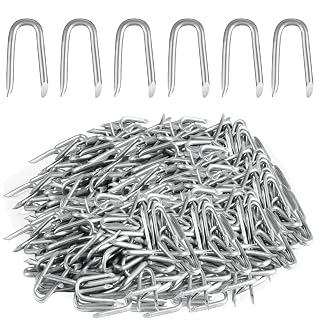
Barbed wire wins on upfront cost and speed: unroll, staple, tension. The listings include the supporting hardware: 300-piece boxes of galvanized U-shaped fence staples, 8-packs of 31 in 25-degree post extender arms for adding height, and a 5.5 lb fence wire tightener that pulls slack out of a line in about 60 seconds with a lifetime replacement guarantee. Woven wire costs more per foot and takes longer to stretch, but it goes up once and holds goats for years. Price the fence over its life, not over the weekend you build it.
Strand count and spacing
A cattle barbed fence typically runs four or five strands; goats need the bottom strand low and the gaps small, which means more strands, more staples and more labor, eroding the cost advantage. At that point the woven wire, which covers the whole height in one product, is the simpler build.
When barbed wire still makes sense
Barbed wire earns its place on cattle ground, on perimeter fences where the stock respects it, and as a single top strand above woven wire to discourage leaning and rubbing. It also suits temporary deterrent lines: the listings market it for critter deterrent and garden protection, jobs where no animal leans on it daily. Keep it away from goat pens, kidding areas and anywhere horned animals work the fence line.
Repair gear worth owning
Whichever wire you run, it will sag. The Holdly fence wire tightener in the listings weighs 5.5 lbs and pulls slack out of a line in about 60 seconds without removing staples, and it carries a lifetime replacement guarantee. Keep a 300-piece box of galvanized U-shaped staples for re-fastening wire to wood posts, and consider the 8-pack of 31 in 25-degree extender arms if you need to add height to an existing fence for privacy or to stop jumpers. A fence is a maintenance item; the right tools make it a quick job instead of a long project.
Around the Barn
- Fence goats with woven wire, not barbed.
- Use barbed wire for cattle perimeters and top strands only.
- Keep a wire tightener on hand; sagging lines fail first.
- Walk the fence line regularly and check for snags and loose barbs.
FAQs from goat keepers
Can goats be kept behind barbed wire?
Not safely. Goats go under, through and into barbed wire; use woven wire for any goat pen or pasture.
What gauge is the barbed wire in the listings?
15 to 18 gauge, 4-point, hot-dip galvanized, in rolls from 25 ft to 1320 ft.
How do you fix a sagging fence line?
With a fence wire tightener: the Holdly listing describes pulling slack out in about 60 seconds without removing staples, and the tool weighs 5.5 lbs.
More from the barn
Also see our field fence vs chain link. Also see our poly wire vs woven wire fence. Also see our fixed knot vs woven wire fence.
More picks: fence stretcher for goat fence, fence post driving vs concrete and fence post best practices.