

On this page
Top picks at a glance
As an Amazon Associate I earn from qualifying purchases.
- 1
 HMOLIKH 4x164 Farm Fence9.6/10View on Amazon
- 2
 DWALE 6x100 Welded Wire9.5/10View on Amazon
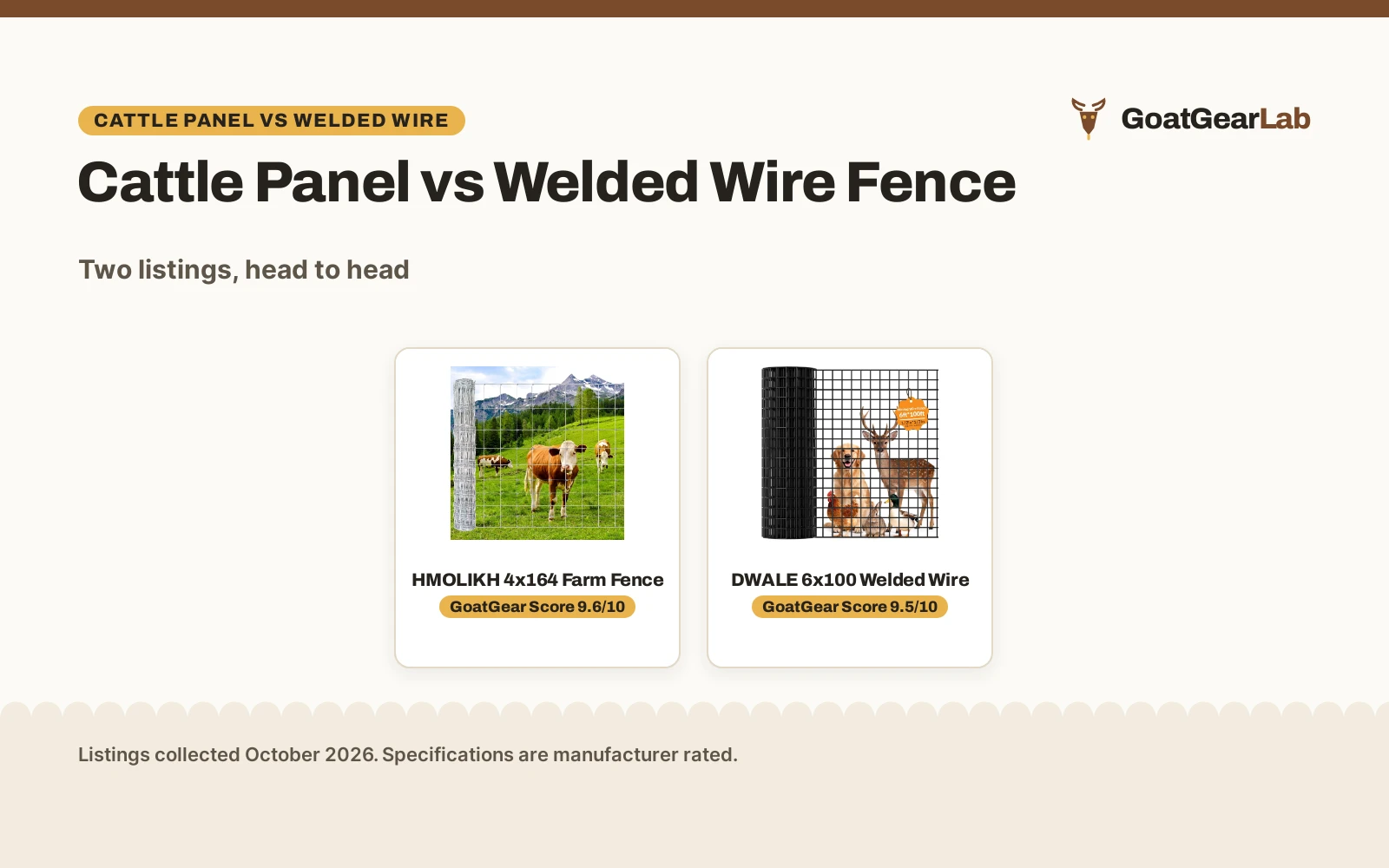
The cattle panel vs welded wire fence question comes up as soon as a goat pen needs walls that hold. Both are steel wire fencing sold in rolls; the difference is whether the wires are woven and twisted together, as on the HMOLIKH example, or welded at each crossing, as on the DWALE example. We compared these two listings on wire gauge, roll size, mesh, coating and the gaps each page leaves, using only what each Amazon listing publishes.
GoatGearLab earns a commission when you buy through links on this page, at no extra cost to you. As an Amazon Associate I earn from qualifying purchases. Affiliate disclosure.
Quick verdict: choose the cattle panel side if the fence must stand up to pushing livestock across a long run, as the HMOLIKH example shows with its 14-gauge woven wire in a 4 ft by 164 ft roll. Choose the welded wire side if the job needs small 1/2-inch openings that keep small animals out of a pen or garden, as the DWALE example shows with its PVC-coated 6 ft by 100 ft roll. Read this as a comparison of fence styles first and of listings second.
Two examples

HMOLIKH 4x164 Farm Fence
A 4 ft by 164 ft roll of 14-gauge hot-dip galvanized steel wire with a woven, twisted construction and mesh that narrows from top to bottom, listed for cattle, goats, sheep and deer.
Pros
- 14-gauge wire stated, heavier than the 16-gauge welded example
- Hot-dip galvanization stated for corrosion resistance
- Woven construction the listing describes as resisting the loosening of welded joints
- Graduated mesh that narrows from top to bottom
Cons
- No warranty term is stated
- No mesh opening size stated in inches
- No installation hardware stated as included
- No stated weight for the 164-foot roll

DWALE 6x100 Welded Wire
A 6 ft by 100 ft roll of 16-gauge welded wire mesh with 1/2-inch square openings, galvanized inside and vinyl coated outside, listed for goat and poultry netting.
Pros
- 1/2-inch mesh stated to keep small animals out
- Double-layer PVC coating over inner galvanization
- 16-gauge wire stated as stronger than common 19-gauge
- 6-foot width suits taller enclosures
Cons
- No warranty term is stated
- No breaking strength stated
- No installation guidance stated
- No stated weight for the 100-foot roll
As an Amazon Associate I earn from qualifying purchases.
Also worth comparing
 Cattle Fence 6ft x 100ftCheck price on Amazon
 Cattle Fence 5ft x 164ftCheck price on Amazon
 200 PCS T304 Stainless Steel Wire Fence ClipsCheck price on Amazon
 Cattle Panel 14Gauge Galvanized Woven Wire Fence 4FT x 328 FTCheck price on Amazon
 Cat's Claw Fasteners Screw In Fence Staples for Wire FencingCheck price on Amazon
 Zhengmy 60 Pcs Cattle Panel Clips Wire Fence Clips withCheck price on Amazon
Cattle panel vs welded wire fence: side by side
| Fence | GoatGear Score | Size | Wire | Mesh | Coating |
|---|---|---|---|---|---|
| HMOLIKH 4×164 Farm Fence | 9.6/10 | 4 ft x 164 ft | 14-gauge | Graduated, narrows downward | Hot-dip galvanized |
| DWALE 6×100 Welded Wire | 9.5/10 | 6 ft x 100 ft | 16-gauge | 1/2 in x 1/2 in | PVC over galvanized |
Figures come from the product pages and reflect what the maker rates, current as of 22 October 2026.
How the wires join
The join is the whole argument. The HMOLIKH listing describes a twisting process that connects horizontal and vertical wires firmly without welding, and claims this avoids the loosening issues it attributes to standard welded products. The DWALE listing describes a welded wire mesh with a carton-packed roll and calls the welded structure extremely sturdy. For the wider debate, see our welded wire vs woven wire fence comparison.
Neither listing gives a breaking strength, so the join question cannot be settled from these two pages alone. Treat the HMOLIKH anti-loosening claim as the maker’s claim, and the DWALE sturdiness claim the same way.
Gauge, roll size and what they cover
The HMOLIKH example lists 14-gauge wire in a 4 ft by 164 ft roll; the DWALE example lists 16-gauge wire in a 6 ft by 100 ft roll. The DWALE listing describes its 16-gauge as stronger than common 19-gauge alternatives, which frames lower gauge numbers as heavier wire on these pages. Do not compute coverage from the dimensions; read the roll size as stated and match it to the length of fence the job needs.
A 164-foot roll suits a long pasture run, while a 100-foot roll suits a pen or garden edge. Neither listing states the roll’s weight, so plan the unrolling and hauling with help on hand.
Mesh openings and what they stop
The DWALE listing states 1/2-inch by 1/2-inch square openings and says they effectively keep unwanted animals out, naming goat and poultry netting among its uses. The HMOLIKH listing states a graduated mesh that narrows from top to bottom to stop small animals passing through low, but gives no opening size in inches. Where one side states a figure and the other does not, call it a gap in the listing rather than a win for either side.
Coating and weather
The HMOLIKH example lists hot-dip galvanization over the steel wire for corrosion resistance. The DWALE example lists inner galvanization under a double-layer PVC coating, described as resisting corrosion, abrasion, oil, water and acid. Both coatings are stated as corrosion protection; the PVC layer adds a black finish that the listing ties to rough environments.
Listing gaps to check
The HMOLIKH spec table lists Unit Count as 656 Count and Color as White, which do not describe a galvanized fence roll; the title and bullets take precedence. The DWALE spec table is cleaner but states no warranty and no breaking strength. Neither listing states a warranty term, so both score zero on warranty. If posts, fasteners or a stated weight decide the purchase, ask the seller before ordering.
Which should you choose?
Choose a cattle panel if the fence will face pushing livestock along a long run and the priority is heavy wire that the listing describes as resisting loosened joints, as the HMOLIKH example shows at 14-gauge in a 4 ft by 164 ft roll. For a related matchup, read our cattle panel vs chain link comparison.
Choose a welded wire fence if the job needs small, even openings that keep small animals out of a pen, garden or poultry area, as the DWALE example shows with its 1/2-inch mesh in a 6 ft by 100 ft roll. Pair it with a fence stretcher for goat fence to keep the roll tight during the install.
Whichever side fits, the listings describe containment as a maker claim. Walk the fence after storms and keep the bottom wire clear of weeds where goats graze first.
Around the Barn
- Unroll the wire along the fence line before fastening it to posts.
- Wear gloves when handling cut wire; the ends are sharp.
- Store leftover rolls upright and dry so the coating is not damaged.
- Check the bottom of the fence where goats push first.
FAQs from goat keepers
Which is stronger, cattle panel or welded wire fence?
The listings state different wire gauges: the HMOLIKH cattle-panel example lists 14-gauge wire, and the DWALE welded example lists 16-gauge wire, which that listing describes as stronger than common 19-gauge. Neither listing states a breaking strength, so gauge is only part of the answer.
What size mesh keeps goats in a pen?
The DWALE listing states 1/2-inch by 1/2-inch openings and names goat netting among its uses. The HMOLIKH listing states a graduated mesh that narrows from top to bottom but gives no opening size in inches.
Do these fences come with posts?
Neither listing states posts or fasteners as included, so plan the post side of the job separately.
Is there a warranty on either fence?
No. Neither listing states a warranty term.
Behind the Farm Score
| Product | GoatGear Score | Perf. /35 | Build /25 | Value /25 | Safety /10 | Warranty /5 |
|---|---|---|---|---|---|---|
| HMOLIKH 4×164 Farm Fence | 9.6 | 30 | 21 | 21 | 5 | 0 |
| DWALE 6×100 Welded Wire | 9.5 | 28 | 20 | 20 | 4 | 0 |
Points become a score between 9.2 and 9.8 by simple proportion, which means a higher point count always reads higher.
The GoatGear Score weighs performance, build, value, safety and warranty. For fence wire, safety points need a stated safety-relevant feature: the HMOLIKH earns them for the twisted construction the listing describes as resisting loosening, and the DWALE earns them for the 1/2-inch mesh the listing describes as keeping unwanted animals out. Neither listing states a warranty term, so both score zero on warranty. The HMOLIKH leads on wire gauge and roll length for long runs, while the DWALE leads on small mesh for pens and gardens. How we pick explains the weights.
More from the barn
See every goat fencing wire guide and all fencing and shelter guides.
More picks: hog panels vs welded wire fence, field fence vs cattle panel and barbed wire vs cattle panel.