

On this page
Top picks at a glance
As an Amazon Associate I earn from qualifying purchases.
- 1
 FOREHOGAR Green Metal Fence Post 4 Feet9.5/10View on Amazon
- 2
 ZESHANGUS Cattle Panel 4 ft by 328 ft9.6/10View on Amazon
- 3
 Zareba HTBP10 Plated Electric Fence Brace Pins 10 Inch9.4/10View on Amazon
- 4
 Cattle Fence 5Ft x 164FtView on Amazon
- 5Cattle Fence 5Ft x 328FtView on Amazon
- 6Cattle Fence 4Ft x 164FtView on Amazon
- 7
 Cattle Fence 4Ft x 328FtView on Amazon
- 8
 Gallagher 1/16" Electric Fence Polywire for LivestockView on Amazon
- 9
 Premier 1 ElectroNet® Electric Fence for Sheep & GoatsView on Amazon
The field fence vs cattle panel decision comes down to herd and layout: field fence suits larger pastures with mixed animals, while rigid cattle panels suit pens, gates and corners that take abuse. We explain both step by step below, using figures from reference listings.
Also worth comparing
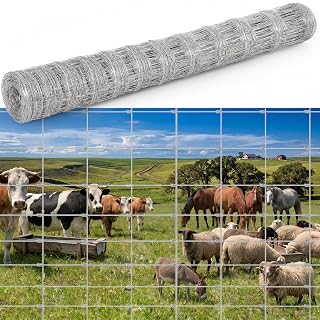 Cattle Fence 5Ft x 164FtCheck price on Amazon
- Cattle Fence 5Ft x 328FtCheck price on Amazon
- Cattle Fence 4Ft x 164FtCheck price on Amazon
 Cattle Fence 4Ft x 328FtCheck price on Amazon
 Gallagher 1/16" Electric Fence Polywire for LivestockCheck price on Amazon
 Premier 1 ElectroNet® Electric Fence for Sheep & GoatsCheck price on Amazon
GoatGearLab earns a commission when you buy through links on this page, at no extra cost to you. As an Amazon Associate I earn from qualifying purchases. Affiliate disclosure.
Field fence vs cattle panel: the short answer
Start with what the roll gives you. The field fence listings here taper their mesh from top to bottom, which keeps kids and small animals from working through the lower wires. The cattle panel listings use heavier 12 gauge wire with reinforced borders for strength against pushing and rubbing. If the job is a long pasture run on a budget, field fence in a 328 ft roll covers ground fast. If the job is a pen, a gate area or a spot where goats lean on the fence, the heavier panel-style fence holds its shape better.
What the listings state
| Listing | Size | Gauge | Mesh |
|---|---|---|---|
| ZESHANGUS cattle panel | 4×328 ft | 14 ga, 12 ga border | 8 in to 3.5 in |
| EliteEdge farm fence | 4×328 ft, 6×262 ft, 6×164 ft | 12 ga | Graduated |
| HMOLIKH farm fence | 4×164 ft | 14 ga | Tapered top to bottom |
| GarveeLife cattle fence | 5×164 ft, 5×328 ft, 4×164 ft | 12 ga | Fixed-knot |
| SANZEUS hardware cloth | 48 in x 100 ft | 19 ga | 1/2 in |
| Jotesnew garden fence | 48 in x 100 ft | 16 ga | 2×3 in |
Graduated mesh
Graduated mesh is the defining trait of field fence for goats. The ZESHANGUS listing states openings that taper from 8 inches at the top down to 3.5 inches at the bottom, and the EliteEdge and HMOLIKH listings describe a mesh that shrinks from top to bottom. The tight bottom stops kids from slipping out while the wide top keeps the fence lighter and easier to see through. For a herd with kids, this mesh pattern matters more than any other single feature.
Gauge and borders
Gauge is wire thickness, and a lower number means heavier wire. The EliteEdge and GarveeLife listings state 12 gauge high-tensile wire, while the ZESHANGUS and HMOLIKH listings state 14 gauge. The ZESHANGUS panel adds a 12 gauge reinforced border around 14 gauge field wire, which is the combination that resists sagging where goats push. Garden-grade wire is much lighter: the SANZEUS hardware cloth is 19 gauge and the Jotesnew garden fence is 16 gauge, fine for garden beds and coops but not for containing goats.
Height and roll length
Heights in these listings run 4 ft, 5 ft and 6 ft. The EliteEdge listing comes in 4 ft and 6 ft heights, and the GarveeLife listing in 4 ft and 5 ft. Taller fence suits jumpers and hilly ground where the fence follows a slope; 4 ft is the standard pasture height. Roll lengths run 100 ft on the garden wire, 164 ft, 262 ft and 328 ft on the livestock fence. The GarveeLife 5 by 328 ft roll weighs 106.9 lb per the listing, so plan help or a cart for the big rolls.
How long it lasts
All the livestock listings state galvanized wire, and the ZESHANGUS listing puts a number on lifespan: 15 to 20 years in normal environments and 10 to 15 years in extreme conditions. Hot-dip galvanizing is the coating named most often. The SANZEUS hardware cloth states double galvanizing after welding, and the Jotesnew garden fence states a vinyl coating over galvanized wire. No listing here states a warranty term, so the coating description is the durability evidence you get.
Which one for goats
Goats push against fences with their heads, horns and hooves, so match the fence to the pressure. For a perimeter pasture, graduated 12 or 14 gauge field fence in a long roll is the economical choice: the ZESHANGUS 4 by 328 ft panel covers a long run with a 12 gauge border, and the EliteEdge 4 by 328 ft roll gives 12 gauge wire throughout. For pens, kidding areas and gates where goats concentrate, the heavier 12 gauge options with fixed knots, like the GarveeLife fence, hold shape under rubbing. For baby goats specifically, our best fence for baby goats roundup compares fences and netting on these same points.
Hardware cloth has its place, but it is not pasture fence. The SANZEUS 48 in by 100 ft roll with 1/2 in mesh suits coop repairs, garden beds and tree guards, not a goat run. Use it where the listing says it belongs: small enclosures, not perimeters.
Read the listing twice
Fence listings contradict themselves, and the conflicting numbers are usually the ones you need to plan the install:
- ZESHANGUS: the title and bullets say 4 ft by 328 ft, while the spec table lists 9 by 9 in dimensions that describe nothing on this fence.
- HMOLIKH: the spec table lists a unit count of 656 against a single 4 by 164 ft roll.
- EliteEdge: the spec table lists a 16 ounce item weight against 328 ft of 12 gauge fence; the GarveeLife 5 by 328 ft roll lists 106.9 lb, which is the believable figure for that much wire.
- GarveeLife: the title says hinge knot while the bullets say fixed-knot woven; both describe a knotted weave rather than a welded grid.
Measure your run before ordering and allow for the larger figure. Some listings also describe their fence in strong containment language; we report containment claims as the maker’s claim only, because a fence is equipment, not a promise.
What this guide does not cover
This guide covers wire fence types only. It does not cover post spacing, gates, or electric fencing. See our fence post driver vs auger guide for setting posts, and our fencing pliers vs bolt cutters guide for the tools.
FAQs from goat keepers
Which gauge is heavier, 12 or 14?
12 gauge is the heavier wire. The EliteEdge and GarveeLife listings state 12 gauge, while the ZESHANGUS and HMOLIKH listings state 14 gauge.
How long does woven wire fence last?
The ZESHANGUS listing states 15 to 20 years in normal environments and 10 to 15 years in extreme conditions. All the livestock listings state galvanized wire.
What mesh keeps kids from slipping out?
Graduated mesh with a tight bottom. The ZESHANGUS listing tapers from 8 in at the top to 3.5 in at the bottom, and the EliteEdge and HMOLIKH listings describe the same top-to-bottom taper.
Can I use hardware cloth for a goat pasture?
No. The SANZEUS 48 in by 100 ft roll with 1/2 in mesh and 19 gauge wire is stated for coops, garden beds and tree guards, not for containing goats.
Do these fence rolls include posts?
The listings state wire fence rolls only, so plan posts separately.
More from the barn
See every goat fencing guide and all fencing and shelter guides. Also see our best fence for baby goats. Also see our fencing pliers vs bolt cutters. Also see our aluminum vs steel fence wire.
More picks: welded vs woven wire, post drivers vs augers, fence chargers vs energizers.