

On this page
A fence post that will not sit straight usually starts with a hole dug in hard ground, and digging bar weight decides how much work each swing does: a heavier bar breaks ground with less effort, while a lighter bar is easier to carry and swing all afternoon. This guide compares the weights in the listings, from short tamping bars to long chisel bars, and shows how to pick one for a post hole.
GoatGearLab earns a commission when you buy through links on this page, at no extra cost to you. As an Amazon Associate I earn from qualifying purchases. Affiliate disclosure.
Digging bar weight: the short answer
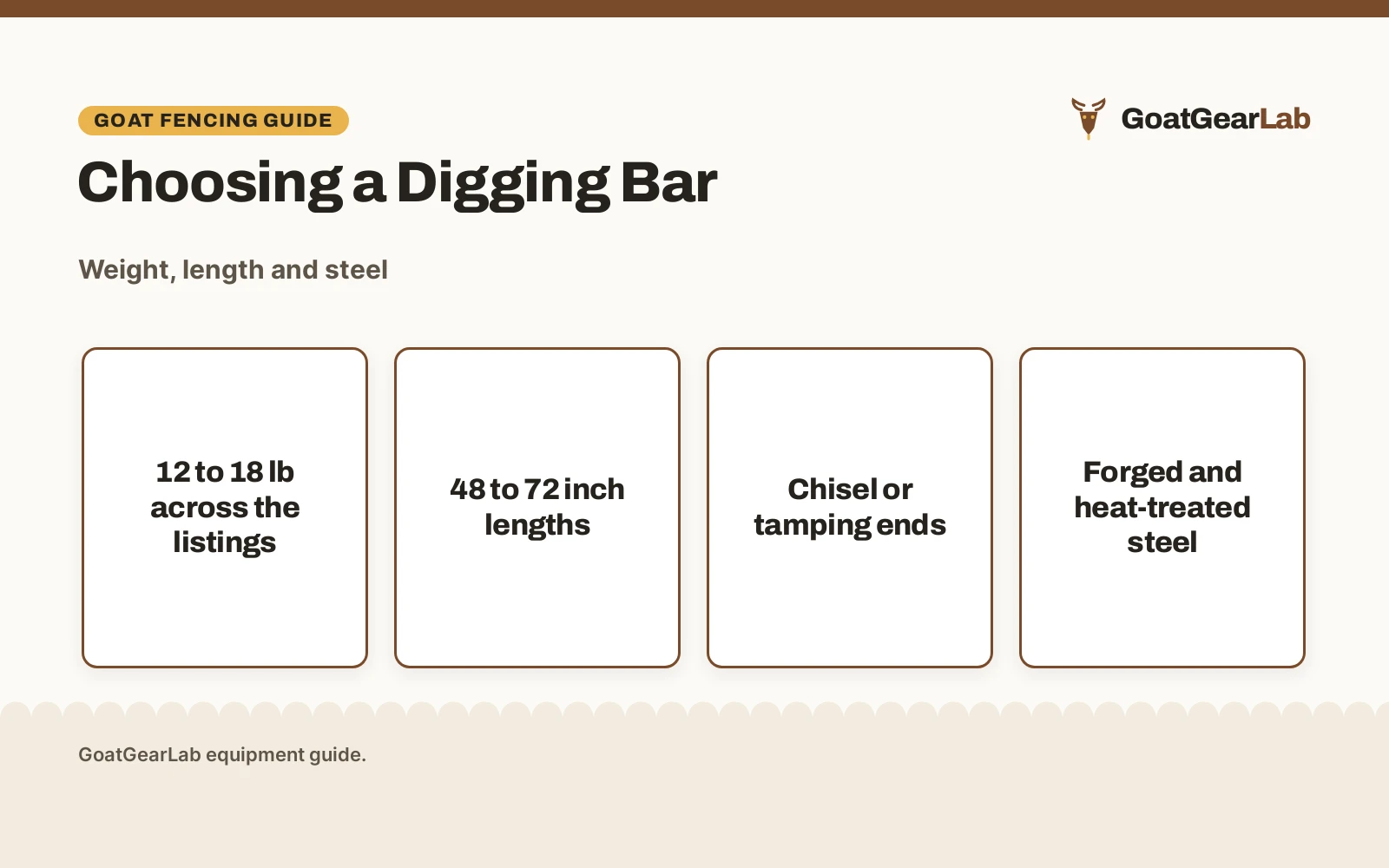
Chisel bars in the listings run 12 to 17 lb at 50 to 72 inches, and tamping bars run 12 to 18 lb at 48 to 69 inches. A 48 inch bar suits a shallow hole and a tight spot, a 60 inch bar suits a standard fence post hole, and a 72 inch bar suits deep holes in hard ground. Pick the length first, then let the weight follow, because two bars at the same length can weigh different amounts.
Bar weights compared
| Bar | Stated weight | Length | Ends |
|---|---|---|---|
| Leriton 50 inch chisel | 12 lb | 50 inches | Conical and flat |
| Leriton 60 inch chisel | 13 lb | 60 inches | Conical and flat |
| Leriton 60 inch chisel | 15 lb | 60 inches | Conical and flat |
| Leriton 72 inch chisel | 17 lb | 72 inches | Conical and flat |
| Leriton 48 inch tamping | 12 lb | 48 inches | Digging bit and tamping end |
| Leriton 69 inch tamping | 15 lb | 69 inches | Digging bit and tamping end |
| Truper 69 inch tamping | 16 lb | 69 inches | Chisel point and flat tamping |
| Truper 48 inch tamping | 12 lb | 48 inches | Digging edge and flat tamping head |
| AbraveOcean 48 inch tamping | 11.68 lb | 48 inches | Flat spade and tamping plate |
| Do It Best 60 inch pinch point | 18 lb | 60 inches | Pinch point |
Chisel bars
Chisel bars are the digging and prying bars in the listings. The Leriton chisel bars run 50, 60 and 72 inches at 12, 13, 15 and 17 lb, with a 25 mm hex shank, a 50 mm blade and a 60mm conical sharpened length. Each bar carries one conical end and one sharpened flat end, forged from heat-treated carbon steel, for digging and prying dirt, cutting roots and breaking through stubborn material. The 72 inch bar at 17 lb is the heaviest chisel bar here, and the 50 inch bar at 12 lb is the easiest to carry.
Tamping bars
Tamping bars dig and then pack the soil back around the post. The Leriton tamping bars measure 48 inches at 12 pounds and 69 inches at 15 pounds, made from 1 inch diameter solid steel bars with 3/8 inch thick steel plates, with a broad tamping end and a pre sharpened digging bit. The Truper tamping bars run 48 inches at 12 lb and 69 inches at 16 lb, in drop-forged and heat-treated steel with a chisel point end and a flat tamping end. The AbraveOcean bar runs 48 inches at 11.68 pounds with a flat spade end and a round tamping plate, and its threaded connection in the middle lets the bar separate into sections for storage.
Pinch point bars
The Do It Best pinch point bar (on Amazon) is the heaviest bar in the listings at 18 lb and 60 inches, in octagonal forged steel with a 2200 lb load capacity. The listing suits it for prying and spading in tough ground, with a 60 inch length for leverage. A pinch point bar has no tamping end, so it digs and pries rather than packing soil around a post.
What the weight does
Weight is the bar’s working force: a heavier bar drives its point deeper with each swing and breaks hard ground with fewer blows, while a lighter bar is easier to lift, carry and swing over a long day of post holes. The listings show the trade clearly: the 72 inch Leriton chisel bar at 17 lb and the 60 inch Do It Best bar at 18 lb hit hardest, while the 48 inch bars at 12 lb and the 50 inch Leriton at 12 lb are the easiest to handle. Weight alone does not settle the choice, because the two 60 inch Leriton chisel bars weigh 13 lb and 15 lb at the same length, so steel and shape move the weight as much as length does.
Length and leverage
Length sets the reach and the leverage. A 48 inch bar works upright in a shallow hole and fits a tight spot between fence lines, while a 60 inch bar suits a standard fence post hole with room to swing. A 69 inch or 72 inch bar reaches a deeper hole and gives more leverage for prying rocks, at the cost of weight and swing room. The Truper 48 inch listing calls out a long handle for upright use and leverage, and the AbraveOcean 48 inch listing makes the same point about reach and controlled force. Match the length to the hole depth and the space around it, not to the weight alone.
Steel and ends
Steel decides whether a bar bends or holds its edge. The Leriton bars are heavy forged, heat-treated carbon steel, the Truper bars are drop-forged and heat-treated steel with a rust-resistant black finish, the AbraveOcean bar is carbon steel, and the Do It Best bar is premium forged steel. Ends decide the job: a conical end and a sharpened flat end for digging and prying, a chisel point for cutting into compacted soil and rocky ground, a flat spade for breaking hard soil, and a flat tamping end or round tamping plate for packing soil tight around a post. Pick the ends for the ground in front of the bar, then check the weight.
Read the listing twice
Digging bar listings often contradict themselves, and the numbers that conflict are usually the ones needed to pick a bar:
- Leriton 72 inch chisel: 72 inches in the title against 73.23 inches in the spec table.
- Leriton 50 inch chisel: 50 inches in the title against 51.97 inches in the spec table.
- Leriton 60 inch chisel, 13 lb: 60 inches in the title against 61.02 inches in the spec table.
- Leriton 60 inch chisel, 15 lb: 60 inches in the title against 62.2 inches in the spec table.
- Leriton 48 inch tamping: 48 inches in the title against 48.23 inches in the spec table.
- Leriton 69 inch tamping: 69 inches in the title against 70.87 inches in the spec table.
- Truper 69 inch: 16 lb in the title against 15.7 pounds in the spec table, and 69 inches in the title against 68.5 inches in the spec table.
- Truper 48 inch: 48 inches in the title against 48.3 inches in the spec table.
- AbraveOcean 48 inch: 48 inches in the title against 44.09 inches in the spec table. The listing states a detachable threaded design in the middle, so the spec table figure may describe a section rather than the assembled bar.
- Do It Best 60 inch: the spec table gives no dimensions or weight, while the bullets give 60 inches, 18 lb and a 2200 lb load capacity.
Measure the hole before ordering and allow for the larger figure where the listing disagrees with itself.
What this guide does not cover
This guide covers digging bar hardware only: weight, length, steel and ends. It does not cover fence layout, post setting or any health question. Ask a veterinarian or the local extension office about goat health.
FAQs from goat keepers
How much does a digging bar weigh?
The listings here run 12 to 18 lb: 12 lb on the short bars at 48 and 50 inches, up to 17 lb on the 72 inch chisel bar and 18 lb on the 60 inch Do It Best pinch point bar.
How long is a digging bar?
The listings here run 48 to 72 inches: 48 inches on the short tamping bars, 50 and 60 inches on the mid-length bars, and 69 and 72 inches on the long bars.
What is the difference between a chisel bar and a tamping bar?
A chisel bar carries a conical end and a sharpened flat end for digging and prying. A tamping bar carries a digging bit or edge and a flat tamping end or plate for packing soil tight around a post after the hole is dug.
Does a heavier digging bar dig better?
A heavier bar hits harder with each swing, but weight is not the whole story: the two 60 inch Leriton chisel bars weigh 13 lb and 15 lb at the same length. Pick by length and ends for the ground, then let the weight follow.
Do digging bars come with a warranty?
Truper states its tools are warranted to be free of material and manufacturing defects, with no term stated. The other listings here state no warranty term.
More from the barn
See every goat fencing guide and all fencing and shelter guides.
More picks: best post hole digger for rocky soil, best gas powered auger for post holes, best fence post driver for wood posts and fence post drivers.