

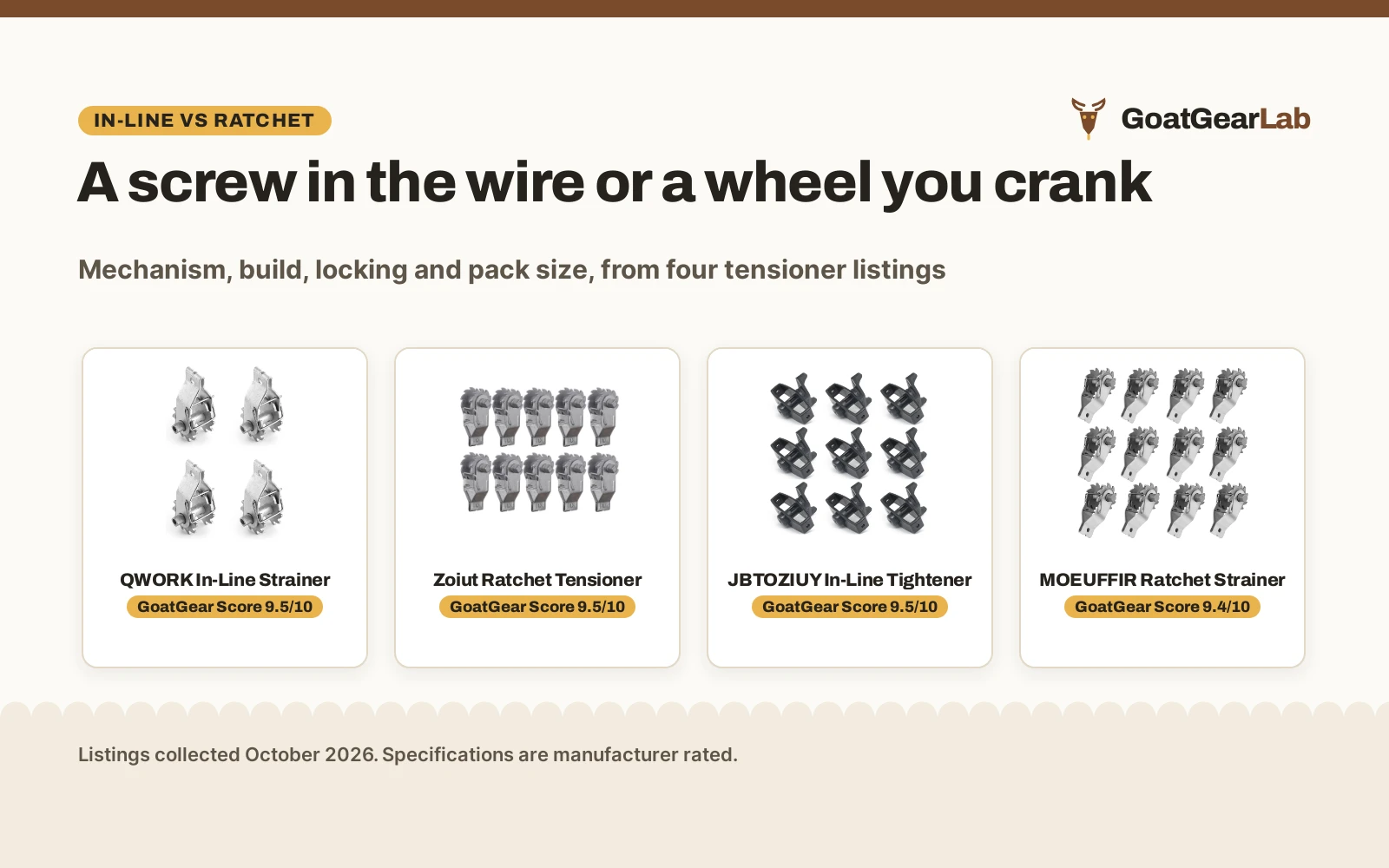
On this page
Top picks at a glance
As an Amazon Associate I earn from qualifying purchases.
- 1
 QWORK In-Line Strainer9.5/10View on Amazon
- 2
 Zoiut Ratchet Tensioner9.5/10View on Amazon
- 3
 JBTOZIUY In-Line Tightener9.5/10View on Amazon
- 4
 MOEUFFIR Ratchet Strainer9.4/10View on Amazon
A goat leaning on the fence will find every slack wire by morning. The in-line vs ratchet fence tensioner question is really about how you take that slack back up: with a screw you turn in the middle of the run, or with a ratchet wheel you crank when the line sags. We compared four listings, two in-line strainers and two ratchet tensioners, on mechanism, build, locking design and pack size, using only what each Amazon listing publishes.
GoatGearLab earns a commission when you buy through links on this page, at no extra cost to you. As an Amazon Associate I earn from qualifying purchases. Affiliate disclosure.
Quick verdict: choose an in-line tensioner if you want to adjust tension mid-wire with a screw mechanism, as the QWORK and JBTOZIUY examples show with their in-line bodies for splicing into a run. Choose a ratchet tensioner if you want to re-tighten a sagging line by cranking a wheel, as the Zoiut and MOEUFFIR examples show with their ratchet wheels and locking designs. Neither side wins on paper unless both listings state the spec; read on for where the listings agree and where they leave gaps.
Four examples
| # | Product | GoatGear Score | Buy |
|---|---|---|---|
| 1 | QWORK In-Line Strainer | 9.5/10 | Buy on Amazon |
| 2 | Zoiut Ratchet Tensioner | 9.5/10 | Buy on Amazon |
| 3 | JBTOZIUY In-Line Tightener | 9.5/10 | Buy on Amazon |
| 4 | MOEUFFIR Ratchet Strainer | 9.4/10 | Buy on Amazon |

QWORK In-Line Strainer
A heavy-duty carbon steel in-line wire strainer with a locking gear design, stated for wire up to 4mm, in a 4-piece pack.
Pros
- Heavy-duty carbon steel body, stated for high strain work
- Non-reversing gears with a locking design that keeps the wheel from turning back
- Two-hole design lets wire up to 4mm run through freely
- Installs in the middle of a long wire or between two corner posts
Cons
- No warranty term is stated
- The 4-piece pack covers fewer runs than the 10 and 12 piece packs here
- No wire types are named, only the 4mm capacity figure
- No rust or corrosion resistance is stated

Zoiut Ratchet Tensioner
A galvanized steel ratchet wire tensioner with a locking notch, stated for wire and poly tape up to 1-1/2 inches wide, in a 10-piece pack.
Pros
- Galvanized steel surface stated as rust proof and corrosion resistant
- Locking notch keeps the tooth wheel from rotating after installation
- Stated for steel or aluminum wire, poly wire and poly tape up to 1-1/2 inches wide
- 10-piece pack covers a full fence run at one order
Cons
- No warranty term is stated
- Tightening needs a wrench, with no handle in the box
- No wire tension rating in pounds is stated
- The title notes that two versions are randomly shipped

JBTOZIUY In-Line Tightener
A weather-resistant in-line wire tightener with a butterfly-handle screw mechanism, stated for poly wire, rope or tape, in a 10-piece pack.
Pros
- Screw-in butterfly handle mechanism for easy tightening
- Stated as not easy to loosen once the tension is set
- Weather resistant for outdoor fence lines
- 10-piece pack covers a full fence run at one order
Cons
- No warranty term is stated
- No body material is named
- No wire size or capacity figure is stated
- The 8.8 ounce weight covers the 10-piece pack, not a single tightener

MOEUFFIR Ratchet Strainer
A galvanized steel ratchet wire strainer with an aluminium cast tooth wheel for re-tightening fence lines, in a 12-piece pack.
Pros
- Galvanized steel frame with an aluminium cast tooth wheel
- Re-tightens a loose line by simply turning the ratchet
- 12-piece pack for long fence runs
- Stated for farm, garden, yard, villas, estates and vineyards
Cons
- No warranty term is stated
- No locking or anti-rotation feature is stated
- No wire sizes or wire types are stated
- The title calls it both an inline tensioner and a ratchet tensioner, which confuses the mechanism
As an Amazon Associate I earn from qualifying purchases.
Also worth comparing
 10Pcs Rapid Inline Wire Tensioner StrainerCheck price on Amazon
 2 PCS Fence Tensioner Ratchet Handle for Agricultural FenceCheck price on Amazon
 Electric Fence Wire StrainersCheck price on Amazon
 TAODAN 1PC Inline Wire TensionerCheck price on Amazon
 Fence Wire StrainersCheck price on Amazon
 20PCS Electric Fence Wire StrainersCheck price on Amazon
In-line vs ratchet fence tensioner: side by side
| Tensioner | GoatGear Score | Side | Pack size | Build | Wire fit | Amazon |
|---|---|---|---|---|---|---|
| QWORK In-Line Strainer | 9.5/10 | In-line | 4 pieces | Carbon steel | Wire up to 4mm | View on Amazon |
| Zoiut Ratchet Tensioner | 9.5/10 | Ratchet | 10 pieces | Galvanized steel | Poly tape up to 1-1/2 in | View on Amazon |
| JBTOZIUY In-Line Tightener | 9.5/10 | In-line | 10 pieces | Not stated clearly | Poly wire, rope, tape | View on Amazon |
| MOEUFFIR Ratchet Strainer | 9.4/10 | Ratchet | 12 pieces | Galvanized steel, aluminium wheel | Not stated clearly | View on Amazon |
Every spec repeats the brand’s rating from its listing (collected on 23 October 2026).
How each style takes up slack
An in-line tensioner sits in the wire run itself. The JBTOZIUY example uses a screw-in mechanism with a butterfly handle: turn the screw to tighten the wire, and the listing states it is not easy to loosen once set. The QWORK example works the same mid-wire idea with a different mechanism: two holes let the wire run through, and non-reversing gears with a locking design keep the wheel from turning back after installation.
A ratchet tensioner works with a toothed wheel you crank. The MOEUFFIR example states that when the fence line loosens after long use, you re-tighten it by simply turning the ratchet. The Zoiut example threads the wire through a hole and tightens both ends with a wrench until the wire is level, with a locking notch that stops the tooth wheel from rotating once set.
Build, materials and locking
On build, the QWORK example names heavy-duty carbon steel, and the Zoiut example names high-quality steel with a galvanized surface for rust and corrosion resistance. The MOEUFFIR example pairs a galvanized steel frame with an aluminium cast tooth wheel. The JBTOZIUY example states weather resistance but names no body material, so its build score leans on the 10-piece pack and the stated mechanism instead.
Locking is where the safety points sit. The QWORK example states non-reversing gears and a locking design that prevents the wheel from rotating after installation. The Zoiut example states a locking notch with the same job: stopping the tooth wheel from turning back. The JBTOZIUY example states it is not easy to loosen. The MOEUFFIR example names no locking feature, so it earns no safety points.
Pack size, weight and what ships
Pack sizes differ across the four. The QWORK example ships 4 pieces at 1.57 pounds, the JBTOZIUY example ships 10 pieces at 8.8 ounces, the Zoiut example ships 10 pieces at 4 pounds, and the MOEUFFIR example ships 12 pieces at 4.99 pounds. Those weights describe the whole pack as listed, so compare them as packs, not per piece.
On wire fit, the QWORK example states wire up to 4mm, and the Zoiut example states steel or aluminum wire, poly wire and poly tape up to 1-1/2 inches wide. The JBTOZIUY example states poly wire, line, rope or tape with no size given. The MOEUFFIR example states no wire sizes at all, a gap to check with the seller. For wire and posts to go with a tensioner, see our wire fence ties picks.
Where each style fits on a goat fence
The listings agree on the uses: farm, garden, yard, vineyards, villas and estates appear across the pages, with the JBTOZIUY example naming cattle and other livestock and the Zoiut example naming temporary electric fence enclosures and managed intensive grazing. An in-line strainer fits a run you are building or repairing, since the QWORK example states it installs in the middle of a long wire or between two corner posts. A ratchet wheel fits a line that sags over time, since the MOEUFFIR example is built around re-tightening. Our fence staples vs fence clips comparison covers the other small hardware a fence line needs.
Which should you choose?
Choose an in-line tensioner if you are running new wire or splicing into an existing run and want to adjust tension with a screw or geared wheel in the line itself, as the QWORK example shows with its mid-wire install and 4mm wire capacity. Keepers building out a new paddock can also compare our hog wire vs woven wire fence picks.
Choose a ratchet tensioner if the fence is already up and you want to crank slack out of a sagging line, as the Zoiut example shows with its wrench-tightened wheel and locking notch. If the line you are tightening runs to a gate, read our wire fence gate picks first, since gate ends move more than fence ends.
Whichever side you pick, the listings describe containment as a maker claim. Walk the line after storms and re-check tension each season.
Around the Barn
- Install in-line strainers in the middle of a long wire or between corner posts, where the QWORK listing places them.
- Re-check the locking notch or gears once the wire has settled under tension.
- Keep the wrench for the Zoiut wheel at the barn, since tightening needs one.
- Re-tighten a loose line by turning the ratchet, as the MOEUFFIR listing describes.
FAQs from goat keepers
Should I choose an in-line or a ratchet fence tensioner?
Choose in-line for new runs you adjust with a screw in the line, as the QWORK and JBTOZIUY examples show. Choose ratchet for existing lines you re-tighten by cranking a wheel, as the Zoiut and MOEUFFIR examples show. Both sides need a locking design so the wire stays tight.
What wire fits these tensioners?
It varies by listing. The QWORK example states wire up to 4mm. The Zoiut example states steel or aluminum wire, poly wire and poly tape up to 1-1/2 inches wide. The JBTOZIUY example states poly wire, line, rope or tape with no size. The MOEUFFIR example states no wire sizes.
How many tensioners come in a pack?
The QWORK example ships 4 pieces, the JBTOZIUY and Zoiut examples ship 10 pieces each, and the MOEUFFIR example ships 12 pieces. Count your corners and long runs before ordering, since each tensioner covers one stretch of wire.
Do these tensioners need tools?
The JBTOZIUY example uses a butterfly handle screw mechanism, and the Zoiut example tightens with a wrench. The QWORK and MOEUFFIR examples name no tool, so check the listing if tool-free adjustment matters to you.
Will a tensioner keep goats from pushing through the fence?
The listings describe containment as a maker claim: the JBTOZIUY example states it helps confine cattle and other livestock safely. A tensioner only keeps the wire tight; the fence design does the containing.
Behind the Farm Score
| Product | GoatGear Score | Perf. /35 | Build /25 | Value /25 | Safety /10 | Warranty /5 |
|---|---|---|---|---|---|---|
| QWORK In-Line Strainer | 9.5 | 30 | 21 | 20 | 3 | 0 |
| Zoiut Ratchet Tensioner | 9.5 | 29 | 20 | 21 | 3 | 0 |
| JBTOZIUY In-Line Tightener | 9.5 | 28 | 19 | 21 | 3 | 0 |
| MOEUFFIR Ratchet Strainer | 9.4 | 28 | 19 | 20 | 0 | 0 |
We translate each weighted point total onto the 9.2 through 9.8 band; ranks never flip, because the conversion is linear.
The GoatGear Score weighs performance, build, value, safety and warranty. For fence tensioners, safety points need a stated locking or anti-loosening feature; the QWORK, Zoiut and JBTOZIUY examples state one, the MOEUFFIR example does not, so it scores zero there. None of the four listings states a warranty term in years or months, so all score zero on warranty. The QWORK example leads on stated mechanism and materials, and the Zoiut example follows on galvanized build and locking notch. How we pick explains the weights.
More from the barn
See every goat fencing guide and all fencing and shelter guides.
More picks: fence staples vs fence clips, hog wire vs woven wire fence, wire fence ties and wire fence gates.