

On this page
Top picks at a glance
As an Amazon Associate I earn from qualifying purchases.
- 1
 Gallagher M120 Electric Fence Charger9.8/10View on Amazon
- 2
 Parmak Fieldmaster 2 Low Impedance 110/120 Volt 15 Mile RangeView on Amazon
- 3
 Parmak HS-100 110-20-Volt Horse Surround Low ImpedanceView on Amazon
- 4
 Parmak SE5 504564 Super Energizer 5 Low ImpedanceView on Amazon
- 5
 Zareba ESP2M-Z Solar Powered Low Impedance Electric FenceView on Amazon
- 6
 MARK8 Low Impedance 110/120-Volt 30-Mile Range Electric FenceView on Amazon
When the goats lean on the fence line every spring, the charger behind the wire decides whether they respect it or walk through. The low impedance vs solid state fence charger question comes down to this: low-impedance chargers push power through weeds and long wire runs, while solid-state chargers are the older low-power type for short, clean fences. We compared fence charger listings to explain what each type does and which fences each suits. Every number below comes from a product listing; where a listing gives no figure, we say so.
Also worth comparing
 Parmak Fieldmaster 2 Low Impedance 110/120 Volt 15 Mile RangeCheck price on Amazon
 Parmak HS-100 110-20-Volt Horse Surround Low ImpedanceCheck price on Amazon
 Parmak SE5 504564 Super Energizer 5 Low ImpedanceCheck price on Amazon
 Zareba ESP2M-Z Solar Powered Low Impedance Electric FenceCheck price on Amazon
 MARK8 Low Impedance 110/120-Volt 30-Mile Range Electric FenceCheck price on Amazon
GoatGearLab earns a commission when you buy through links on this page, at no extra cost to you. As an Amazon Associate I earn from qualifying purchases. Affiliate disclosure.
Low impedance vs solid state fence charger: the short answer
Choose low impedance for real farm fences: the Zareba EDC15M-Z lists 15 miles in ideal conditions and still 3 miles in heavy weeds at 0.8 joules, and the FenceMate lists up to 25 miles at 1 joule. Choose a solid-state type only for short, weed-free runs where low power is enough. Our what low impedance means guide explains the term in depth.
What a low-impedance charger does
Low-impedance chargers are built to push their pulse through vegetation touching the wire. The listings show the range: the Zareba battery unit lists 15 miles with no weeds, 7.5 miles in light weeds and 3 miles in heavy weeds at 0.8 joules on a 12-volt battery. The FenceMate AC unit lists 1 joule with a 10 kV peak (5.5 kV under a 500-ohm load) for up to 25 miles of single wire with no vegetation, or about 5 miles in average conditions. The Parmak Fieldmaster 2 lists 15 miles at 110 to 120 volts with fuse protection and built-in lightning arrestors. Low impedance is the modern standard for livestock fence: it keeps working when the fence line is not perfect.
What a solid-state charger is
Solid-state is the older charger type: low-power, short-pulse units meant for short fences with no weed load. Here is the twist the listings reveal: “solid-state” also describes electronic components. The Parmak Fieldmaster 2 is sold as a low-impedance charger and its bullets brag about “advanced solid-state circuitry”: the same word doing two different jobs. So read the listing, not just the label: a charger described as the solid-state type is the old low-power kind, while a low-impedance charger with solid-state circuitry is the modern kind. For goats on real pasture, the listings point to low impedance: the folosem 0.10-joule unit covers 2 miles for small animals, while the 2-joule VEVOR and 3-joule FarmNix units cover 1.86 and 15 miles for livestock.
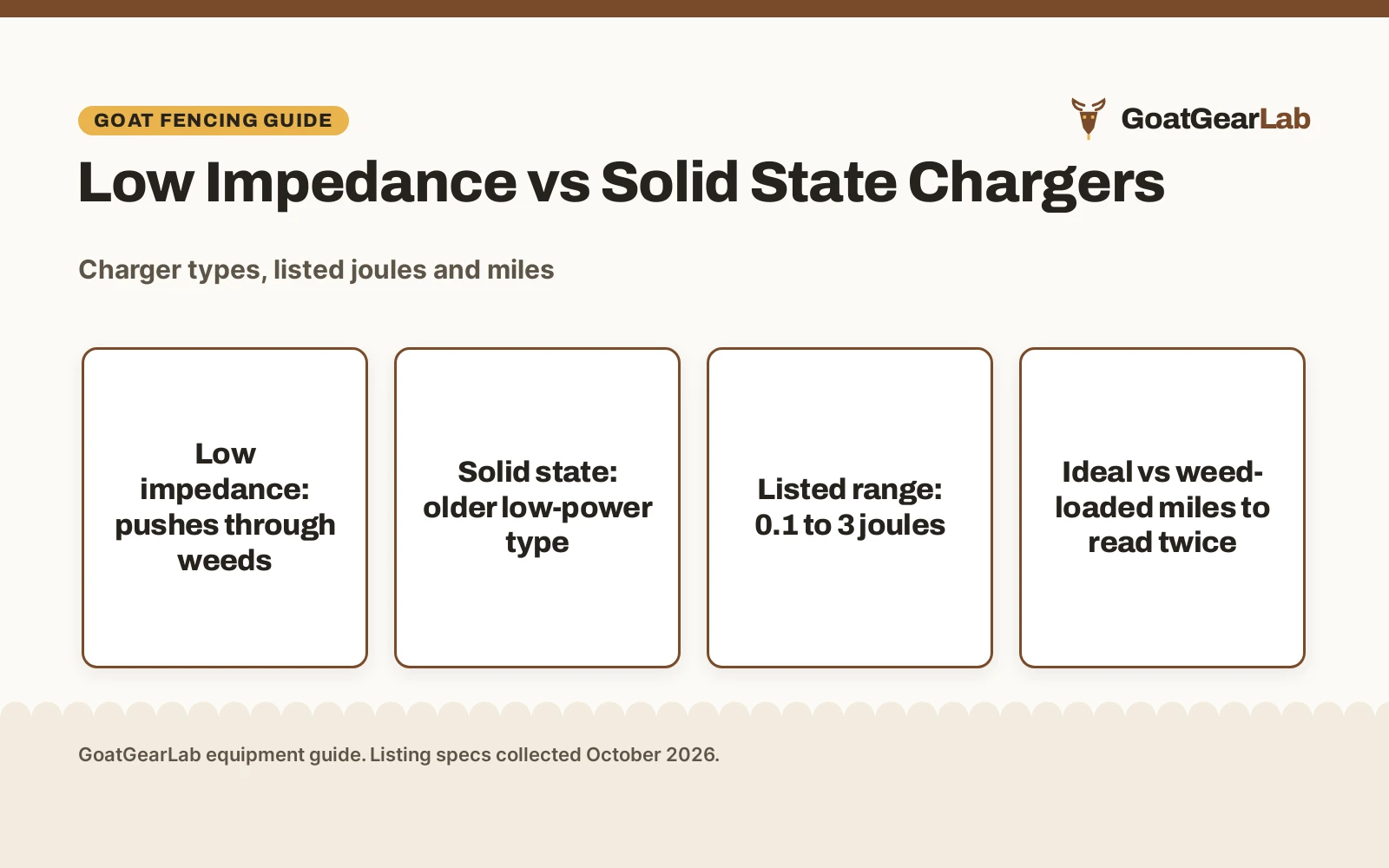
Low impedance vs solid state at a glance
| Type | How it works | Suits | Watch for |
|---|---|---|---|
| Low impedance | Pushes the pulse through weeds and long runs | Pasture fences, livestock | 0.1 to 3 joules on these listings |
| Solid state (type) | Older low-power short-pulse design | Short, weed-free runs | Not the same as solid-state circuitry |
Which should you buy?
Match the charger to the fence. Goats on pasture with weeds along the wire point to low impedance: the 0.8-joule Zareba on battery or the 1-joule FenceMate on AC. A short garden fence with no weed load can run on a small solid-state type. Size by joules and miles with our what size fence charger guide, then browse the electric fence chargers category for the full range. Several listings include a 1-year warranty, some covering lightning damage.
Read the listing twice
Fence charger listings mix ideal and real-world figures:
- FenceMate: the title says up to 25 miles, but the bullets say about 5 miles in average conditions.
- Zareba: the 15-mile rating needs ideal conditions with no weeds; heavy weeds cut it to 3 miles.
- Parmak Fieldmaster 2: sold as low impedance with “advanced solid-state circuitry”; the terms describe different things, so check which one the listing means.
Trust the title and bullets over the spec table, and size by the weed-loaded figure, not the ideal one.
What this guide does not cover
This guide covers charger types only. It does not cover grounding, wire choice or fence layout, which depend on your soil and pasture. The charger’s manual covers installation, and your local extension office can advise on grounding for your area.
FAQs from goat keepers
How many joules do I need for goats?
The listings range from 0.1 joules for 2 miles to 3 joules for 15 miles. Match joules to your fence length and weed load; the Zareba 0.8-joule unit lists 15 miles ideal and 3 miles in heavy weeds.
What is the difference between low impedance and solid state?
Low impedance is the modern type that works through weeds; solid state as a charger type is the older low-power design for short clean fences. Note that low-impedance chargers can still use solid-state circuitry, as the Parmak listing shows.
Can a fence charger work in weeds?
Low-impedance units are built for it: the Zareba lists 3 miles in heavy weeds and the Parmak says its circuitry works through weeds and brush. Solid-state types are not.
Do I need a battery or plug-in charger?
The listings offer both: the Zareba runs on a 12-volt battery, the FenceMate plugs into 110/120V AC, and the VEVOR and FarmNix support AC, DC and solar. Our plug-in vs battery fence charger guide compares the power options.
More from the barn
See every electric fence charger guide and all fencing guides.
More picks: what low impedance means, plug-in vs battery fence chargers and 1 joule vs 2 joule fence chargers.