

On this page
What does low impedance fence charger mean? It means the energizer is built to keep shocking even when the fence touches weeds, grass or a wet post. A low-impedance charger pushes its pulse through the leakage that would drain an older high-impedance unit, so the far end of the fence still bites. For goats, that matters: a charger that dies under weed load is a charger goats learn to ignore.
GoatGearLab earns a commission when you buy through links on this page, at no extra cost to you. As an Amazon Associate I earn from qualifying purchases. Affiliate disclosure.
What does low impedance fence charger mean in plain terms
Impedance is the charger’s internal resistance to its own pulse. A low-impedance design lets the pulse surge out fast and hard, then shuts off. That short, sharp pulse is what makes modern fence chargers safe and effective: the animal gets a memorable zap, not a continuous burn. The FenceMate listing in these references describes itself as an AC powered low impedance charger with 1J output covering up to 25 Miles, which is the classic low-impedance pitch: serious energy over serious distance.
Why low impedance beats weeds
Weeds touching the wire leak voltage to ground. A high-impedance charger loses its punch fast under that load; a low-impedance charger keeps enough voltage at the far end to matter. That is why the Zareba EAC2M-Z and ESP2M-Z listings call out 2-Mile low impedance designs: two miles of wire with weed contact is exactly where impedance shows.
Joules: the energy figure
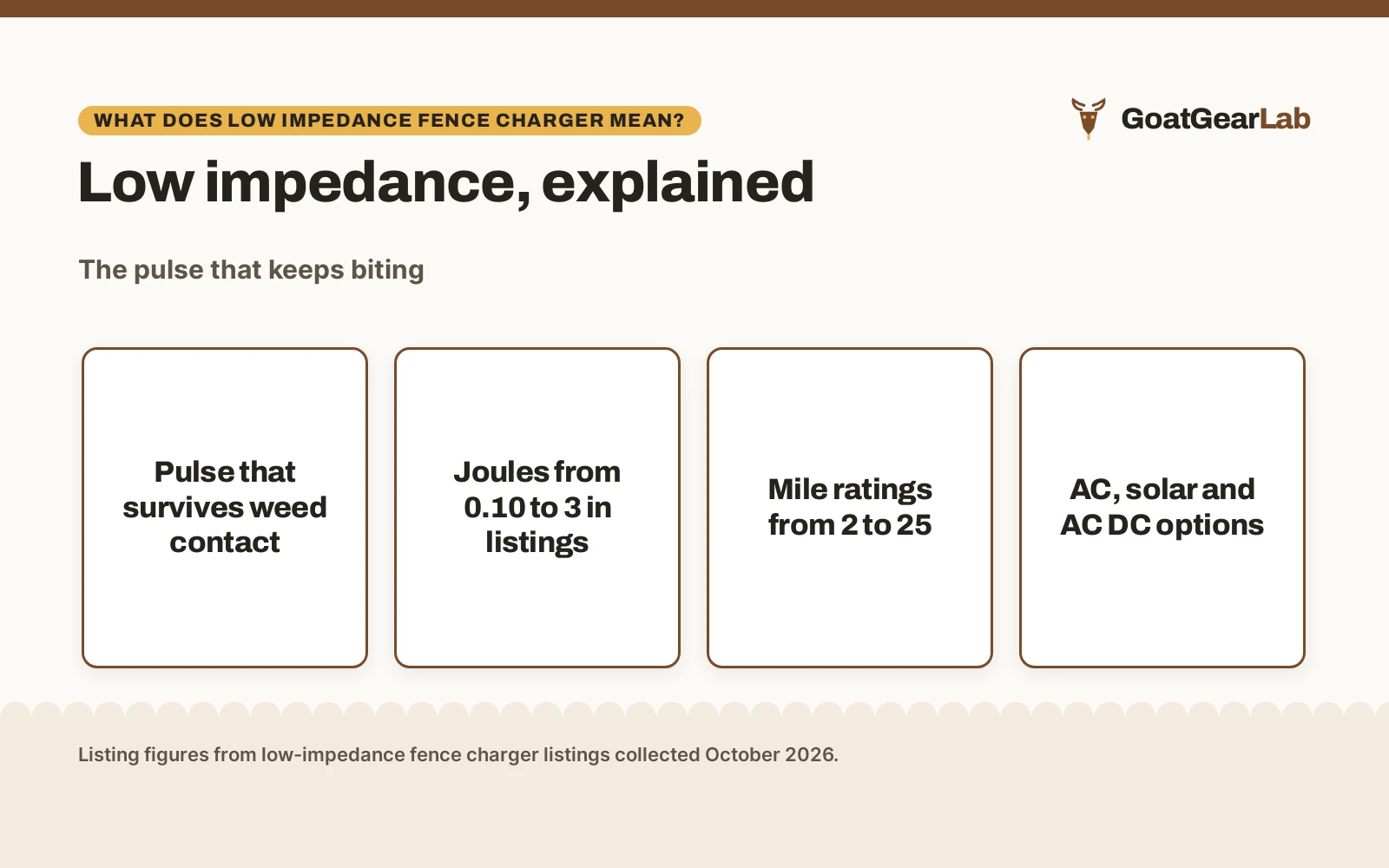
Joules measure the energy in each pulse. The reference listings run from 0.10 Joule on the folosem 2 Mile charger (on Amazon), through 0.11J on the EVIORTER solar (on Amazon) unit and 0.16J on the Pirjeco PE5 (on Amazon) (10 Mile/40 Acres), up to 1J on the FenceMate and the LEOMAUNYX 5Miles/ 8KM charger (on Amazon), and 3J on the Csyibeielec 15 Miles kit (on Amazon) and the KUVOMIXA 3 Joules 10-15 Mile charger. More joules push the pulse farther and through heavier weed load. For a small goat pen, the low-joule end is plenty; for multi-acre pasture, look to the higher joules.
Volts: the pressure figure
Volts measure the pulse’s pressure. The EVIORTER listing cites 8100V maximum output voltage, the Csyibeielec cites 12KV, the KUVOMIXA cites 9-12-14KV multi-powered, and the LEOMAUNYX cites 10KV. Higher voltage jumps small gaps and pushes through light weed contact. But volts without joules is a short, thin pulse: both figures matter together.
Miles and acres: the range figure
Mile ratings describe how much wire the charger can drive. These listings show 2 Mile (folosem, Zareba EAC2M-Z, Zareba ESP2M-Z solar), 5Miles/ 8KM (LEOMAUNYX), 10 Miles (EVIORTER) and 10 Mile/40 Acres (Pirjeco), 10-15 Mile (KUVOMIXA), 15 Miles (Csyibeielec) and up to 25 Miles (FenceMate). Buy for the wire you will actually run, with room to grow. A charger rated far above your fence still works; a charger rated below it will not.
Power sources
Low-impedance chargers come in AC plug-in, solar and battery flavors. The FenceMate, folosem and KUVOMIXA listings here are AC powered plug-in units; the EVIORTER and Zareba listings are solar; the LEOMAUNYX is AC DC. Solar suits remote pasture with no outlet; AC suits the barn. The low-impedance design is about the pulse, not the power source.
What low impedance does not mean
It does not mean stronger than everything: a low-impedance charger still needs good grounding, usually multiple ground rods, to complete the circuit. It does not mean weed-proof: heavy brush will drain any charger. And it does not replace proper wire: rusty, broken or poorly spliced wire wastes the pulse before it reaches the goat.
How to shop one
- Match joules to fence length and weed pressure.
- Check the mile rating against your wire run.
- Pick AC near the barn, solar for remote pasture.
- Plan grounding: more rods for longer fences.
- See our electric fence chargers guides for picks.
FAQs from goat keepers
Is low impedance better for goats?
Yes for most goat fences. Goats challenge fences constantly, and weed contact is normal on pasture. Low impedance keeps the shock credible.
How many joules do goats need?
The listings here run from 0.10 Joule to 3J. Small pens do fine at the low end; large pastures want more.
Does a higher mile rating hurt a short fence?
No. A charger rated for 25 Miles works fine on a short run; the rating is a maximum, not a requirement.
Solar or plug-in?
Plug-in (AC) near the barn is simplest; solar suits remote fences. The LEOMAUNYX lists AC DC for both.
More from the barn
See every fencing guide, including electric fence chargers.
More picks: fencing.