

On this page
Top picks at a glance
As an Amazon Associate I earn from qualifying purchases.
- 1
 Gallagher M120 Electric Fence Charger9.8/10View on Amazon
- 2
 Parmak SE5 504564 Super Energizer 5 Low ImpedanceView on Amazon
- 3
 Zareba ESP2M-Z Solar Powered Low Impedance Electric FenceView on Amazon
- 4
 MARK8 Low Impedance 110/120-Volt 30-Mile Range Electric FenceView on Amazon
- 5
 Parmak Fieldmaster 2 Low Impedance 110/120 Volt 15 Mile RangeView on Amazon
- 6
 Parmak HS-100 110-20-Volt Horse Surround Low ImpedanceView on Amazon
A goat leaning on the fence line in wet grass is when the low impedance vs continuous fence charger question usually lands. A low impedance charger sends short high-voltage pulses down the wire, so the shock gets through weeds and damp insulators instead of leaking away. A continuous charger is the older style: it holds a steady low current on the wire, which drains in vegetation and can start a fire where dry weeds touch the line. This guide explains how each output works, which fence setups each suits and the listed joules, miles and volts to compare. Every number below comes from a product listing; where a listing gives no figure, we say so.
Also worth comparing
 Parmak SE5 504564 Super Energizer 5 Low ImpedanceCheck price on Amazon
 Zareba ESP2M-Z Solar Powered Low Impedance Electric FenceCheck price on Amazon
 MARK8 Low Impedance 110/120-Volt 30-Mile Range Electric FenceCheck price on Amazon
 Parmak Fieldmaster 2 Low Impedance 110/120 Volt 15 Mile RangeCheck price on Amazon
 Parmak HS-100 110-20-Volt Horse Surround Low ImpedanceCheck price on Amazon
GoatGearLab earns a commission when you buy through links on this page, at no extra cost to you. As an Amazon Associate I earn from qualifying purchases. Affiliate disclosure.
Low impedance vs continuous fence charger: the short answer
Buy a low impedance charger. Every charger in these listings uses pulsed output, from the FBULWSEC at 0.1J for 2 miles and 8 acres up to the Gallagher M1500 at 15 stored joules for 160 miles and 100 acres. Continuous-output chargers are the obsolete weed-burner style: steady current, heavy drain in vegetation and a fire risk in dry weeds, and none of these listings sell one. If your fence touches brush, the low impedance pulse is the reason the shock still reaches the goat. Read what a low impedance fence charger means for more on the term.
How low impedance chargers work
A low impedance charger charges a capacitor and dumps it into the wire as a brief high-voltage pulse, then waits. The LEOMAUNYX listing states a 100-microsecond pulse at 12KV and 4.0 joules of output energy over 15 miles, and the FarmNix states 3 joules with a 1-second pulse interval and 12 kV over 15 miles. The short pulse is the safety feature: the animal gets a sharp sting and lets go, because the current is off most of the time.
Low impedance also means the charger pushes through vegetation. The Gallagher M1500 listing describes low impedance circuitry that keeps a consistent shock through weeds and fence shorts over long runs, and the FenceMate 0.25J listing states a 6 kV peak with 3.5 kV under a 500-ohm load, up to 5 miles and 20 acres. The folosem listing states a 0.10 joule pulse at up to 5kV across a 2-mile fence, built to run continuously at high intensity for over 10,000 hours.
How continuous chargers work
A continuous charger holds current on the wire at all times instead of pulsing. In clean wire it can still sting, but the moment weeds, damp wood or a sagging insulator touches the line, the steady current drains to ground and the fence goes dead along its whole length. Worse, that constant current heats dry vegetation against the wire, which is how fence fires start.
No listing here sells a continuous-output charger: the trade moved to pulsed low impedance designs years ago. When a listing says “continuous operation,” like the EVIORTER solar charger with its 30-day backup, it means the charger keeps running day and night on its panel and battery, not that the output is continuous.
Low impedance vs continuous at a glance
| Output style | How it shocks | Listed sizes | Suits | Watch for |
|---|---|---|---|---|
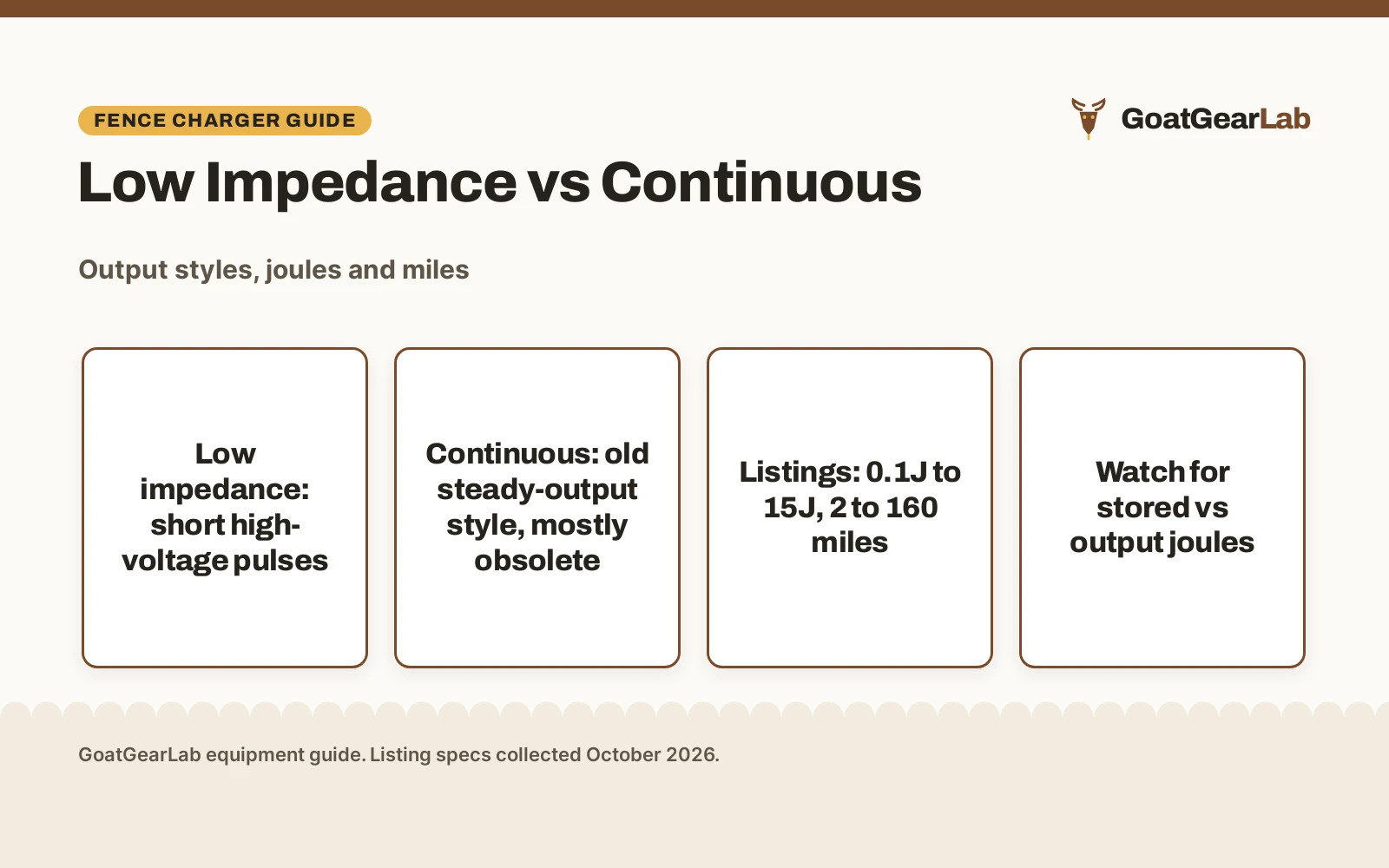
| Low impedance | Short high-voltage pulses | 0.1J to 15J, 2 to 160 miles on these listings | Goat fences, weedy lines, long runs | Compare stored joules vs output joules |
| Continuous | Steady low current | No listings | Nothing modern | Drains in weeds; fire risk in dry grass |
Which should you buy?
Match the joules and miles to the fence. For a small goat paddock, the Realpoultry states 0.12 joule stored (0.09 output) at 5kV peak and 2.3kV under a 500-ohm load for 2 miles and 8 acres with a 1-year warranty. For bigger ground, the FenceMate 1J states 25 miles at a 10 kV peak and 5.5 kV under a 500-ohm load, and the FarmNix states 15 miles at 3 joules and 12 kV. The Gallagher M1500 sits at the top of these listings with 160 miles under ideal conditions and 60 to 100 miles of multi-wire fence in real setups.
Then check the power source: the EVIORTER solar charger states 0.11J at 8100V over 10 miles with a 5W panel, and the FenceMate battery model states 1J over 25 miles on a 12V battery. See plug in vs battery fence charger and solar vs plug in fence charger for the power choice.
Read the listing twice
Fence charger listings mix up stored and output joules, and the wattage-style headline is the usual place it happens:
- Gallagher M1500: the title and bullets state 15 stored joules while the spec table states 0.86 joules of output energy and 1.6 joules stored.
- FenceMate 0.25J: the title states 0.25J while the spec table states 0.15J of output energy.
- Realpoultry: the title states 0.12 joule while the bullets state 0.09 output energy.
Stored joules is what the capacitor holds; output joules is what reaches the fence. Trust the bullets over the spec table, and confirm the output figure before you buy: every figure in these listings is named there, not buried in the specs.
What this guide does not cover
This guide covers charger output styles only. It does not cover grounding, wire spacing or any animal health question. Ask your local extension office about fence building advice.
FAQs from goat keepers
What is the difference between low impedance and continuous fence chargers?
Low impedance chargers send short high-voltage pulses that push through weeds, while continuous chargers hold a steady low current that drains in vegetation. All of these listings use pulsed output; no continuous-output charger is listed.
Are continuous fence chargers still sold?
None of these listings sells one. The continuous weed-burner style is largely obsolete because of the drain in vegetation and the fire risk in dry weeds. When a listing says continuous operation, it means the charger runs day and night, as on the EVIORTER solar charger with its 30-day backup.
What joules do low impedance chargers list?
These listings state 0.1J (FBULWSEC), 0.10J (folosem), 0.11J (EVIORTER), 0.12J stored with 0.09J output (Realpoultry), 0.25J in the title with 0.15J in the spec table (FenceMate), 1J (two FenceMate models), 3J (FarmNix), 4.0J (LEOMAUNYX) and 15 stored joules in the title (Gallagher M1500).
What miles do low impedance chargers list?
These listings state 2 miles (FBULWSEC, Realpoultry, folosem), 5 miles (FenceMate 0.25J), 10 miles (EVIORTER), 15 miles (FarmNix, LEOMAUNYX), 25 miles (two FenceMate 1J models) and 160 miles (Gallagher M1500).
Should I worry about the pulse hurting goats?
The short pulse is designed to sting and release: the LEOMAUNYX states a 100-microsecond pulse, and the FarmNix states a 1-second pulse interval. The current is off most of the time, which is what makes pulsed chargers safer than steady current.
More from the barn
See every electric fence chargers guide and all goat fencing guides.
More picks: what does low impedance fence charger mean, AC vs DC fence charger and solar vs battery fence charger.