

On this page
Top picks at a glance
As an Amazon Associate I earn from qualifying purchases.
- 1
 JNGBVIX Fine Mesh Strainer Bags with Stainless Frame9.7/10View on Amazon
- 2
 MIATTCLD Ultra-Fine Nylon Mesh Strainer9.7/10View on Amazon
- 3
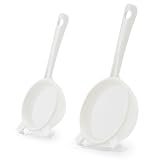 Luckyiren Kefir Strainer Set9.6/10View on Amazon
Plastic vs stainless milk strainer comes down to the job size, because the listings here differ more in format than in material. The two plastic listings are hand-held sieves at 3.15 to 5.51 inches for jars, bowls and small batches. The stainless listing is a three-bag set on a steel frame for larger volumes. None of the three states a warranty term, and the mesh figures run from 149 microns to a stated 400 mesh.
GoatGearLab earns a commission when you buy through links on this page, at no extra cost to you. As an Amazon Associate I earn from qualifying purchases. Affiliate disclosure.
Quick verdict: pick the JNGBVIX stainless-frame set for larger milk batches and repeated use, pick the MIATTCLD 400 mesh sieve for everyday kitchen straining with dishwasher-safe cleanup, and pick the Luckyiren two-size set for mason-jar kefir and kombucha work.
The strainers
| # | Product | GoatGear Score | Buy |
|---|---|---|---|
| 1 | JNGBVIX Fine Mesh Strainer Bags with Stainless Frame | 9.7/10 | Buy on Amazon |
| 2 | MIATTCLD Ultra-Fine Nylon Mesh Strainer | 9.7/10 | Buy on Amazon |
| 3 | Luckyiren Kefir Strainer Set | 9.6/10 | Buy on Amazon |

JNGBVIX Fine Mesh Strainer Bags with Stainless Frame
JNGBVIX 3-piece mesh strainer bag set with a stainless steel frame and handle, 149 micron mesh, for milk, coffee, juice and cheese.
Pros
- Three interchangeable bags plus a stainless steel frame
- 149 micron mesh stated for the filtration
- 11.5 inch detachable handle with hanging for drip drying
- Reusable and washable, an alternative to paper filters
Cons
- Conical bags need the frame to hold their shape
- No stated warranty term
- Bag depth of 10.0 inches needs a tall vessel
- No stated mesh figure for the bags beyond 149 microns

MIATTCLD Ultra-Fine Nylon Mesh Strainer
MIATTCLD 5.51 inch ultra-fine nylon mesh strainer with handle, 400 mesh, dishwasher safe, for milk, soy milk, juice and more.
Pros
- 400 mesh stated, the finest mesh figure here
- Dishwasher safe, the only one to state it
- Food-grade PP and nylon, handle with hanging hole
- 5.51 inch diameter suits bowls and pots
Cons
- Mesh figures conflict: 0.04 millimeters vs 130 and 75 microns
- Single strainer, no second size
- No stated warranty term
- Plastic frame needs care with boiling liquids
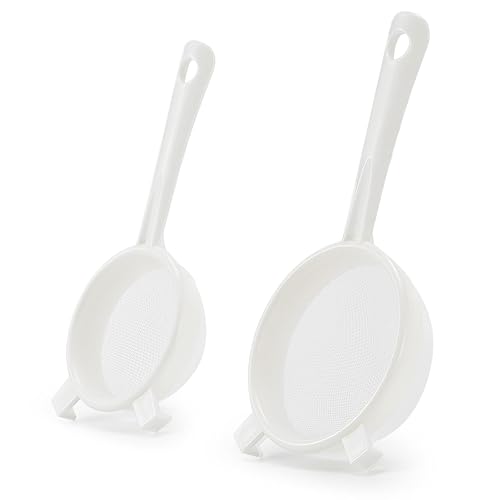
Luckyiren Kefir Strainer Set
Luckyiren 2-piece plastic strainer set, 3.15 and 3.94 inch diameters, fine mesh for mason jars, kefir and kombucha.
Pros
- Two diameters, 3.15 and 3.94 inches, in one set
- 3.15 inch strainer fits wide-mouth mason jars
- Food-grade non-metal plastic, gentle on cultures
- Fine 0.02 inch mesh opening stated
Cons
- Small diameters, not for large pots
- No handle on either strainer
- No stated warranty term
- Kefir focus, less suited to big milk batches
As an Amazon Associate I earn from qualifying purchases.
Also worth comparing
 Fine Mesh StrainerCheck price on Amazon
 Speak Naturals Half Gallon Plastic Milk JugCheck price on Amazon
Compare the strainers
| Strainer | GoatGear Score | Side | Format | Mesh | Warranty | Amazon |
|---|---|---|---|---|---|---|
| JNGBVIX Bag Set | 9.7/10 | Stainless milk strainer | 3 bags + steel frame | 149 microns | Not stated | |
| MIATTCLD Sieve | 9.7/10 | Plastic | 5.51 inch sieve with handle | 400 mesh stated | Not stated | |
| Luckyiren Set | 9.6/10 | Plastic | 2 strainers, 3.15 and 3.94 in | 0.02 inches | Not stated |
Specifications are as listed, collected 19 October 2026.
Plastic vs stainless milk strainer: what separates the sides
Size decides the batch
The listings state sizes clearly. The Luckyiren gives 3.15 and 3.94 inch strainers for mason jars, the MIATTCLD gives a 5.51 inch sieve for bowls and pots, and the JNGBVIX gives a 5.3 inch frame with 10.0 inch deep bags for larger volumes. Match the strainer to the vessel you strain into, not to the side label.
Mesh figures need a careful read
The JNGBVIX states 149 microns and the Luckyiren states a 0.02 inch mesh opening. The MIATTCLD states 400 mesh but lists 0.04 millimeters in its spec table against 130 and 75 microns in its bullets, so its exact fineness is unclear. For milk straining basics, see best milk strainer for beginners.
Structure and cleanup
The stainless side wins on structure: the JNGBVIX frame holds the bags open and hangs for drip drying, and the bags are reusable and washable. The plastic side wins on cleanup convenience: the MIATTCLD is the only one to state dishwasher safe, while the Luckyiren pair is small enough to rinse in seconds. For cheese work that follows straining, wood vs plastic cheese press compares the next step.
Around the Barn
- Strain milk as soon as it cools, and keep the strainer covered between the pail and the jar.
- Rinse mesh strainers right after use; dried milk plugs fine mesh faster than any brush clears it.
- Hang the JNGBVIX bags by the frame handle to drip dry, and store the Luckyiren pair nested together.
- Run the MIATTCLD through the dishwasher on the top rack only, since it is the one listing that states dishwasher safe.
FAQs from goat keepers
Is plastic or stainless better for a milk strainer?
It depends on the batch. The plastic listings here are small sieves for jars and bowls, while the stainless listing is a bag-and-frame set for larger volumes. No listing states a warranty, so buy on size and format.
What mesh size do I need for milk?
The JNGBVIX states 149 microns and the Luckyiren states 0.02 inches. The MIATTCLD states 400 mesh but contradicts itself on microns, so treat its exact fineness as unclear.
Can I put these strainers in the dishwasher?
Only the MIATTCLD states dishwasher safe. The other two listings do not state it, so hand wash them.
Which strainer fits a mason jar?
The Luckyiren 3.15 inch strainer is designed for wide-mouth mason jars. The MIATTCLD at 5.51 inches suits bowls, and the JNGBVIX frame at 5.3 inches suits larger vessels.
Behind the Farm Score
| Product | GoatGear Score | Perf. /35 | Build /25 | Value /25 | Safety /10 | Warranty /5 |
|---|---|---|---|---|---|---|
| JNGBVIX Fine Mesh Strainer Bags with Stainless Frame | 9.7 | 29 | 25 | 24 | n/a | 0 |
| MIATTCLD Ultra-Fine Nylon Mesh Strainer | 9.7 | 28 | 25 | 22 | n/a | 0 |
| Luckyiren Kefir Strainer Set | 9.6 | 26 | 24 | 21 | n/a | 0 |
A score of 9.2 marks the weakest point total on our scale and 9.8 the strongest; totals in between are placed proportionally. No power and no stated safety feature means no safety row: the score is then out of 90 points.
The GoatGear Score weighs performance, build, value, safety and warranty. No listing states a safety certification or a warranty term, so both score zero on warranty across all three. The JNGBVIX leads on stated contents with three bags and a stainless frame, and loses nothing on materials since its mesh is stated at 149 microns. No side wins on mesh fineness alone: the MIATTCLD states 400 mesh but contradicts itself on the micron figure, so the listing leaves it unclear.
More from the barn
See every milk pails and strainers guide and all milking guides.
More picks: milk strainers for beginners, milk strainers for homesteads, cheesecloth for cream cheese and cheese making kit vs cheese mold.