

On this page
Top picks at a glance
As an Amazon Associate I earn from qualifying purchases.
- 1
 EFencSolv Step-In Electric Fence Posts9.7/10View on Amazon
- 2
 D&D TruClose Multi-Adjust Round Post Gate Hinge9.7/10View on Amazon
- 3
 MIWEVRO Metal Garden Fence Posts9.7/10View on Amazon
- 4
 50 PCS Electric Fence PostsView on Amazon
- 5
 Electric Fence Posts 50 PackView on Amazon
- 6
 Electric Fence Posts 25 PackView on Amazon
- 7
 30PCS 41" Electric Fence Step-in Pigtail PostsView on Amazon
- 8
 FENSMILE 25 Pack 48Inch Step-in Electric Fence Posts withView on Amazon
- 9
 Gallagher 3/8" x 48" Fiberglass Step-in Fence PostsView on Amazon
Step in posts vs t posts is the temporary-versus-permanent choice in goat fencing. Step-in posts push into the ground by foot, hold electric wire with built-in clips, and move in minutes. T-posts are steel posts driven into the ground with a post driver, and they stay put for years. If you rotate pastures or protect a garden for a season, step-in posts are your tool. If you are building a permanent perimeter, T-posts carry it.
Also worth comparing
 50 PCS Electric Fence PostsCheck price on Amazon
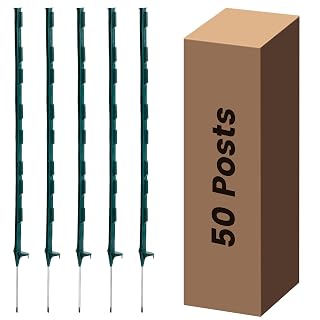 Electric Fence Posts 50 PackCheck price on Amazon
 Electric Fence Posts 25 PackCheck price on Amazon
 30PCS 41" Electric Fence Step-in Pigtail PostsCheck price on Amazon
 FENSMILE 25 Pack 48Inch Step-in Electric Fence Posts withCheck price on Amazon
 Gallagher 3/8" x 48" Fiberglass Step-in Fence PostsCheck price on Amazon
GoatGearLab earns a commission when you buy through links on this page, at no extra cost to you. As an Amazon Associate I earn from qualifying purchases. Affiliate disclosure.
Step-in posts: what they are
A step-in post is a lightweight post with a foot peg and a metal spike at the base. You put your foot on the peg and push it into the soil: no tools, no pilot hole. The listings we compared sell them in packs of 25, 30 and 50, which tells you they are meant for whole fence lines, not single posts.
Sizes and exposed heights
The common step-in sizes in the listings are 48 inches and 50 to 57 inches. The Toriexon plastic step-in posts measure 48 inches total with 39 inches exposed above ground. The Gallagher fiberglass step-in posts are 3/8 inch by 48 inches with 40 inches exposed. FENCE SHOCK lists its 48-inch posts at 38.2 inches out of the ground. Taller Toriexon fiberglass posts come in 50 and 57 inch lengths for taller fence lines.
Materials: fiberglass, plastic and pigtail steel
Three materials show up in the listings. Fiberglass posts, like the Toriexon 3/8 inch posts and the Gallagher 48-inch posts, are non-conductive, so they do not short out an electric fence, and they will not rust. Plastic step-in posts, like the Toriexon 48-inch polyethylene posts reinforced with metal stakes at the base, are lighter and molded with clasps. Pigtail posts, like the FENSMILE 41-inch posts with 35 inches above ground, use galvanized spring steel with an insulated pigtail that holds a single wire or rope.
Built-in clips
Step-in posts carry their wire with built-in clips, so you do not buy separate insulators for every post. The clip counts in the listings run from 4 on the Gallagher fiberglass posts to 6 and 7 on the Toriexon fiberglass posts, up to 8 molded clips on the FENCE SHOCK posts. More clips mean more wire strands, which matters for goats: three to four strands keep a determined goat honest.
When step-in posts win
Step-in posts win wherever the fence line moves. Rotational grazing is the classic case: divide a pasture, graze it down, and step the line over to the next paddock. They also win for seasonal work like protecting a garden, a temporary holding pen at a show, or a lane between pastures. Fiberglass and plastic step-in posts are light enough to carry in bulk, and a 50-pack covers a long line.
T-posts: what they are
A T-post is a steel post with a T-shaped cross section, named for the letter it looks like end-on. It has studs or clips along the face that hold wire or fence clips, and an anchor plate near the base that grips the soil. Unlike a step-in post, a T-post goes in with force: you drive it with a fence post driver, a heavy steel tube you lift and drop over the post.
When T-posts win
T-posts win wherever the fence must not move. A permanent perimeter fence, a corner, a gate end, or a stretch that carries woven wire all want steel set deep. T-posts also hold tension: high-tensile wire and long runs put real load on a post, and a driven steel post takes it without leaning. For electric wire on a T-post, add electric fence insulators, since steel conducts and step-in posts insulate by themselves.
Step in posts vs t posts: the differences
Installation
Step-in posts go in by foot in seconds and pull out by hand. T-posts need a post driver and muscle, and they do not come out easily once set. If your soil is frozen or rock-hard, even step-in posts struggle: the listings note heavy-duty spikes and anti-rotation designs for hard ground.
Permanence and strength
A step-in post is a temporary post. It flexes, it leans under load, and a horned goat rubbing on the wire can push it over. A T-post is a permanent post: driven steel with an anchor plate resists leaning and holds wire tension for years. For a fence that must stand through winter and goats, steel wins.
Insulation
Most step-in posts are fiberglass or plastic, so the post itself insulates the electric wire. T-posts are steel and conduct, so every strand needs an insulator. That adds parts and labor to a T-post electric fence.
Cost and effort per foot
Step-in posts cost less per post and need no tools, which makes them the cheap way to fence a long temporary line. T-posts cost more per post and need a driver, but a permanent line you build once beats a temporary line you rebuild every season.
Which one should you buy?
Buy step-in posts if the fence line moves: rotational grazing, temporary pastures, garden protection, show pens. Choose fiberglass for durability and insulation, plastic for light weight, and pigtail posts for single-strand rope lines. Match the clip count to your strands: four clips suit a three-strand goat fence, while eight clips let you run more strands or polytape.
Buy T-posts if the fence stays: the perimeter, corners, gate ends, and any run that carries woven or high-tensile wire under tension. Pair them with a post driver and insulators, and they will hold a fence line for years.
Many keepers use both: T-posts for the permanent perimeter and step-in posts for the temporary interior lines that divide pastures. That combination gives you a fence that stands up and a grazing plan that moves.
Around the Barn
- Walk every fence line after storms; step-in posts lean and pull out.
- Drive T-posts before hanging wire, and cap the tops.
- Match clip count to strand count before you buy a 50-pack.
- Check the voltage at the far end of every line, not just at the charger.
FAQs from goat keepers
Can I use step-in posts for a permanent fence?
You can, but they will lean and need resetting. For a permanent line, driven steel T-posts hold up far better.
How tall should a goat fence be?
The step-in posts in the listings run 41 to 57 inches tall, with 35 to 40 inches exposed. Most goat fences run three to four strands within that height.
Do step-in posts need insulators?
No. Fiberglass and plastic step-in posts insulate by themselves and carry wire in built-in clips. Steel T-posts need a separate insulator per strand.
What tool drives a T-post?
A fence post driver: a heavy steel tube you drop over the post. See our t post drivers for small homesteads guide.
Can goats push over step-in posts?
A determined goat leaning on the wire can push a step-in post over, especially in soft soil. Set step-in posts deep and check the line often.
More from the barn
See every fencing guide, including fence post drivers and electric fence insulators.
More picks: t post drivers for small homesteads, t posts for wood fence and fencing.