

On this page
Top picks at a glance
As an Amazon Associate I earn from qualifying purchases.
- 1
 Cyclops Champ 12V Fence Charger9.7/10View on Amazon
- 2
 Gallagher M120 Electric Fence Charger9.8/10View on Amazon
- 3
 Bouge 6V Battery Charger9.5/10View on Amazon
- 4
 12KV Electric Fence Charger with LED IndicatorView on Amazon
- 5
 10 Joule Electric Fence ChargerView on Amazon
- 6
 16 Joule Electric Fence ChargerView on Amazon
- 7
 Electric Fence ChargerView on Amazon
- 8
 5.5J Electric Fence Charger EnergizerView on Amazon
- 9
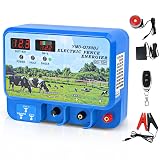 15.5J Electric Fence ChargerView on Amazon
A 12v vs 110v fence charger choice comes down to power source, not power level. A 12v charger runs from a battery and goes anywhere, while a 110v charger plugs into an outlet and never needs a battery swap. Both can run a goat fence: the Zareba battery charger is listed at 15 miles of fence with 0.8 joule output, and the Gallagher plug-in is listed at 0.1 joule for up to 0.5 mile of typical fence. This guide compares the two kinds with figures from listings.
Also worth comparing
 12KV Electric Fence Charger with LED IndicatorCheck price on Amazon
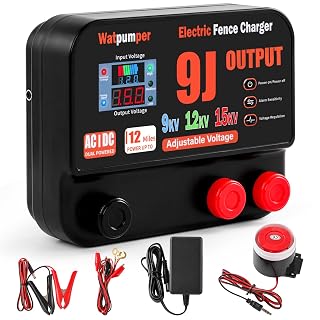 10 Joule Electric Fence ChargerCheck price on Amazon
 16 Joule Electric Fence ChargerCheck price on Amazon
 Electric Fence ChargerCheck price on Amazon
 5.5J Electric Fence Charger EnergizerCheck price on Amazon
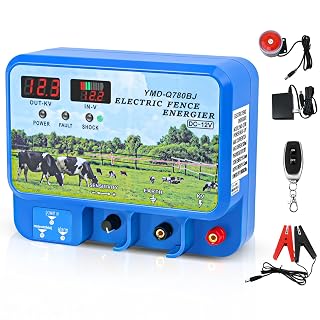 15.5J Electric Fence ChargerCheck price on Amazon
GoatGearLab earns a commission when you buy through links on this page, at no extra cost to you. As an Amazon Associate I earn from qualifying purchases. Affiliate disclosure.
12v vs 110v fence charger: the short answer
Buy a 12v battery charger when the fence is far from the barn: battery units like the Zareba 15-mile charger or the 5 joule Cyclops run remote pastures with no outlet. Buy a 110v plug-in charger when an outlet is nearby: plug-in units like the Gallagher M10 run constant with no battery to tend, listed for up to 0.5 mile of typical fence or 3 acres. Dual power units exist: the Watpumper lists 12V DC and 100-240V AC dual power with 10 joule stored energy, and the Speedrite lists 12V/110V input with 1.4 joule stored energy.
The voltage number on the plug is not the shock. Fence pulse energy is measured in joules: 0.1 joule for the Gallagher, 0.5 joule for the FenceMate, 2 joules for the VEVOR, up to 10 joules stored for the Watpumper, per the listings. Range ratings shrink in heavy weeds: the Zareba is listed at 15 miles in ideal conditions but 3 miles in heavy weeds.
How a 12v battery charger works
A 12v charger runs from a 12-volt battery with pulsed DC output, per the Zareba listing. You mount the charger, connect fence and ground terminals, and the unit pulses about once per second. The Zareba EDC15M-Z is listed with 0.8 joule output, a 1-year limited warranty including lightning damage, and UL specification. The Cyclops Champ battery charger lists 5 joules and 5 miles of protection for 40 acres. The FenceMate battery charger lists 0.5 joule output with a range up to 10 miles, and its spec table lists 0.35 joule output energy with about 2.5 miles effectively powered in average conditions.
Battery chargers suit remote fences, rotational grazing and rented land where you cannot wire an outlet. The tradeoff is the battery: you charge or swap it. Solar panels pair with some units, and our solar vs battery fence charger guide compares those options.
How a 110v plug-in charger works
A 110v charger plugs into a standard outlet and runs continuously. The Gallagher M10 is a 110V plug-in charger listed with 0.1 joule stored energy, recommended for up to 0.5 mile of typical fence or about 3 acres, with clean-fence capacity up to 2 miles or 10 acres under ideal conditions, and a 3-year warranty. The FenceMate spec table lists plug-in 110/120V, 60 Hz power. Plug-in chargers suit the barn lot, the garden and any fence within cord reach of the barn.
The tradeoff is the outlet: no outlet, no charger. Lightning protection matters near buildings, and grounding still decides performance. See our best plug-in fence charger for small barns guide for short runs.
Compare: range, joules and warranties
| Type | Example listing | Listed range | Listed joules | Listed warranty |
|---|---|---|---|---|
| 12v battery | Zareba 15-mile | 15 miles ideal, 3 miles heavy weeds | 0.8 | 1 year limited |
| 12v battery | Cyclops Champ | 5 miles, 40 acres | 5 | Not stated |
| 12v battery | FenceMate | Up to 10 miles, 2.5 miles average | 0.5 | One year limited |
| Dual power | Watpumper | 12 miles | 10 stored, 9 output | Not stated |
| Dual power | Speedrite | 10 miles, 40 acres | 1.4 stored | Not stated |
| 110v plug-in | Gallagher M10 | 0.5 mile typical, 2 miles clean | 0.1 | 3 years |
Which one fits your pasture
Remote pasture with no outlet: a 12v battery charger. The Zareba’s 15-mile ideal rating and 1-year warranty with lightning damage coverage suit long fences, while the FenceMate’s 2.5-mile average rating suits a smaller paddock. Barn lot or garden near an outlet: a 110v plug-in. The Gallagher M10’s 3-year warranty and simple plug-in operation suit short perimeter fences. Not sure which side of the line you are on: the Watpumper dual power unit lists 12V DC and 100-240V AC operation, and the VEVOR supports AC, DC battery and solar, per the listings.
Weeds decide real range more than the label. The Zareba listing drops from 15 miles ideal to 3 miles in heavy weeds. Keep fence lines clear and the rating holds. See all fencing and shelter guides for the rest of the build.
Around the Barn
- Ground rods decide performance: drive them deep in moist ground.
- Clear weeds from the fence line to hold the rated range.
- Fit warning signs where people may reach the fence.
- Check the pulse at the far end of the fence regularly.
FAQs from goat keepers
Can a 12v charger power as much fence as a 110v one?
Yes, sometimes more. The Zareba 12v battery charger lists 15 miles in ideal conditions, while the Gallagher 110v plug-in lists 0.5 mile of typical fence. Power source does not set pulse power; joules do.
How long does a 12v battery last on a fence charger?
The listings do not state battery life figures. Battery life depends on the charger’s joule draw, the battery size and the weather.
Do I need a special battery for a 12v fence charger?
The Zareba listing specifies a 12-volt battery with pulsed DC output at 1-second intervals. Use a battery that matches the charger’s stated input.
Which warranty is longer, 12v or 110v?
From the listings, the Gallagher 110v plug-in has a 3-year warranty, while the Zareba and FenceMate 12v units list 1 year and one year limited warranties. Warranty terms vary by model, not by power source.
Can one charger run both battery and outlet power?
Yes, dual power units exist. The Watpumper lists 12V DC and 100-240V AC dual power, the Speedrite lists 12V/110V input, and the VEVOR supports AC, DC battery and solar, per the listings.
More from the barn
See every electric fence chargers guide and all fencing and shelter guides.
More picks: solar vs plug-in fence charger, solar vs battery fence charger, electric fence chargers and fencing and shelter.