

On this page
Top picks at a glance
As an Amazon Associate I earn from qualifying purchases.
- 1
 MorningRo Electric Fence Charger Kit 1J 25 Mile 250ft Wire 509.4/10View on Amazon
- 2
 CimoroWin 63 Pcs Electric Fence Kit9.5/10View on Amazon
A goat that slips through the fence at feeding time is usually following a gap in the circuit, not a gap in the wire, and a diagram of electric fence parts shows why: the charger, the wire, the insulators and the ground rod form a loop, and a break anywhere in that loop leaves the fence silent. This guide walks through that loop part by part, with figures from charger and netting kits, so you can read a fence diagram and check each part on your own fence.
Also worth comparing
 Patriot PE2 Electric Fence EnergizerCheck price on Amazon
 Briidea 2-Mile Electric Fence Energizer for Preventing WildCheck price on Amazon
 Zareba Standard T-Post Insulators for Electric FenceCheck price on Amazon
 ALLOSUN GK503B NEON Electric Fence Voltage Tester FaultCheck price on Amazon
 10 Pack Metal Fence PostCheck price on Amazon
 20 Pack Metal Fence PostCheck price on Amazon
GoatGearLab earns a commission when you buy through links on this page, at no extra cost to you. As an Amazon Associate I earn from qualifying purchases. Affiliate disclosure.
Diagram of electric fence: the short answer
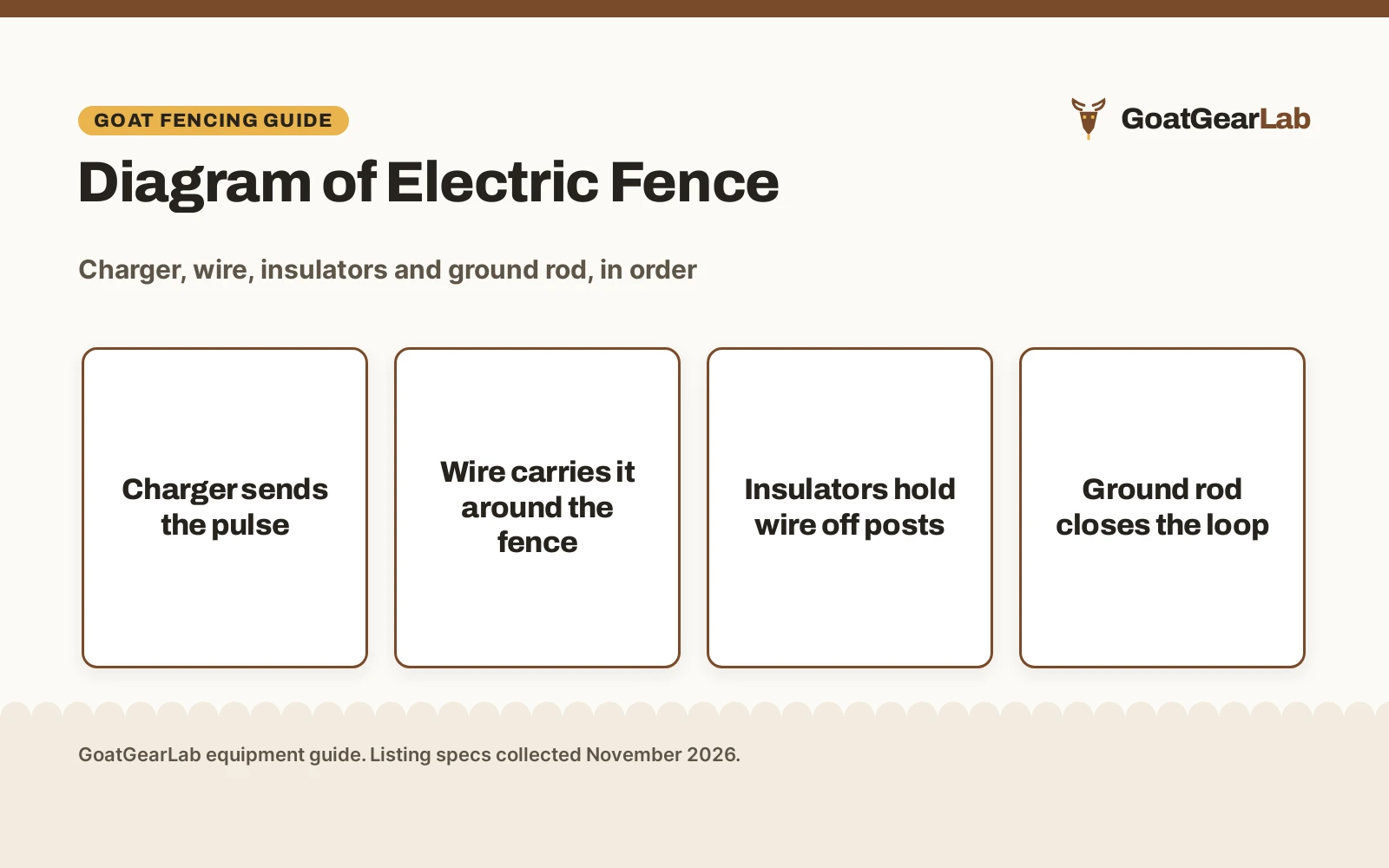
Read a fence diagram from the charger outward. The charger, also called an energizer, sends a short pulse down the fence wire at set intervals. Insulators hold the wire away from posts and rails so the pulse stays in the wire. When an animal touches the wire, the pulse passes through the animal into the soil and back to the charger through the ground rod, which closes the loop. A diagram shows that loop as a ring: charger to wire, wire to animal, animal to soil, soil to ground rod, ground rod to charger. If the wire sags onto a post, a strand breaks, or the ground rod sits in dry soil, the loop breaks and the fence stops working.
The figures on a diagram come from the charger listing. A plug-in MorningRo kit (on Amazon) lists 1 joule and 25 miles of coverage on 110V AC power, while a plug-in CimoroWin kit lists 0.1 joule, 5000V output and 2 miles of coverage. A REEPLAR solar netting kit (on Amazon) lists a 0.25 joule solar energizer with a 47 inch by 164 foot net. Joules, miles and volts describe the charger, not the fence wire, so compare chargers on those figures and wire on length and gauge.
The parts on the diagram
Every electric fence diagram shows the same parts, whether the fence is a strand of wire or a roll of netting. The table below names each part, what it does, and a figure from a listing that shows it.
| Part | What it does | Figure from a listing |
|---|---|---|
| Energizer | Sends pulses down the wire | MorningRo: 1 joule, 25 miles, 110V AC |
| Wire or polywire | Carries the pulse around the fence | MorningRo: 250ft 14AWG aluminum wire |
| Insulators | Hold wire off posts and rails | MorningRo: 50 insulators; CimoroWin: 20 insulators, 40 T-post insulators |
| Ground rod | Returns the pulse to the charger | REEPLAR: grounding rod included; MorningRo: rod sold separately |
| Netting | Wire and posts in a moveable roll | REEPLAR: 47 inch by 164 foot net, 15 posts |
The energizer
The energizer is the box on the diagram, usually drawn near a barn outlet or a solar panel. Plug-in models run on household power: the MorningRo kit lists 110V AC power with 1 joule and 25 miles of coverage, and the CimoroWin kits list 5000V output with 0.1 joule and 2 miles of coverage. Solar models carry their own panel: the REEPLAR kit lists a 0.25 joule solar energizer. Match the energizer to the fence length on the listing, and keep the charger under cover where the manual directs.
The wire
The wire is the line on the diagram, drawn as a strand around the posts. Aluminum wire suits permanent runs: the MorningRo kit lists 250ft of 14AWG aluminum wire with a 90 lbs breaking load, and says it will not rust in rain, snow or heat. Polywire suits portable runs: the CimoroWin kit (on Amazon) lists a 200m polywire roll, 656 feet long, with 6 interwoven stainless steel wires and 20 nylon ropes, at 0.12 inches in diameter. A longer roll covers more ground: another CimoroWin kit lists a 400m polywire roll, 1312 feet long.
Insulators and posts
Insulators are the small blocks on the diagram where wire meets post. They keep the pulse in the wire instead of leaking into a wooden post or a steel T-post. The MorningRo kit lists 50 insulators with a socket tool, and the CimoroWin kit lists 20 insulators with a socket plus 40 T-post insulators. The insulators in these kits use a PP and PE material mix, and the CimoroWin insulators list self-tapping screws with a notched design for wooden fences. Netting skips separate insulators: the REEPLAR net lists 15 preinstalled PVC posts with 6 inch galvanized double-spiked stakes, and vertical struts spaced every 6.3 inches.
The ground rod and the return path
The ground rod is the short line on the diagram that runs from the charger into the soil. It gives the pulse a path home after it passes through an animal and into the ground. The MorningRo kit says to purchase a ground rod separately, while the REEPLAR kit includes a grounding rod that doubles as a mount for the solar energizer. A fence with a weak return path feels weak at the far end, so site the rod in soil that stays damp and check the charger manual for rod placement.
Reading the loop: how the pulse travels
Follow the pulse around the diagram in order. The charger sends a pulse into the lead-out wire, the lead-out wire carries it to the fence wire, and the fence wire carries it around the posts on insulators. An animal that touches the wire while standing on the ground feels the pulse, and the pulse travels through the animal into the soil. From the soil it travels to the ground rod and back to the charger, which closes the loop and readies the next pulse. The MorningRo listing describes the pulse as short and at a safe level, designed to deter without lasting harm. When a fence stops working, walk the loop in the same order: charger, lead-out, wire, insulators, ground rod.
Plug-in, solar and netting layouts
Plug-in kits suit a fixed fence near power. The MorningRo kit runs on 110V AC with 1 joule and 25 miles of coverage, and the CimoroWin kits run on plug-in power with 5000V output, 0.1 joule and 2 miles of coverage, or 8 acres on the 63-piece kit. Solar kits suit a fence away from power: the REEPLAR kit pairs a 0.25 joule solar energizer with a net, so the charger and the fence move together. Netting suits a moveable pen: the REEPLAR net measures 47 inch by 164 foot, with 11 horizontal strands, 10 of which are conductive, and 15 preinstalled posts. A strand fence suits a fixed boundary, while a net suits rotational grazing and garden protection that moves with the season.
What this guide does not cover
This guide covers fence hardware only. It does not give fence heights, wire spacing, grounding depth or pulse settings, because those depend on the animals, the ground and the charger manual. Check the charger manual and the kit listing for the figures that fit your fence, and ask your local extension office about layout for your area. Keep warning signs on the fence where people pass, as the REEPLAR kit includes a warning sign with its netting.
FAQs from goat keepers
What parts does an electric fence diagram show?
A charger, fence wire, insulators, posts and a ground rod, with a lead-out wire joining the charger to the fence. Netting diagrams show the same loop with the wire and posts built into a roll.
How does an electric fence shock work?
The charger sends a short pulse down the wire. An animal touching the wire completes the circuit through the soil to the ground rod and back to the charger. The MorningRo listing describes the pulse as short and at a safe level, designed to deter without lasting harm.
What is the difference between polywire and aluminum wire?
Polywire is a woven line: the CimoroWin kit lists a 200m polywire roll, 656 feet long, with 6 stainless steel wires and 20 nylon ropes at 0.12 inches in diameter. Aluminum wire is a metal strand: the MorningRo kit lists 250ft of 14AWG aluminum wire with a 90 lbs breaking load.
How far can a charger cover?
It depends on the charger. The MorningRo kit lists 1 joule and 25 miles, the CimoroWin kits list 0.1 joule and 2 miles, and the REEPLAR solar kit covers a 47 inch by 164 foot net. Match the charger to the fence length on the listing.
Does an electric fence need a ground rod?
Yes. The pulse returns to the charger through the ground rod, so the loop needs it. The REEPLAR kit includes a grounding rod, while the MorningRo kit says to purchase a ground rod separately.
Can I move an electric fence?
Netting moves most easily: the REEPLAR kit is a portable net with preinstalled posts that you can shift to fresh ground. The MorningRo kit is designed for portable and permanent fencing, so a strand fence can move too, with the posts and wire taken down and set up again.
More from the barn
See every goat fencing guide and all fencing and shelter guides.
More picks: solar fence chargers, electric fence installation, checking an electric fence and fence post caps.