

On this page
Top picks at a glance
As an Amazon Associate I earn from qualifying purchases.
- 1
 Wall Mount Hay Rack 16 Gallon 27'' Long Livestock Hay Feeder9.7/10View on Amazon
- 2
 Martx 5x5ft Round Bale Hay Net9.7/10View on Amazon
- 3
 Bloomoak Slow Hay Net Feeder for Horses9.6/10View on Amazon
- 4
 Livestock Hay Feeder 35 Gallon Heavy Duty Livestock FeederView on Amazon
- 5
 Goat Hay FeederView on Amazon
- 6
 Partrade Trading Corporation Ultra Slow Feeder Hay Net Brand:View on Amazon
- 7
 Partrade Trading Corporation Ultra Slow Feeder Hay Net BlackView on Amazon
- 8
 Country Pride Ultra Slow Feeder Hay NetView on Amazon
Morning chores: half the hay you put out last night is trampled into the bedding, and the goats are standing on the fence eyeing the round bale. In the hay feeder vs hay net debate, the short answer is that a rigid feeder wastes less hay day to day and is easier to fill, while a net slows down fast eaters and suits travel or tight spaces. This guide walks through how each one works, what the listings state for size and build, and which suits your herd.
Also worth comparing
 Livestock Hay Feeder 35 Gallon Heavy Duty Livestock FeederCheck price on Amazon
 Goat Hay FeederCheck price on Amazon
 Bloomoak Slow Hay Net Feeder for HorsesCheck price on Amazon
 Partrade Trading Corporation Ultra Slow Feeder Hay Net Brand:Check price on Amazon
 Partrade Trading Corporation Ultra Slow Feeder Hay Net BlackCheck price on Amazon
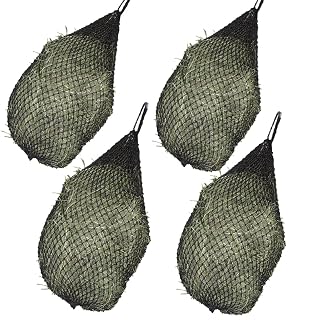 Country Pride Ultra Slow Feeder Hay NetCheck price on Amazon
GoatGearLab earns a commission when you buy through links on this page, at no extra cost to you. As an Amazon Associate I earn from qualifying purchases. Affiliate disclosure.
Hay feeder vs hay net: the short answer
A hay feeder is a rigid rack, manger or bin that holds hay off the ground; goats pull flakes through bars or over an edge. A hay net is a knotted mesh bag or net you fill and hang; goats work hay through the holes, which slows them down. Pick the feeder for everyday feeding of the herd, and the net when you want to slow intake, feed on the move, or fit hay into a tight spot like a trailer. Many keepers use both: feeder in the barn, net for travel.
What each one looks like
Feeders come as wall racks, manger boxes and freestanding bins in metal, wood or plastic. In the reference listings, metal rack feeders run from 6.9 x 4.7 x 6.6 inches (CAIQINLI) to 9.7 x 4.7 x 6.6 inches (Harhana), and a wooden manger listing (Niteangel) gives 9.6 x 5.7 x 13.8 inches at 1.9 pounds. Nets are simpler: a fabric hay bag listing (UPINS) gives 28 x 25 cm with 2 feeding holes. Those listings target small animals, so scale up for goats and measure your animals before buying. For the full rundown of feeder styles, see how to choose a hay feeder for goats.
Waste: the real cost
Hay on the ground becomes bedding, and goats will not eat soiled hay. A feeder with a catch tray or sealed bottom keeps more hay in front of the goat; the Harhana listing notes a sealed bottom that contains hay. Nets also cut waste because the goat can only pull small mouthfuls through the mesh. Either beats feeding on the ground. If waste is your main complaint, the feeder usually wins for a whole herd, since one filling serves many animals at once.
Safety around horns and legs
This is where the two differ most. A rigid feeder has fixed bars; the Harhana listing mentions a narrower gap so small animals will not get heads stuck, which is the right thing to check on any feeder. Nets are softer, but the mesh can catch a horn or a leg if the holes are large or the net hangs low. Hang nets high and tight, check them daily for holes, and retire a net with torn mesh. Never hang a net where a goat can get tangled while you are away.
Capacity and filling
A feeder holds a volume you can see: the Harhana lists 1.1 quarts capacity at 14.4 ounces weight, and CAIQINLI racks list enough hay for a day per their descriptions. A net holds what fits in the bag; the UPINS bag is 28 x 25 cm. For a herd, a feeder you fill once a day beats refilling several nets. For one or two goats, or for travel, a net is quicker to hang and lighter to carry.
Which one should you buy
Buy the feeder if you feed a herd every day and want the least waste with the least fuss. Buy the net if you have a fast eater to slow down, travel with goats, or need hay in a spot where no rack fits. If you can only buy one, start with the feeder; add a net later for the trailer or for the goat that inhales her dinner. See our best hay feeder for goats and best hay net for goats lists when you are ready to shop.
FAQs from goat keepers
Can goats eat from a hay net safely?
Yes, with care. Hang the net high and tight so legs and horns cannot reach through slack mesh, and check it daily for torn holes. Retire damaged nets.
Do hay nets reduce waste?
They do, because goats pull small mouthfuls through the mesh instead of dragging out flakes. A feeder with a catch tray wastes less still for a whole herd.
What size feeder do my goats need?
Measure your goats, not the listing photos. Reference listings for rack feeders run from 6.9 x 4.7 x 6.6 inches (CAIQINLI) to 9.7 x 4.7 x 6.6 inches (Harhana); those target small animals, so size up for goats.
Can I use a feeder and a net together?
Many keepers do. Use the feeder for daily barn feeding and the net for travel, shows, or the one goat that needs slowing down. See slow feed vs free choice hay for the feeding-rate side.
More from the barn
See every hay feeder guide and all feeding and water guides. Also see our hay net vs hay rack. Also see our wood vs metal hay feeder. Also see our wall mount vs hanging hay feeder.
More picks: slow feed hay nets for goats, hay net guides and slow feed vs free choice.