

On this page
Top picks at a glance
As an Amazon Associate I earn from qualifying purchases.
- 1
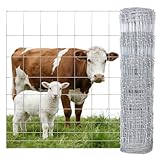 Cattle Panel 4ft x 165ft 14 Gauge Galvanized Woven Wire Fence9.7/10View on Amazon
- 2
 ZESHANGUS Cattle Panel 14 Gauge Galvanized Woven Wire Fence9.6/10View on Amazon
- 3
 Proster Hog Ring Pliers Kit with 2500 Rings9.6/10View on Amazon
A goat with its head through the fence rails turns morning chores into a rescue mission, and the panel you fence with decides whether it happens once or every day. This guide answers hog panels vs goat panels directly: both are wire livestock panels, but goat panels use tighter bottom mesh that stops goats slipping through, while hog panels keep a uniform grid that suits pigs. Four Amazon listings show how the difference works in practice: a woven roll the maker positions for both jobs, two PVC-coated welded wire rolls and one handling board, compared on mesh size, wire gauge, roll length and what each listing actually states.
GoatGearLab earns a commission when you buy through links on this page, at no extra cost to you. As an Amazon Associate I earn from qualifying purchases. Affiliate disclosure.
hog panels vs goat panels: the short answer
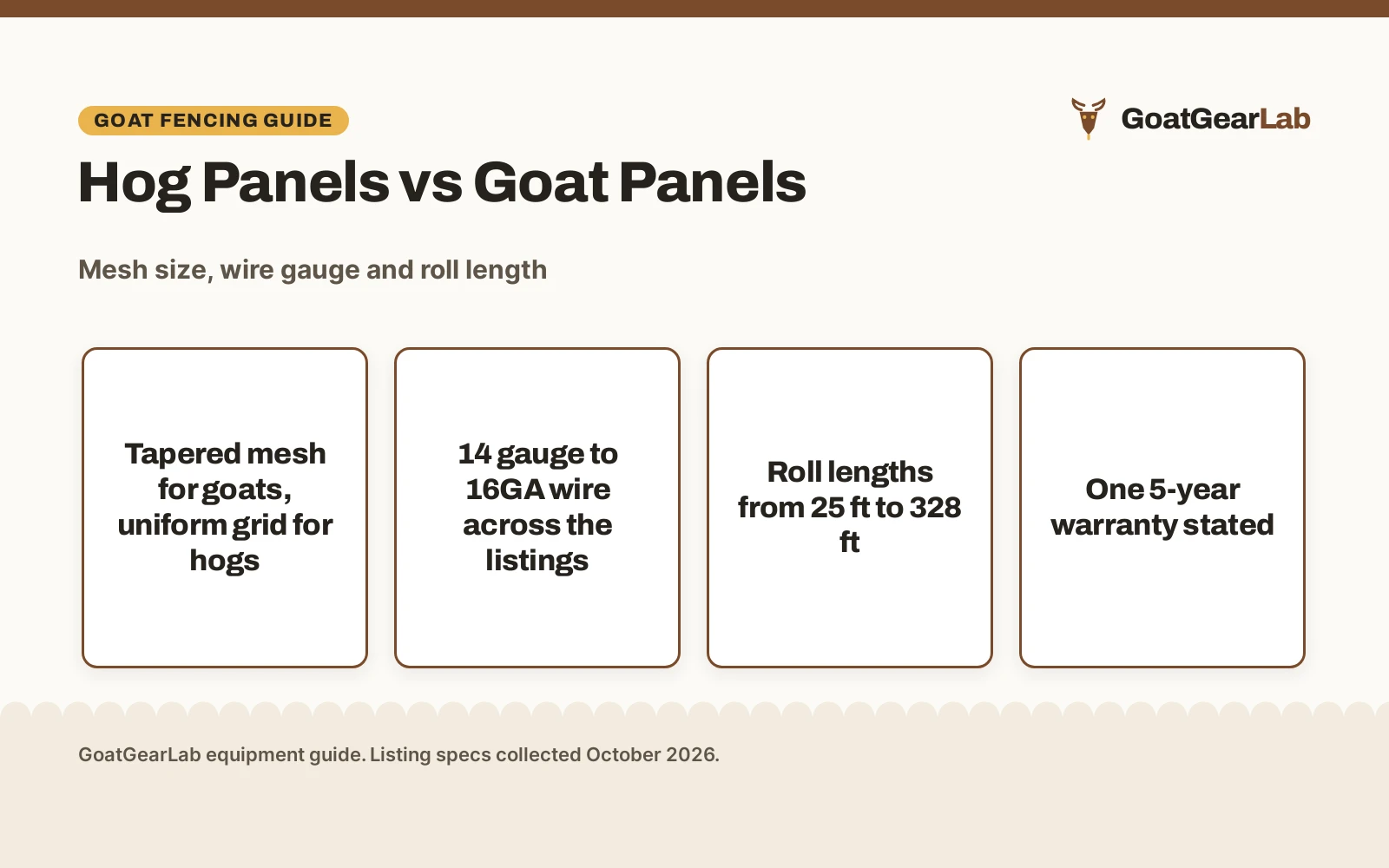
Choose a panel with tight bottom mesh for goats and a uniform grid for hogs. The ZESHANGUS listing, the one roll below marketed for both jobs, lists a tapered mesh that narrows from 8 inches at the top to 3.5 inches at the bottom, with the wider top for visibility and the tighter bottom to stop small animals from slipping out. That taper is the maker’s answer to the goat half of hog panels vs goat panels. The two welded wire rolls below keep a uniform grid, 2 by 2 inches on the GILPWA and 2 by 3 inches on the DWALE, which matches how hog panels are usually built. The Weaver listing is a different thing entirely: a 37 by 30 inch hand-carried sorting board for moving animals, not a fence panel.
For the companion comparison of hog panels against welded wire in general, see hog panels vs welded wire fence.
The four listings compared
The gear section below features all four listings from the comparison set, ranked in this order.
| Listing | Stated size | Wire | Mesh opening |
|---|---|---|---|
| ZESHANGUS woven livestock roll | 4 ft x 328 ft | 14 gauge, 12 gauge border | 8 to 3.5 in, tapered |
| GILPWA PVC-coated welded wire roll | 36 in x 50 ft | 16GA | 2 x 2 in |
| DWALE PVC-coated welded wire roll | 36 in x 25 ft | 16GA | 2 x 3 in |
| Weaver Livestock sorting board | 37 x 30 in | Not stated | Not a fence panel |
ZESHANGUS woven livestock roll
The listing states a 4 ft by 328 ft roll of woven wire fence built with 14 gauge galvanized steel wire and a 12 gauge reinforced border. The mesh openings taper from 8 inches at the top down to 3.5 inches at the bottom, and the maker claims the wider top keeps visibility while the tighter bottom keeps small animals in. The listing names goat fence and hog wire fence panels among its uses, which is why it anchors this comparison. The maker states 15 to 20 years of service in normal environments and 10 to 15 years in extreme conditions, and says one person can handle the roll.
GILPWA PVC-coated welded wire roll
The listing states a 36 in by 50 ft roll of welded wire fencing with 2 by 2 inch mesh and 16GA inner wire, galvanized inside and coated in black vinyl outside. The unit count is stated as 150 square feet. The listing mentions T posts or wooden boxes as mounting options and says the mesh can be cut with scissors. It is the only listing of the four to state a warranty: 5 years on all products, with return or refund within 24 hours if the buyer is not satisfied.
DWALE PVC-coated welded wire roll
The listing states a 36 in by 25 ft roll of welded wire fence with 2 by 3 inch openings and 16 gauge wire, galvanized inside with a double-layer PVC coating outside. The maker claims the 16-gauge construction is significantly stronger than common 19-gauge alternatives. The item weight is stated as 8.58 pounds and the package measures 37 x 6 x 6 inches. The listing names hog panels, deer fencing and livestock barriers among its uses, and also describes the mesh as goat and poultry netting. No warranty term is stated.
Weaver Livestock sorting board
The listing is for a hand-carried sorting board, 37 x 30 inches in the title and 9.28 pounds, in purple, with grip holes on the sides. It is made to guide animals between pens, barns and show rings, and the listing names pigs, hogs, cattle, sheep and goats among the animals it suits. It is not a fence panel and does not contain wire, mesh or a gauge, so it ranks last for this topic. Note the size contradiction: the spec table lists 1.5 x 38 x 30.5 inches against the title’s 37 x 30 inches.
Mesh size: the goat side of the question
Mesh size is where goats and hogs diverge. A goat tries every opening with its head, so the listings aimed at goats tighten the bottom: the ZESHANGUS roll narrows from 8 inches at the top to 3.5 inches at the bottom and the maker claims this stops small animals slipping out. Hogs push with their bodies against a uniform grid, which is how the 2 by 2 inch GILPWA and 2 by 3 inch DWALE meshes are built. If your pen holds goats, pick the tapered pattern; if it holds pigs, the uniform grid is the pattern the listings describe. Do not treat any fence as a containment promise: the claims above are the makers’ claims, reported exactly as each listing states them.
Wire gauge and coatings
Wire gauge runs from 14 on the ZESHANGUS roll to 16GA on the two welded rolls, with the ZESHANGUS adding a heavier 12 gauge border wire for stiffness. Lower gauge numbers mean thicker wire, so the ZESHANGUS lists the heaviest wire of the four. Coatings differ too: the ZESHANGUS relies on hot-dip galvanization, while the GILPWA and DWALE rolls add a vinyl or PVC coating over galvanized wire. The maker claims for the coatings are rust and weather protection, and the GILPWA listing adds a smooth surface that does not harm animals. All four listings describe these coatings as the maker’s claim rather than a measured fact.
Roll length and the sorting board
The stated roll lengths run from 328 ft on the ZESHANGUS roll to 50 ft on the GILPWA and 25 ft on the DWALE. A longer roll means fewer joins on a long fence run, while a 25 ft roll suits a small pen or a repair. The Weaver board at 37 by 30 inches is not a fence at all: it is a handling tool, and it belongs in this comparison only to show what a panel is not. For pen gates and hardware that goes with any panel fence, see best gate hinge for goat pens.
Read the listing twice
Two of the four listings contradict themselves on size, and the conflicting number is usually the one you need for planning posts and runs:
- GILPWA: 36 in by 50 ft in the title and bullets, against 300″L x 25″W in the spec table. Trust the title and bullets.
- Weaver: 37 x 30 inches in the title, against 1.5 x 38 x 30.5 inches in the spec table and 39.25 x 31 x 2.37 inches for the package. Trust the title.
Also note what is missing: only the GILPWA listing states a warranty, with a 5-year term, while the other three state none. And the DWALE and GILPWA listings quote no mesh size besides their stated openings, so there is no stated bottom mesh to compare against the ZESHANGUS taper.
What this guide does not cover
This guide covers panel hardware only. It does not cover fence posts, which the cedar vs redwood fence posts guide compares, and it does not cover electric fencing or chargers. For a different wire choice entirely, see barbed wire vs cattle panel.
FAQs from goat keepers
What is the difference between hog panels and goat panels?
Hog panels use a uniform grid that suits pigs, while goat panels tighten the bottom mesh so goats cannot slip through. The ZESHANGUS listing below shows the pattern: a taper from 8 inches at the top to 3.5 inches at the bottom, with the tighter bottom positioned for goats.
Is 16-gauge wire strong enough for livestock panels?
The two welded rolls below list 16GA wire, and the DWALE maker claims 16-gauge construction is significantly stronger than common 19-gauge alternatives. The ZESHANGUS roll lists heavier wire: 14 gauge with a 12 gauge reinforced border.
How long do these listings say a panel roll lasts?
The ZESHANGUS listing states 15 to 20 years in normal environments and 10 to 15 years in extreme conditions. The GILPWA listing states a 5-year warranty, with return or refund within 24 hours. The other two listings state no warranty term.
Is a sorting board the same as a fence panel?
No. The Weaver listing is a hand-carried handling board, 37 x 30 inches and 9.28 pounds, made to guide animals between pens. It contains no wire or mesh and is not a fence panel.
More from the barn
See every goat fencing wire guide and all fencing and shelter guides.
More picks: hog panels vs welded wire fence, barbed wire vs cattle panel, gate hinges for goat pens and cedar vs redwood fence posts.