

On this page
Top picks at a glance
As an Amazon Associate I earn from qualifying purchases.
- 1
 TIBEGOLD Chain Link Fence Butterfly Gate Latch for 1-3/8 Inch9.6/10View on Amazon
- 2
 APEXGATE 2-Way Lockable Gate Latch for 1 5/8 to 2 Inch Round9.7/10View on Amazon
- 3
 XIEKRAB 2-Way Lockable Gate Latch for 1-5/8 to 2 Inch Round9.6/10View on Amazon
- 4
 Metal Fence Post 4 Feet GreenView on Amazon
- 5
 XtremepowerUS 1500W Electric Post Hole Digger Earth Auger DigView on Amazon
- 6
 Metal Garden Fence PostsView on Amazon
- 7
 1 Pack 24 Inch Black Fence Post Driver with Handle 34LB IronView on Amazon
- 8
 VEVOR 3 ft Fence PostView on Amazon
- 9
 MTB Supply 1 Pack 24 Inch Fence Post Driver with Handle 12LBView on Amazon
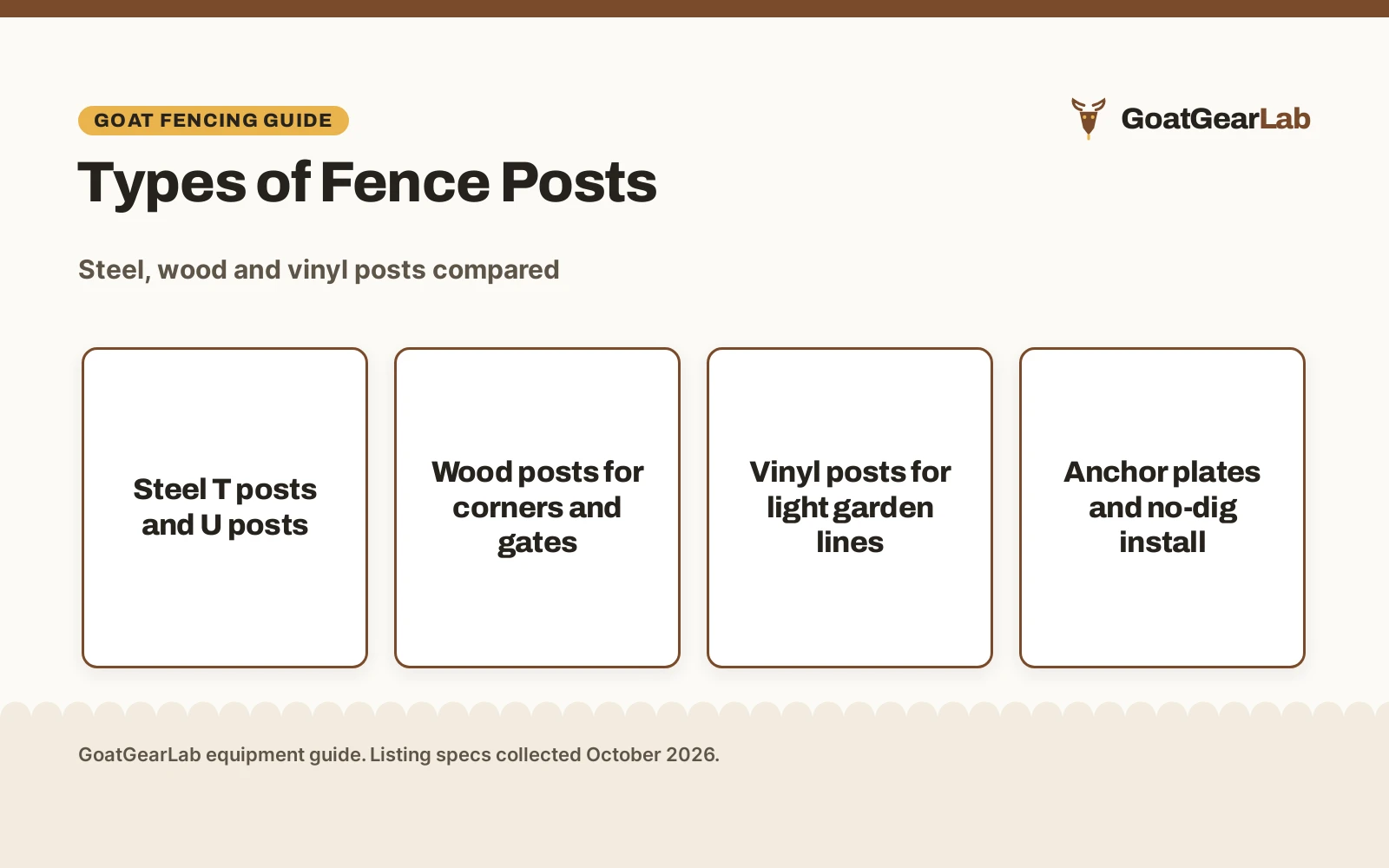
Types of fence post decide how a goat fence stands, because the posts carry the wire while goats lean, rub and push on the line each morning. This guide walks through steel T posts, steel U posts, wood posts and vinyl posts, and how each kind holds wire, stands in the ground and fits a goat yard. Read the post types below, then match the post to the fence, the ground and the gate.
Also worth comparing
 Metal Fence Post 4 Feet GreenCheck price on Amazon
 XtremepowerUS 1500W Electric Post Hole Digger Earth Auger DigCheck price on Amazon
 Metal Garden Fence PostsCheck price on Amazon
 1 Pack 24 Inch Black Fence Post Driver with Handle 34LB IronCheck price on Amazon
 VEVOR 3 ft Fence PostCheck price on Amazon
 MTB Supply 1 Pack 24 Inch Fence Post Driver with Handle 12LBCheck price on Amazon
GoatGearLab earns a commission when you buy through links on this page, at no extra cost to you. As an Amazon Associate I earn from qualifying purchases. Affiliate disclosure.
Types of fence post: the short answer
Steel T posts suit wire fence lines, steel U posts suit light wire and garden fence with no digging, wood posts suit corners, gates and heavy wire, and vinyl posts suit light garden lines where goats do not lean hard. Pick the post by the fence it must hold, the ground it must stand in, and whether the line needs a corner, a gate or a straight run. A post that fits the wire and the ground lasts, while a post that fits neither sags with the fence.
Post types at a glance
| Post type | Material | How it goes in | What it holds |
|---|---|---|---|
| Steel T post | Steel | Driven into the ground | Wire and electric fence |
| Steel U post | Steel | Pushed in, anchor plate flush | Wire, garden and mesh fence |
| Wood post | Wood | Set in a dug hole, often with concrete | Woven wire, gates and corners |
| Vinyl post | Vinyl | Set in a dug hole | Light garden fence |
Steel T posts
A steel T post has a T-shaped cross-section with studs along the face, and clips snap onto the studs to hold wire and insulators away from the metal. T posts suit long wire lines and electric fence, where the wire must stay at a set line and the post must stand firm while goats lean on it. Corner posts and gate posts need more than a line T post: a corner takes the pull of wire from each direction, so a wood post or a braced steel post carries that load better. When a line changes direction or ends at a gate, plan a stronger post there and keep T posts for the straight runs between.
Steel U posts
A steel U post has a U-shaped channel with an anchor plate at the base and hooks that adjust to hold wire fence. The cited listing from HuaSheWJ gives a green metal U post at 4 feet in a pack of 10, made to push straight into the ground with the anchor plate flush with the ground and cable ties to fix the fence to the post. The listing gives nano-paint on the surface to prevent rust and corrosion. No digging is needed, which suits garden fence, lawn edging and light wire mesh where the ground is soft enough to take the post. U posts suit light work: a long goat fence with heavy wire and daily leaning needs a heavier post, while a garden line or a short run of mesh fence sits well on U posts.
Wood posts
Wood posts suit corners, gates and ends, where the fence changes direction or hangs a gate and the post must hold a steady load. A wood post goes into a dug hole and often sits in concrete, which holds it upright while wire pulls from each side and goats lean on the line. Cedar and cypress are common wood choices for outdoor posts, and the cedar vs cypress fence posts guide compares cedar and cypress. Wood needs more work at install than a driven steel post, and a wood post that rots at the ground line loses the fence, so check the base when the seasons change.
Vinyl posts
Vinyl posts suit light garden fence and yard lines where the fence marks a boundary rather than holding goats back from a push. Vinyl will not rust, and it needs no paint, but it bends under a steady load, so a goat that leans hard on a vinyl line will bow the post and slacken the wire. The vinyl vs steel fence posts guide compares vinyl and steel for strength and use. Save vinyl for garden beds, flower lines and light mesh, and keep steel or wood where goats press on the fence each day.
Corners, gates and line posts
A fence line asks its posts to do a few jobs: straight runs, corners and gates, and each job wants a different post. Line posts carry wire along a straight run and can be lighter, since the wire pulls evenly from each side. Corner posts take the pull of wire from each direction at once, so they need depth, bracing or a heavier post, and a corner that leans will slacken the whole line. Gate posts carry the gate and the pull of the gate hardware, so they need the same strength as a corner post, and a sagging gate often means a gate post that has shifted in soft ground. Plan the corners and gates with wood or braced steel, then fill the runs between with T posts or U posts that match the wire.
Setting a post: dig, drive or push in
How a post goes into the ground decides how it stands up to leaning goats and pulling wire. A wood post goes into a dug hole, and concrete around the base holds it upright while the wire pulls; the how to set fence post in concrete guide walks through that method. A steel T post drives into the ground with a manual fence post driver, which suits firm ground and long lines where digging each hole would take too long. A steel U post pushes straight in with the anchor plate flush with the ground and no digging at all, which suits soft ground and light fence. Match the method to the ground: hard, rocky ground resists a driven post, soft ground lets a pushed post sink, and a post set in concrete needs time to set before the wire goes on.
Matching the post to the fence
Match the post to the wire it must hold. Woven wire and welded wire need posts that stand firm and hold the mesh at a set line, so steel T posts and wood posts suit those fences. Electric fence needs posts with insulators or clips that hold the wire away from metal, so steel T posts with T-post clips suit that fence, while wood posts take insulators screwed or nailed to the face. Poly tape and light mesh need less strength, so U posts suit garden lines and short runs. When the fence must hold goats that lean and rub, pick the heavier post and brace the corners; when the fence only marks a garden bed, a light post will do.
What this guide does not cover
This guide covers post types only. It does not cover wire types, fence chargers or electric fence setup, and it does not cover how much fence a goat needs or any health question. Ask your veterinarian or local extension office about goat health, and see the electric fence how to install guide for the wire side of the fence.
FAQs from goat keepers
What is the best fence post for goats?
Steel T posts suit wire fence lines, wood posts suit corners and gates, and U posts suit light garden lines. Match the post to the fence, the ground and the gate, and brace the corners where the wire changes direction.
Do fence posts need concrete?
Wood posts often sit in concrete at corners and gates, while steel T posts drive in and steel U posts push in with no digging. Concrete suits a post that must hold a steady load, and a driven or pushed post suits a straight line in firm ground.
How tall should a fence post be?
The cited U post listing from HuaSheWJ gives 4 feet in a pack of 10. Match the post to the fence it must hold and the ground it goes into, and check the listing for the size before ordering.
What is the difference between a T post and a U post?
A T post has a T-shaped cross-section with studs that take snap-on clips, while a U post has a U-shaped channel with an anchor plate and adjustable hooks. T posts suit long wire lines, and U posts suit light wire and garden fence with no digging.
Can you use T posts for electric fencing?
Yes, with clips or insulators that hold the wire away from the metal post. T-post clips snap onto the studs and hold the wire, and wood posts take insulators on the face instead.
Do goats push over fence posts?
Goats lean and rub on fence lines, so a post that stands in soft ground or at a corner can shift over time. Brace corners, set gate posts with care, and walk the line to check for posts that lean.
More from the barn
See every goat fencing guide and all fencing and shelter guides.
More picks: best fence for goats and sheep, electric fence charger for goats, electric netting for goats and goat shelters.