

On this page
Top picks at a glance
As an Amazon Associate I earn from qualifying purchases.
- 1
 Maxsa Farm Fence 5ft x 328ft9.6/10View on Amazon
- 2
 Garvee Farm Fence 5ft x 328ft9.6/10View on Amazon
- 3
 EliteEdge Farm Fence 4ft x 328ft9.6/10View on Amazon
- 4
 Zareba 17 Gauge Aluminum Wire for Electric FencingView on Amazon
- 5
 Freeman 10.5-Gauge Fencing StaplesView on Amazon
- 6
 VEVOR Electric Fence TapeView on Amazon
- 7
 Electric Fence Tape for LivestockView on Amazon
- 8
 Freeman 16-Gauge Fencing StaplesView on Amazon
- 9
 One Man Fencing PM Livestock Panel T-Post ConnectorView on Amazon
Morning chores start with hay on the ground and a goat with her head through the fence, reaching for the green patch on the far side. Types of livestock fencing fall into a few main groups: woven wire rolls, welded wire, no-dig panel fence, rigid livestock panels and electric fencing, and the right pick depends on the animals, the ground and how often the fence needs to move. This guide walks through each type with the sizes, gauges and panel counts the listings state, so you can match the fence to the pen before you order.
Also worth comparing
 Zareba 17 Gauge Aluminum Wire for Electric FencingCheck price on Amazon
 Freeman 10.5-Gauge Fencing StaplesCheck price on Amazon
 VEVOR Electric Fence TapeCheck price on Amazon
 Electric Fence Tape for LivestockCheck price on Amazon
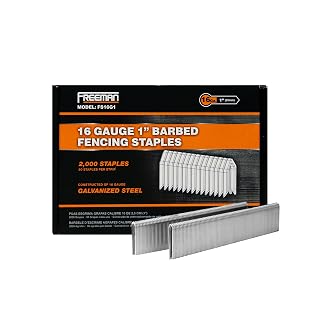 Freeman 16-Gauge Fencing StaplesCheck price on Amazon
 One Man Fencing PM Livestock Panel T-Post ConnectorCheck price on Amazon
GoatGearLab earns a commission when you buy through links on this page, at no extra cost to you. As an Amazon Associate I earn from qualifying purchases. Affiliate disclosure.
Types of livestock fencing: the short answer
Start with the animals and the ground, then pick the type, then check the stated size and build. Woven wire rolls suit long runs of pasture fence. No-dig panels suit garden beds, patios and short runs where digging post holes is out of the question. Rigid panels suit pens, stalls and sorting areas where the fence needs to hold its shape. Electric fencing suits a line that needs to move with grazing or back up a wire fence. After the type is settled, compare the stated height, length, gauge and panel count, and read the listing again for figures that do not line up.
For wire sized for goats, see the goat fencing wire guides, which cover the wire styles in this guide in more depth.
Fence types compared
| Type | Example listing | Stated size | Build |
|---|---|---|---|
| Woven wire roll | Garvee 4 ft x 328 ft | 4 ft x 328 ft | Galvanized steel, 14 gauge |
| Woven wire roll | GarveeTech 5 ft x 328 ft | 5 ft x 328 ft | Galvanized steel, 12 gauge |
| Woven wire roll | Garvee 4 ft x 345 ft | 4 ft x 345 ft | Galvanized steel |
| No-dig panel fence | jinligogo 48 in x 23.6 ft | 48 in x 23.6 ft, 10 panels | Welded steel, powder-coated |
| No-dig panel fence | FXW 50 in x 20.8 ft | 50 in x 20.8 ft, 8 panels | Metal, rounded ball-tip stakes |
| No-dig garden fence | Zippity 35 in x 42 in | 35 in x 42 in, 2 panels | Poly-steel, plastic-coated |
| Rigid panels | Rite Farm aluminum panels | 5 ft long, 40 in tall, 6 rail | Welded aluminum |
| Portable corral | YOHKOH octagonal pen | 8 panels | Carbon steel |
Woven wire rolls
Woven wire comes as a roll that unrolls along a line of posts. The Garvee listings state rolls of 4 ft x 328 ft and 4 ft x 345 ft in 14 gauge, and a GarveeTech listing states a roll of 5 ft x 328 ft in 12 gauge. The weave uses a hinge knot on the GarveeTech roll, and the Garvee rolls describe a graduated mesh that gets smaller toward the bottom, which keeps small animals from slipping through the lower part of the fence. The maker lists the wire as high-tensile galvanized steel with a thick zinc coating, and the Garvee 4 ft x 328 ft listing states that gloves and zip ties ship with the roll. A roll suits a long pasture boundary, and it needs posts and tensioning to hold its shape.
Welded wire and no-dig panels
No-dig panel fence arrives as panels that join with stakes, with no post holes to dig. The jinligogo listing states a run of 48 in high by 23.6 ft long with 10 panels and a gate, in welded steel with a black powder-coated finish, and lists height options of 24, 32, 40 and 48 inches. The FXW listing states a run of 50 in high by 20.8 ft long with 8 panels, and the bullets describe each piece as 2.61 ft wide with a 4.5 ft stake, 9 stakes in all. The Zippity kit states 2 panels, each 35 in high by 42 in wide, with 3.5 in picket spacing, a weight of 11.5 pounds and around 60 minutes for assembly of the 2 panels. Panels like these suit garden beds, patios and short runs, and they can be lifted and rearranged when the layout changes.
Rigid livestock panels
Rigid panels hold their shape without tensioning, which makes them handy for pens, stalls and sorting areas. The Rite Farm listing states a 4 pack of aluminum panels, each 5 ft long and 40 in tall with 6 rails, at 36 pounds, and the spec table states a 1 year warranty. The YOHKOH listing states a portable corral of 8 panels in an octagonal layout, in carbon steel with a high-temperature curing finish, at 81.0 pounds, and the panels stack flat for storage. A clamp set helps tie panels to lumber: the Conderyang listing states an 8 pack of clamps that fit 1-5/8 in round pipe with 2 in thick boards, each clamp with a carriage bolt and a 3/8 in nut.
Electric fencing
Electric fencing uses strands or tape that carry a charge from a charger, and it works as a stand-alone line or as a backup on a wire fence. It suits a line that moves with grazing, a strip of pasture that needs a rest, or a boundary where a full wire fence is more than the job needs. The charger, the grounding and the insulators matter as much as the strand itself, and the fence needs clear vegetation along the line to keep the charge where it belongs. Our woven wire vs electric fence for goats comparison walks through where each style fits.
Reading roll size and gauge
Roll size is stated as height by length, and the listings here give 4 ft x 328 ft, 4 ft x 345 ft and 5 ft x 328 ft. Height sets how much of the animal the fence covers, and length sets how far a roll runs before a splice or a new roll is needed. Gauge describes the wire: the listings state 12 gauge and 14 gauge, and a lower gauge number means thicker wire. Check the gauge on the variation you pick, and check the height the same way, because height options vary from listing to listing.
Length also decides how many rolls a run needs, so measure the line before ordering and allow for gates and corners. A roll that ends short of the gate leaves a gap to close with a panel or an extra roll, so walk the line with the figures from the listing in hand.
Panels, posts and fixings
Panels need posts, stakes or clamps to stay upright, and the listings state what ships with each set. The FXW set states 9 stakes at 4.5 ft long with rounded ball tips, and the jinligogo set states stakes that thread through connection loops, with a rubber mallet recommended to drive them in. The Conderyang clamps fit 1-5/8 in round pipe with 2 in boards and use a 3/8 in nut, so they tie a panel to lumber without welding. For posts set in the ground, how to set fence post in concrete walks through the job, and how to use post driver covers driving posts without concrete.
Materials: galvanized steel, welded steel or aluminum
Material sets how the fence handles weather, chewing and climbing. The listings we compared use these materials:
- Galvanized steel: the Garvee and GarveeTech rolls, described by the maker as rust resistant with a thick zinc coating.
- Welded steel with powder coating: the jinligogo panels (on Amazon), in black, described as rustproof by the maker.
- Poly-steel, plastic-coated: the Zippity kit, described as rust resistant with a welded steel core.
- Carbon steel: the YOHKOH corral (on Amazon), with a high-temperature curing finish.
- Welded aluminum: the Rite Farm panels, made in Saltillo, Texas.
Galvanized and powder-coated finishes suit fence that lives outdoors in rain and damp. Aluminum panels are light for their size and will not rust the way steel can, while plastic-coated panels trade some toughness for light weight and easy handling.
Read the listing again
Fence listings often contradict themselves, and the figures that conflict are usually the ones you need to plan the run:
- FXW: 8 panels in the title against 7 panels and a door in the bullets, so check what counts as a panel in the variation you pick.
- jinligogo: 48 in high in the title against height options of 24, 32, 40 and 48 inches in the bullets.
- Garvee 4 ft x 328 ft: the spec table gives 53.0 x 11.0 x 10.0 inches, which reads as the size of the rolled package rather than the fence.
- GarveeTech 5 ft x 328 ft: the spec table gives 59.0 x 196.85 x 196.85 inches, which does not match the roll size in the title.
- YOHKOH: ground anchors of 48.97 in by 55.19 in in the bullets against 127.0 in by 127.0 in by 55.2 in in the spec table, so read which figure belongs to the panel and which to the anchors.
What this guide does not cover
This guide covers fence hardware only. It does not cover how much pasture a goat needs, grazing plans or any health question. Ask your veterinarian or local extension office about rations, pasture and goat health.
FAQs from goat keepers
What type of livestock fencing works for goats?
It depends on the pen. Woven wire with a graduated mesh that gets smaller toward the bottom suits a pasture boundary, rigid panels such as the 5 ft long, 40 in tall Rite Farm panels suit a pen or stall, and no-dig panels suit a short run or a garden bed. Electric fencing can back up a wire fence where the line needs to move.
How tall is livestock fencing?
The listings in this guide state heights of 35 inches, 40 inches, 48 inches and 50 inches. Pick the height against the animals in the pen and the ground under the fence, and check the height on the variation you order, because height options vary by listing.
What gauge wire is used for livestock fencing?
The listings here state 12 gauge and 14 gauge wire, and a lower gauge number means thicker wire. The 12 gauge GarveeTech roll and the 12 gauge Garvee roll suit heavy use, while the 14 gauge Garvee roll suits a lighter run.
Can panel fencing be moved?
Yes, in most cases. No-dig panels lift out with their stakes, the YOHKOH corral panels stack flat for storage, and the Zippity kit weighs 11.5 pounds for 2 panels, so it carries easily. Rigid panels need a hand to lift and a place to lean them, so plan the move before you start.
More from the barn
See every fence charger guide and all fence post driver guides.
More picks: no climb vs woven wire fence, welded wire vs no climb fence, goat panels vs woven wire fence and wire fence repair.