

On this page
Top picks at a glance
As an Amazon Associate I earn from qualifying purchases.
- 1
 MechMaxx EH50 Red9.7/10View on Amazon
- 2
 MechMaxx EH50 Yellow9.7/10View on Amazon
- 3
 MechMaxx D50HTFL Gas9.6/10View on Amazon
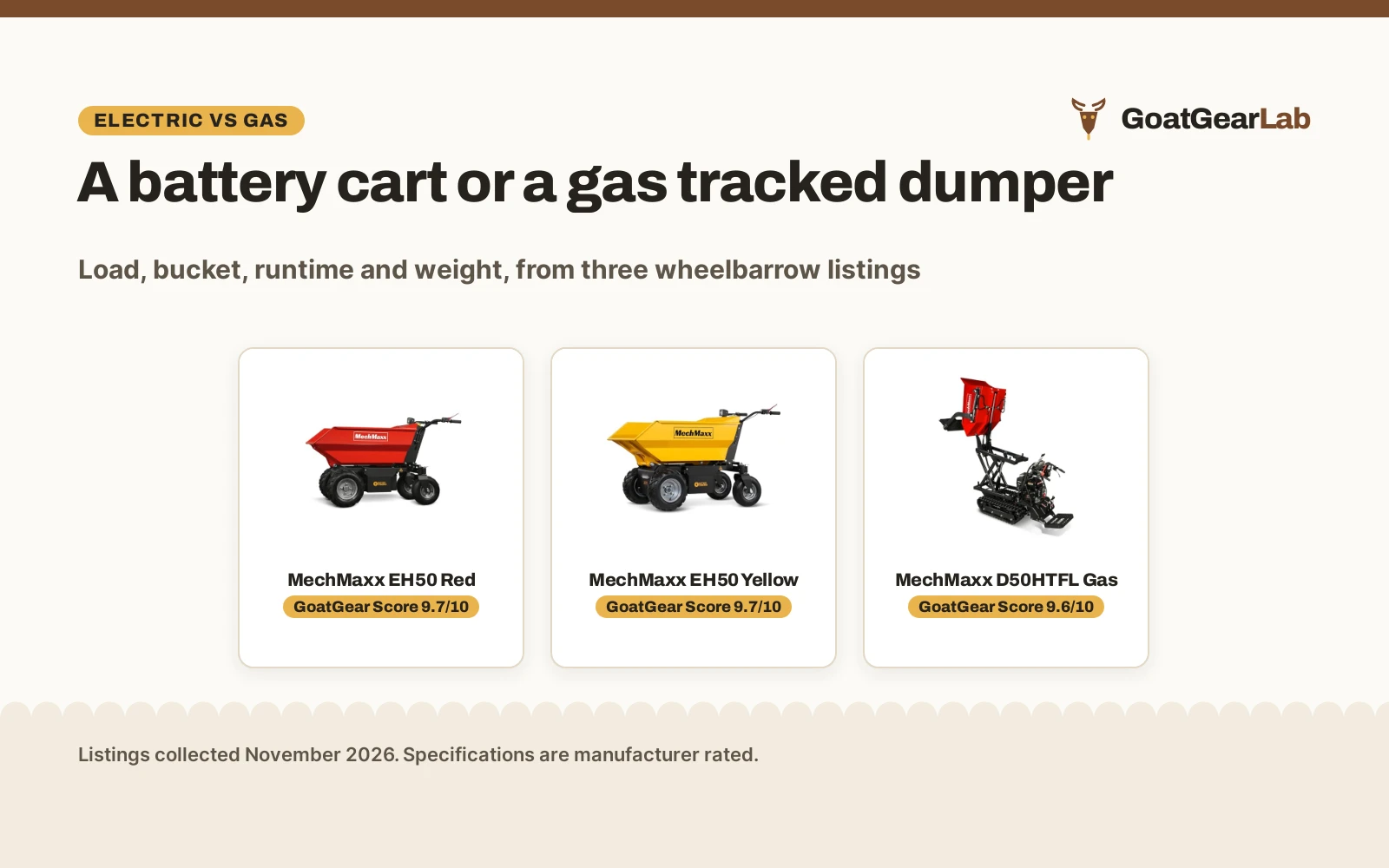
Hauling a barrow of soiled bedding to the muck heap is the chore that shows whether a wheelbarrow helps or fights back, and electric vs gas wheelbarrow is the choice that sets how the work feels. This comparison puts two battery-powered dumper carts, one red and one yellow, against a gas-powered tracked dumper, using only what each listing publishes. The pages cover load, bucket, runtime, weight and the gaps each one leaves, so the choice comes down to the ground and the job, not the badge.
GoatGearLab earns a commission when you buy through links on this page, at no extra cost to you. As an Amazon Associate I earn from qualifying purchases. Affiliate disclosure.
Quick verdict: choose the electric side if the work stays near the barn, on firm ground and through standard doorways, as the EH50 examples show with quiet running, zero emissions and a 29-inch width. Choose the gas side if the ground turns muddy or rough and the load needs tracks and a front shovel, as the D50HTFL example shows. The two electric examples are the same machine in different colors, so the real choice is between one electric cart and one gas cart.
Three examples
| # | Product | GoatGear Score | Buy |
|---|---|---|---|
| 1 | MechMaxx EH50 Red | 9.7/10 | Buy on Amazon |
| 2 | MechMaxx EH50 Yellow | 9.7/10 | Buy on Amazon |
| 3 | MechMaxx D50HTFL Gas | 9.6/10 | Buy on Amazon |

MechMaxx EH50 Red
A battery-powered dumper cart with a 1000W brushless motor, a 48V32Ah battery, hydraulic tipping and an 1100-pound safe load.
Pros
- 1000W brushless DC motor with a 48V32Ah lead-acid battery
- 1100-pound safe load, with a 1500-pound maximum load stated
- Hydraulic tipping with one-key lifting and lowering of the bucket
- LED display shows voltage and battery level; two 30W lights for dark work
Cons
- Lead-acid battery, with a 5-hour full charge stated
- Runtime drops to 6 hours when fully loaded, from 12-15 hours under normal circumstances
- The listing gives no slope or grade figure
- The other EH50 listing states the same figures, so color is the only difference

MechMaxx EH50 Yellow
A battery-powered dumper cart in yellow, with a 1000W brushless motor, a 48V32Ah battery, hydraulic tipping and an 1100-pound safe load.
Pros
- 1000W brushless DC motor with a 48V32Ah lead-acid battery
- 1100-pound safe load, with a 1500-pound maximum load stated
- Hydraulic tipping with one-key lifting and lowering of the bucket
- Two 30W lights and an LED display showing voltage and battery level
Cons
- Lead-acid battery, with a 5-hour full charge stated
- Runtime drops to 6 hours when fully loaded, from 12-15 hours under normal circumstances
- The listing gives no slope or grade figure
- The other EH50 listing states the same figures, so color is the only difference

MechMaxx D50HTFL Gas
A gas-powered tracked dumper with a 302cc engine, hydraulic tipping, a front shovel and an 1100-pound capacity.
Pros
- 302cc single-cylinder, 4-stroke, air-cooled, OHV gas engine
- 10 cu.ft hopper, the largest bucket volume here
- Tracked walking for smooth, slippery or muddy terrain
- Front shovel and platform, with 6 forward and 2 reverse gears
Cons
- The title says 10HP and the bullets say 9HP, so the listing leaves horsepower unclear
- 930.0 pounds, more than the 450.0-pound electric examples
- No runtime or fuel capacity is stated
- Gasoline, 10W-30 engine oil and AW 46 hydraulic oil are all needed
As an Amazon Associate I earn from qualifying purchases.
Also worth comparing
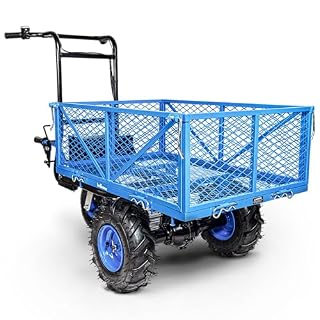 Landworks Electric Utility CartCheck price on Amazon
 SuperHandy Utility Service Cart Power Wagon WheelbarrowCheck price on Amazon
 60V 1500W Electric WheelbarrowCheck price on Amazon
Electric vs gas wheelbarrow: side by side
| Wheelbarrow | GoatGear Score | Power | Load | Bucket | Weight | Warranty | Amazon |
|---|---|---|---|---|---|---|---|
| MechMaxx EH50 Red | 9.7/10 | 1000W brushless motor, 48V32Ah battery | 1100 lb safe, 1500 lb max | 8.2 cu.ft | 450.0 pounds | 1-year warranty | View on Amazon |
| MechMaxx EH50 Yellow | 9.7/10 | 1000W brushless motor, 48V32Ah battery | 1100 lb safe, 1500 lb max | 8.2 cu.ft | 450.0 pounds | 1-year warranty | View on Amazon |
| MechMaxx D50HTFL Gas | 9.6/10 | 302cc gas engine | 1100 lb | 10 cu.ft | 930.0 pounds | 1-year machine, 1-year engine | View on Amazon |
Figures come from the product pages and reflect what the maker rates, current as of 13 November 2026.
How each one moves a load
The electric examples run on a 1000W brushless DC motor fed by a 48V32Ah lead-acid battery, with a thumb throttle for walking speed and three forward speeds and one reverse speed. The listing states no noise and zero emissions, and the battery charges in 5 hours, then runs 12-15 hours under normal circumstances or 6 hours when fully loaded. An LED display shows voltage and battery level, and two 30W lights suit dark work.
The gas example runs on a 302cc single-cylinder, 4-stroke, air-cooled, OHV gas engine, driving tracks instead of wheels. 6 forward and 2 reverse gears cover the speeds, and the hydraulically controlled hopper raises and lowers to save manpower. A front shovel and platform come with the machine, and the listing names clean, fresh, unleaded gasoline, 10W-30 engine oil and AW 46 hydraulic oil.
Load and bucket size
Load is where the two sides meet. Both electric examples state a safe load of 1100 pounds and a maximum load of 1500 pounds, while the gas example states an 1100-pound capacity with no higher figure. The safe loads match, so the electric maximum is the only load figure that separates them.
Bucket volume separates them the other way. The gas example states a 10 cu.ft hopper, against 8.2 cu.ft for the tipping bucket on the electric examples. Both sides state the volume, so the gas hopper holds more by the listings. The electric bucket still carries solid and semi fluid cargo, and the gas skip carries a wide variety of materials.
Runtime, charging and fuel
Runtime is stated on the electric side only. The electric examples charge in 5 hours and run 12-15 hours under normal circumstances, dropping to 6 hours when fully loaded. The gas example states no runtime and no fuel capacity, so the two sides cannot be compared on hours of work from the listings alone.
Charging and fueling shape the daily routine. The electric cart plugs in for 5 hours and then works without fuel, oil or exhaust, while the gas cart needs gasoline and two oils kept on hand. Neither listing states how far the cart travels on a charge or a tank.
Size, weight and getting through the gate
The electric examples measure 65.0 inches by 30.0 inches by 42.0 inches and weigh 450.0 pounds, and the listing states the 29-inch width passes through standard doorways and narrow aisles. The gas example measures 97.0 inches by 33.0 inches by 49.0 inches and weighs 930.0 pounds, with a bucket width of about 30 inches for restricted passages. The gas cart is longer, wider and heavier by the listings.
Wheels and tracks decide the ground. The electric examples run on tubeless tires, two 16 by 6.5-8 and two 13 by 5.00-6, with hubs integrally molded so the tires do not flatten under load, and locking pins hold the rear wheels straight on uneven roads. The gas example runs on tracks, which the listing states can navigate smooth, slippery or muddy terrain.
Warranty and listing gaps to check
All three listings state a warranty. Both electric examples state a 1-year warranty, and the gas example states a 1-year warranty for the machine and a 1-year warranty for the engine. Every product in this comparison earns warranty points.
The gaps are what to check before ordering. The gas listing disagrees with itself on horsepower, title 10HP against bullets 9HP, so horsepower stays unclear. The two electric listings are the same machine in red and yellow, with every figure identical, so color is the only choice between them. Neither side states a slope or grade figure, and the gas listing states no runtime or fuel capacity.
Which should you choose?
Choose the electric side if the work stays near the barn on firm ground, the cart must pass through standard doorways, and quiet running with zero emissions matters, as the EH50 examples show with a 29-inch width, no noise and a 12-15 hour runtime under normal circumstances.
Choose the gas side if the ground turns muddy or rough, the load needs a front shovel and a larger hopper, and a tracked cart that weighs 930.0 pounds is acceptable, as the D50HTFL example shows with tracks, a front shovel and a 10 cu.ft hopper. For hand carts without a motor, see the best wheelbarrow picks.
Whichever side wins, match the cart to the ground before the load. Check the width of the gate and the state of the ground before ordering.
Around the Barn
- Charge the electric cart for 5 hours before a long day, and check the LED display for voltage and battery level before setting out.
- Lock the rear wheels with the pins on uneven roads, and release the red safety handle to stop the electric cart.
- Keep clean, fresh, unleaded gasoline, 10W-30 engine oil and AW 46 hydraulic oil on hand for the gas cart.
- Use the hydraulic tipping to empty the bucket before parking the cart.
- Measure the gate: the electric cart is 29 inches wide, and the gas bucket is about 30 inches wide.
FAQs from goat keepers
Is an electric or gas wheelbarrow better for a small farm?
It depends on the ground and the gate. The electric EH50 examples run quiet with zero emissions, charge in 5 hours and fit through standard doorways at 29 inches wide. The gas D50HTFL example runs on tracks for muddy ground and carries a 10 cu.ft hopper.
How long does the electric wheelbarrow run on a charge?
The EH50 listings state 12-15 hours under normal circumstances and 6 hours when fully loaded, after a 5-hour full charge. The gas listing states no runtime, so the two sides cannot be compared on hours.
How much can these wheelbarrows carry?
Both electric examples state a safe load of 1100 pounds and a maximum load of 1500 pounds, with an 8.2 cu.ft bucket. The gas example states an 1100-pound capacity with a 10 cu.ft hopper.
What is the difference between the red and yellow electric wheelbarrows?
Color only. Both EH50 listings state the same motor, battery, load, bucket, runtime and weight, so the two are the same machine in red and yellow.
Does the gas wheelbarrow need oil as well as gasoline?
Yes. The D50HTFL listing names clean, fresh, unleaded gasoline, 10W-30 engine oil and AW 46 hydraulic oil. The electric examples need no gasoline or engine oil.
Behind the Farm Score
| Product | GoatGear Score | Perf. /35 | Build /25 | Value /25 | Safety /10 | Warranty /5 |
|---|---|---|---|---|---|---|
| MechMaxx EH50 Red | 9.7 | 30 | 21 | 21 | 7 | 2 |
| MechMaxx EH50 Yellow | 9.7 | 30 | 21 | 21 | 7 | 2 |
| MechMaxx D50HTFL Gas | 9.6 | 29 | 21 | 20 | 4 | 3 |
Points become a score between 9.2 and 9.8 by simple proportion, which means a higher point count always reads higher.
The GoatGear Score weighs performance, build, value, safety and warranty. For wheelbarrows, safety points need stated features such as a handle that stops the machine or pins that lock the wheels, and the electric examples earn them with a red safety handle that releases to stop and rear-wheel locking pins, while the gas example earns fewer with tracked travel for slippery or muddy terrain. All three listings state a warranty term, so all three earn warranty points. The electric examples lead on stated runtime, lights and display, and lose points for the lead-acid battery and the 5-hour charge. The gas example scores on bucket volume, tracks and the front shovel, and loses points for the horsepower contradiction. How we pick explains the weights.
More from the barn
See every farm carts and wheelbarrows guide and all barn and farm tools guides. Also see our steel vs poly wheelbarrow. Also see our hay fork vs bale spear. Also see our leather vs synthetic work gloves. Also see our muck boots vs rubber boots. Also see our best small garden wheelbarrow.
More related guides (108)
- best fly traps for inside the house
- best garden cart with seat
- single track vs double track barn door hardware
- dump cart vs wheelbarrow
- wheelbarrow vs garden cart
- best home fly trap
- led vs solar barn light
- barn fan vs ceiling fan
- frost free vs heated water hose
- best wheelbarrow for home use
- heat lamp vs barn heater
- barn boots vs muck boots
- best wheelbarrow for concrete
- best two wheel wheelbarrow
- insulated coveralls vs bib overalls
- muck bucket vs muck cart
- manure fork vs shovel
- quick hitch vs pin hitch
- drop spindle vs spinning wheel
- best heavy duty wheelbarrow
- best dump cart for lawn tractor
- pneumatic vs solid tire wheelbarrow
- best garden dump cart
- rubber boots vs leather work boots
- best hay bags for horses
- led barn light vs heat lamp
- heat mat vs heat lamp
- best pallet forks for compact tractor
- yarn swift vs ball winder
- garden cart vs utility wagon
- best folding utility wagon
- dump cart vs garden cart
- quick hitch vs 3 point hitch
- brass vs plastic hose fittings
- best dump cart for atv
- barn fan vs exhaust fan
- best steel garden cart
- garden cart folding best
- insulated vs heated dog house
- wheelbarrow vs utility wagon
- best yard dump cart
- best poly dump cart
- best utility cart with wheels
- garden cart on wheels heavy duty
- wheelbarrow lightweight
- wheelbarrow one front wheel
- pick mattock vs cutter mattock
- pasture seeder vs broadcast spreader
- stall mats vs trailer mats
- drag harrow vs chain harrow
- led vs fluorescent barn light
- barn fan vs box fan
- heat lamp vs infrared heat lamp
- pallet forks vs clamp on forks
- best electric barn heater under 150
- single wheel vs two wheel wheelbarrow
- best pallet forks for compact tractor under 300
- best folding utility wagon under 60
- best boot care kit under 25
- best steel garden cart under 120
- best brush for deck stain
- best wheelbarrow for gardening
- best cold weather garden hose under 50
- best winter work gloves under 25
- best heated work gloves under 75
- best small garden wheelbarrow under 80
- sliding vs bi fold barn door hardware
- box blade vs drag harrow
- wool comb set
- pick mattock small
- pick mattock wood
- best work gloves for winter chores
- best farm cart for rough terrain
- wall mount vs floor barn fan
- best outdoor utility wagon under 100
- aluminum vs steel wheelbarrow
- aluminum vs steel garden cart
- heated water hose vs regular garden hose
- best wheelbarrow for small farms
- hand truck with platform
- 5/8 vs 3/4 inch garden hose
- leather vs cotton work gloves
- pitchfork with metal tines
- frost free vs standard hydrant
- led vs halogen barn light
- best wheelbarrow for mulch
- best wheelbarrow for cement
- best wheelbarrow for hauling wood
- insulated vs waterproof barn coat
- best rubber work boots for summer
- frost free hose vs garden hose
- pneumatic vs solid tire garden cart
- electric barn heater vs heat lamp
- wheel chock cart
- leather vs rubber work gloves
- best metal grain shovel
- best grain scoop shovel
- best aluminum grain shovel
- best plastic grain shovel
- work gloves with built in lights
- best farm cart for small farms
- grain shovel with long handle
- best grain shovel for snow
- wheelbarrow cleaning brush
- garden cart sides
- remote control wagon cart
- garden dump cart 7 cu ft
- heavy duty wheelbarrow 6 cu ft
More picks: wheelbarrows, barn equipment, hay handling and farm workwear.